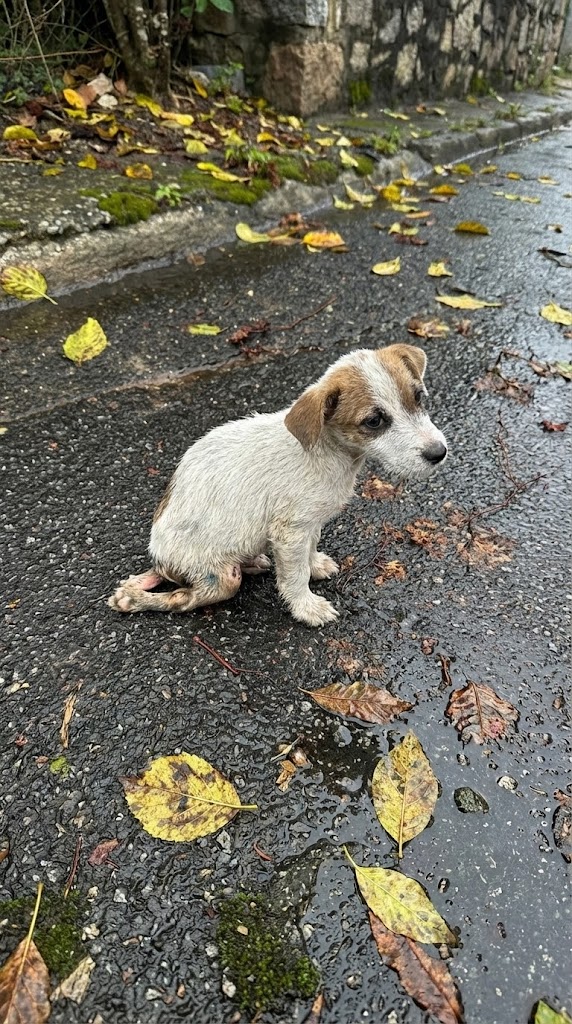
The rain didn’t let up.
Traffic moved through it without slowing. People passed with their heads down, collars turned up, eyes on wherever they were going.
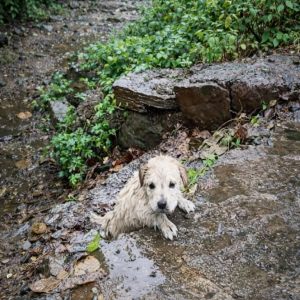
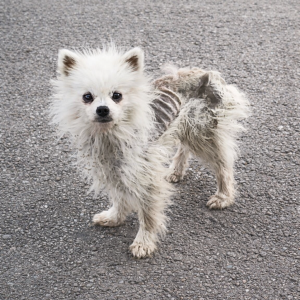
On the cold, wet pavement — invisible to nearly everyone — two tiny bodies pressed against each other.
One black. One white.
Barely two months old.
Sharing the last warmth they had.
What Had Been Done to Them
They hadn’t simply wandered there.
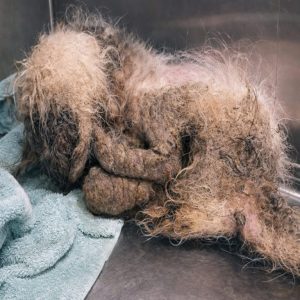
The black puppy’s body carried the evidence of something deliberate and cruel — open wounds, burns, marks that told a story no innocent creature should ever have had written onto them.
Beside her, the white puppy lay unnaturally still.
His legs weren’t responding. His eyes held the particular dimness that comes not from sleep but from a body running down — from hunger and cold and the accumulated weight of too many hours without anyone coming.
They pressed together because there was nothing else.
No shelter. No mother. No warmth that hadn’t come from each other.
Just the rain, and the pavement, and the unbroken sound of a world moving past without noticing.
The Man Who Knelt Down
He almost didn’t stop.
That’s the honest truth of these moments — that the gap between stopping and not stopping is often smaller than we think, and entirely dependent on something we can’t quite name or predict.
He stopped.
He knelt down beside them, expecting what you might expect from two frightened, injured puppies — flinching, pulling away, the fear response of animals that have learned humans mean harm.
Instead, their tails moved.
Two tiny, rain-soaked tails, twitching toward him.
As if they had been waiting not to be rescued by anyone in particular — just by someone. Anyone willing to stop and see them.
He lifted them from the wet concrete and ran.
VIDEO: Watch the Moment These Two Tiny Lives Were Rescued From the Rain
What the Clinic Found
At the veterinary clinic, the siblings were separated so the medical team could assess each of them properly.
The black puppy’s wounds demanded immediate attention — blood loss and infection that required urgent, careful work.
But it was the white puppy — the one they named Clark — who became the center of the room’s concern.
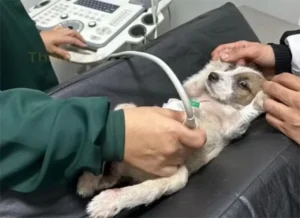
He couldn’t urinate on his own. His abdomen had swollen painfully from the pressure accumulating inside him. A catheter was inserted immediately, draining what had been building and buying his body a little more time.
Then came the ultrasound.
And the news nobody wanted to deliver.
Possible spinal damage.
The small twitches in Clark’s paws that had offered a flicker of hope — the veterinarians explained them gently but clearly. Those were reflexes. Not recovery. His nervous system was responding to stimulation the way a damaged system does, not the way a healing one does.
If Clark was ever going to have the chance to walk, he would need surgery.
Risky surgery, on a body that was already compromised and small.
With no guarantees attached.
When Strangers Became Part of the Story
Something happened when Clark’s situation became known.
People who had never met him — who lived in different cities, different countries, different circumstances entirely — found themselves caring about whether a small white puppy in a veterinary clinic would make it.
Donations arrived. Messages of support arrived. The collective weight of strangers choosing to invest in an outcome they couldn’t control but refused to be indifferent to arrived.
Because of them, the surgery happened.
The Long Silence of the Operating Room
The surgery was not quick.
The team worked with the focused stillness of people who understand that the margin between enough and not enough is sometimes very thin, and that everything they do exists inside that margin.
Clark survived.
When he opened his eyes in the hours that followed, they were still bright. Still present. Still carrying the particular quality that had been visible from the very first moment he twitched his tail in the rain toward a stranger.
Still fighting.
The Slow, Beautiful Work of Recovery
Rehabilitation for Clark was measured in the smallest increments.
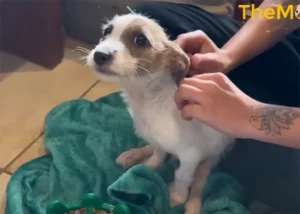
Acupuncture sessions, designed to reach damaged nerves and encourage pathways that had been disrupted. Hydrotherapy, where the support of water allowed his body to practice movement that the ground couldn’t yet hold him through. And alongside all of it — the kind of consistent, patient, daily presence that no clinical protocol can replace.
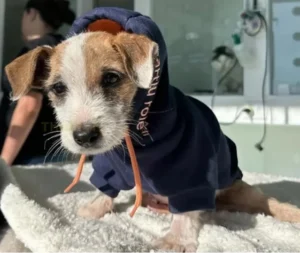
He and his sister wore soft little outfits to protect their healing skin.
For the first time, they were warm.
Not just in their bodies.
In the way that warmth means something beyond temperature — the warmth of being surrounded by people who had chosen to be there, who came back each day, who spoke to them as if their understanding mattered.
The Moment That Stopped the Room
It happened during a water therapy session.
Clark’s right leg moved.
Not a reflex. Not an involuntary twitch that the medical team had learned to interpret carefully and honestly.
A deliberate movement. A kick. His leg responding to his intention.
His rescuer, watching from the edge of the pool, collapsed into tears.
Not the tears of the hard weeks before — the ones that come from fear and uncertainty and the weight of not knowing.
Different tears entirely.
The ones that come when something you stopped allowing yourself to hope for quietly becomes real.
Who Clark and His Sister Are Now
They sleep on soft blankets.
That is where their story lives now — in the ordinary, profound miracle of two puppies who pressed together on cold, wet pavement and survived to sleep somewhere warm.
Clark may always move a little differently than other dogs.
His body carries what happened to it, the way bodies do, in ways that don’t entirely disappear. But what he has become — what both of them have become — is something the rain-soaked pavement could never have predicted.
Proof.
That resilience exists in bodies that have been broken. That two months old is not too young to survive the unsurvivable. That a small tail twitching toward a stranger in the rain can be the beginning of an entirely different life.
What Their Story Carries Forward
Somewhere right now, another Clark is waiting.
On another wet street. In another cold, unnoticed corner. Pressing against whatever warmth is available and hoping that the sound of footsteps approaching this time means something different from all the times before.
The distance between that animal and a completely different life is one person.
One moment of noticing. One decision not to keep walking. One choice — ordinary and irreversible — to stop.
That is all it took for Clark and his sister.
That is all it ever takes.
They had only each other when the rain was falling. They have so much more now.
Because one person stopped. And the whole world, for two small lives, changed direction.