Deep in a quiet corner of the woods, where the ground was covered in tangled roots and fallen leaves, animal control officers came across something that did not feel real at first.
Hidden low against the earth was a small dog, so thin and still that he almost blended into the forest floor. He was barely more than skin and bones. He made no sound. He did not try to run.
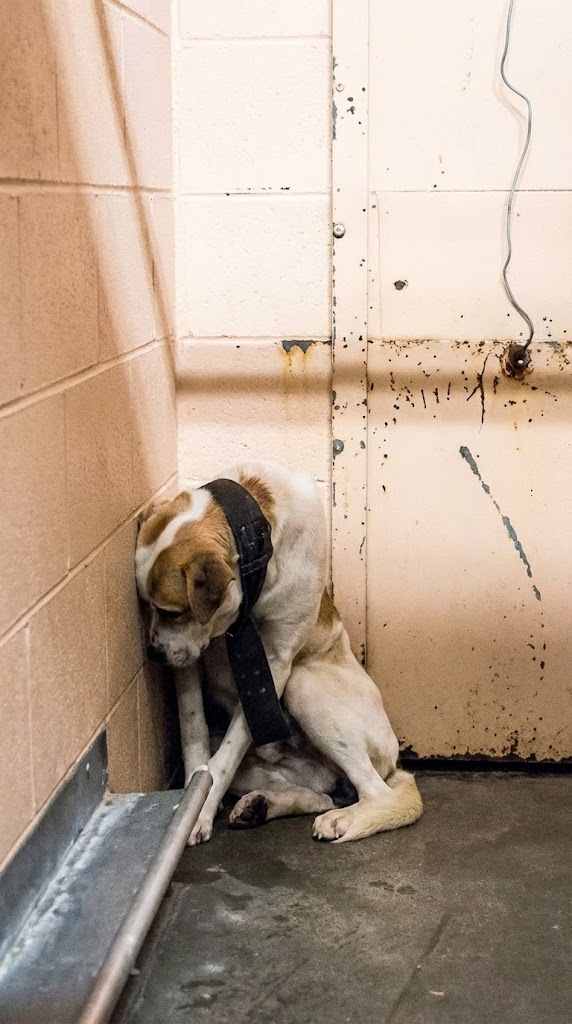
Around his neck was not a collar.
It was a thick leather belt.
Wrapped tightly enough to cut into his fragile body, it held him to the ground as though he were an object that had been left behind rather than a living creature capable of fear, pain, and memory. He lay there in silence, motionless, as if waiting had become the only thing left to do.
Later, he would be given the name Stephen.
A gentle name for a life that had known far too little gentleness.
By the Time He Was Found, Fear Had Become His Whole World
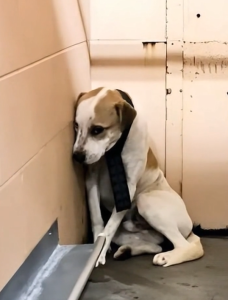
Stephen did not arrive at the shelter like a dog who believed rescue meant relief.
He did not wag his tail.
He did not rush toward food.
He did not lift hopeful eyes toward the people around him.
Instead, he folded himself into the farthest corner of his kennel and shook so hard that volunteers feared his small body might not hold up under the strain. His lips curled at times, but not from aggression. Not from defiance.
From terror.
To someone seeing him briefly, he might have appeared dangerous or difficult. But Stephen was not a dog trying to threaten anyone.
He was a dog who had been taught, over and over, that humans meant pain.
Restraint.
Control.
Abandonment.
Fear.
The belt around his neck had become more than a piece of leather. It had become part of the way he understood the world. Every sound startled him. Every movement near him felt uncertain. Every reaching hand seemed like something to survive rather than trust.
Fear was no longer a moment in Stephen’s life.
It was the shape of his life.
The Day the Weight Around His Neck Finally Came Off
Because the belt had likely been on him for so long—and because his panic was so severe—the shelter team made a careful decision.
Stephen would be gently sedated before they removed it.
There are some moments in rescue that carry a kind of silence no one in the room forgets. This was one of them.
When the scissors finally cut through the thick leather, everything seemed to pause.
It was not only a belt being removed.
It was the visible ending of something cruel.
It was the release of pain he had carried for far too long.
It was the first moment in years that Stephen’s neck was no longer trapped.
For the first time in what may have felt like forever, he was free.
VIDEO: From the Woods to a New Life — Stephen’s Long Journey Back From Fear
What Changed First Was Very Small — But It Meant Everything
When Stephen woke up, nothing dramatic happened.
There was no instant transformation.
No sudden leap into trust.
No perfect moment that erased what he had been through.
But something was different.
He lifted his head.
He looked around.
Not with comfort yet, and certainly not with confidence.
But with curiosity.
It was a small shift, easy to miss if someone had been expecting something bigger. Yet in a dog like Stephen, curiosity itself was a sign that something inside him had loosened.
And then came one more tiny moment.
His tail moved.
Only once.
Only a small, uncertain wag.
But for the people who had been caring for him, it meant more than words could say.
It was not complete trust.
Not yet.
But it was the first quiet sign that Stephen might still be reachable.
That beneath all the fear, some part of him was still willing to feel something other than terror.
Real Healing Did Not Arrive Quickly
Stephen’s recovery was never going to be fast.
Dogs who have lived through prolonged fear rarely heal in a straight line, and Stephen was no exception. His progress came slowly—so slowly that some days it may have been visible only to the people who knew him best.
Some days, he stepped a little closer.
Other days, he pulled back again.
Sudden sounds still made him freeze. New faces still overwhelmed him. His body remained ready to protect itself, even when no harm was coming.
But the shelter staff offered him something powerful precisely because it was so simple.
Consistency.
They sat near him without forcing contact.
They spoke to him softly.
They showed up at the same times each day.
They let him learn their presence without demanding anything in return.
That kind of patience matters deeply.
For a dog whose life has taught him that control and pain come from people, trust cannot be pulled forward. It has to be built. Quietly. Repeatedly. Gently.
And that is exactly what they gave him.
The Things He Had Never Known Began to Make Sense
Little by little, Stephen started to understand something new.
Hands could bring food.
Voices could stay calm.
People could approach without causing pain.
Nothing bad happened every time someone came near.
These lessons may sound simple, but for Stephen they were life-changing.
A dog who has lived inside fear for too long does not only need shelter. He needs a new understanding of the world. He needs enough safety, repeated often enough, that his body can begin to believe what his mind cannot yet fully trust.
That process is never loud.
It happens in pauses.
In quieter breathing.
In a body that no longer flinches quite as fast.
In a glance that lingers a little longer before turning away.
Stephen’s healing lived inside those moments.
The Dog in Front of Them Slowly Became Someone New
Watching Stephen change was not like witnessing a sudden miracle.
It was more like watching winter slowly loosen its hold.
His coat began to improve.
His body started to fill out.
His posture softened.
But the deepest change was in his eyes.
Where there had once been emptiness, there was now awareness.
Where there had once been only fear, there was now curiosity.
Where there had once been resignation, there was now the beginning of life returning.
He was no longer only the dog found tied in the woods.
He was becoming Stephen.
A dog with preferences.
A dog with feelings beyond fear.
A dog with the possibility of joy, however quietly it arrived.
There is something profoundly moving about that kind of transformation—not because it is dramatic, but because it is real.
Why Stephen’s Story Matters
Stephen’s story reminds us that not all suffering looks the same.
Not all trauma is loud.
Not all healing is visible at first glance.
Not all courage looks like strength in the way people usually imagine it.
Sometimes, courage looks like a frightened dog lifting his head.
Sometimes, it looks like staying present through another day.
Sometimes, it looks like a tail moving once after a lifetime of fear.
Stephen was once defined by a leather belt, by restraint, and by the kind of suffering that teaches a soul to disappear.
Now, he is defined by something very different.
Resilience.
Gentleness rediscovered.
The quiet bravery it takes to trust again.
His story is proof that even deeply wounded animals can learn that the world may still hold kindness—if someone is patient enough to keep showing them.
And for Stephen, that patience changed everything.