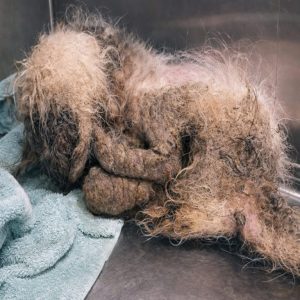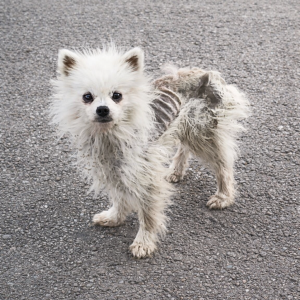
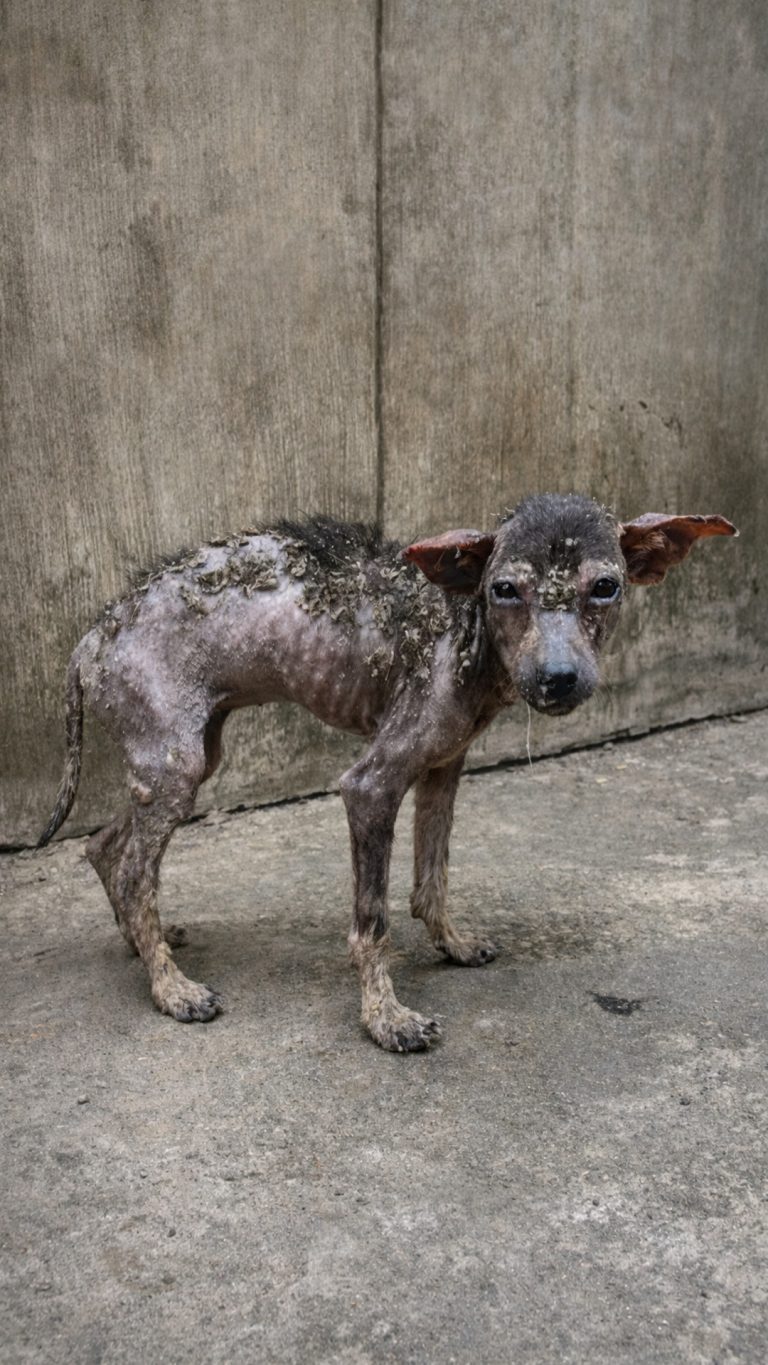
Bali moves fast.
Motorbikes weave through narrow streets without slowing. Tourists rush from one beautiful place to the next. Life on the island pulses with color and noise and constant motion.
Nobody stops for long.
And so nobody noticed Mochi.
He was standing at the edge of the road — six weeks old, barely larger than a human hand — trembling in the shadow of everything moving past him. His small body had already learned a lesson that no puppy should ever have to learn.
Stay still. Stay quiet. Take up as little space as possible.
Maybe then, the world would leave him alone.
Eyes That Were Already Too Old
He should have been tumbling over his own paws.
He should have been discovering smells and chasing things and falling asleep in the middle of meals the way puppies do when the world is safe and full of warmth.
Instead, Mochi moved through each hour with a careful, calculated economy — every step deliberate, every sound sending a ripple of alert through his tiny frame.
His fur was thin and grey with street dust. His belly was hollow. His movements had none of the clumsy joy that belongs to puppies his age.
But what stopped people who finally did look at him — really look — wasn’t his body.
It was his eyes.
They were tired in a way that young eyes shouldn’t be. Careful. Watchful. Carrying the particular weight of a creature that has already learned that curiosity leads to pain and that the safest thing is to expect nothing good.
He was six weeks old.
And he had already stopped hoping.
What He Had Already Learned About People
For Mochi, humans were not a source of comfort.
They were something to avoid — large, unpredictable presences that moved too quickly and too loudly and never seemed to slow down long enough to notice that he was there.
He had no memory of gentle hands. No experience of a voice that spoke softly and meant safety. No reference point for kindness at all.
He simply survived.
Each day exactly like the one before — finding enough food to continue, staying small enough to be overlooked, moving through a world that had never once acknowledged him.
Until the day it did.

The People Who Decided to Stop
A small group of people noticed him beside the road.
Not because he made himself known — he never did. But because something made them slow down, look more carefully, feel that quiet discomfort that appears when a living creature is struggling just out of the frame of what everyone else has chosen to see.
They could have kept moving.
It would have been easy. There was somewhere to be, things to do, the ordinary momentum of a day pulling them forward.
They stopped anyway.
They approached him slowly — speaking softly, moving carefully, giving him every opportunity to understand that this was different from everything that had come before.
Mochi watched them come.
He didn’t run.
Something in him — some small, stubborn flicker of a thing — held still and waited to see what came next.
VIDEO: From Streets to Safety — Mochi’s Journey Toward Healing and Hope
The First Night of Safety
He didn’t understand it at first.
The warmth was unfamiliar. The quiet was disorienting. The food — a full bowl, just sitting there, not requiring him to search or compete or fight — didn’t quite make sense.
He ate quickly, as if it might disappear. He slept lightly, startling awake at small sounds. He stayed close to the edges of the room, where he could see everything and be seen by as little as possible.
Old habits don’t dissolve overnight.
His caregivers understood this. They didn’t rush him. They didn’t fill the space with too much noise or too much movement or too many demands.
They simply stayed close.
Consistent. Patient. Present.
And slowly — so slowly that it was hard to notice happening — Mochi began to adjust.
The Quiet Markers of Healing
There was the morning he didn’t flinch when a hand reached toward him.
There was the afternoon he stayed in the center of the room instead of pressing himself against the wall.
There was the day a toy was placed in front of him and he didn’t know what to do with it — sniffing it carefully, pawing it once, then looking up as if checking whether this was allowed.
It was allowed.
And when he realized that — when some part of him integrated the information that play was safe, that joy was permitted, that the world inside this space operated by entirely different rules than the world outside — something visibly relaxed in him.
His tail, which had been permanently tucked, began to move.
Tentatively at first. Then more freely. Then with the kind of wholehearted enthusiasm that belongs exclusively to puppies who have discovered that happiness is real.

Finding the Dog He Was Always Meant to Be
The weeks that followed were a kind of unfolding.
Each day revealed a little more of who Mochi actually was beneath the fear and the hunger and the learned invisibility of his early weeks.
Curious. That was the first thing.
He wanted to investigate everything — every smell, every texture, every new object placed in his environment. The caution was still there, but underneath it, a genuine, bright inquisitiveness was emerging.
Playful. That came next.
He discovered that he had opinions about toys. That some textures delighted him and some didn’t. That he could initiate play, not just respond to it.
Affectionate. That came last, and most beautifully.
The puppy who had never known a gentle touch began to seek them out. To approach hands rather than avoid them. To settle into laps with a deep, trusting sigh that said everything words couldn’t.
He had found himself.
It had just taken someone finding him first.
Who Mochi Is Today
You would not recognize him from that roadside shadow.
He is healthy — coat soft and clean, body filled out with proper nourishment, eyes carrying a brightness that has nothing to do with vigilance and everything to do with genuine happiness.
He moves through his days with confidence now. Curiosity leads where fear used to.
He plays without reservation. He accepts love without hesitation. He sleeps deeply, fully, in the uncomplicated way of a creature that no longer needs to keep one ear open through the night.
The streets of Bali are part of his story.
But they are not who he is.
What Mochi Reminds Us
Kindness doesn’t need to be grand to be transformative.
It doesn’t need a dramatic gesture or a large organization or a complicated plan.
Sometimes it is just a few people on a busy street who feel that quiet pull of concern and choose — in the small, ordinary, irreversible way — to act on it.
Mochi was invisible until he wasn’t.
And from that single moment of being seen, an entire life changed direction.
He stood trembling at the edge of the road and waited for a world that had never noticed him.
And then, one quiet afternoon in Bali — it did.
Mochi is no longer invisible. He is no longer afraid. He is loved. And he always deserved to be.