Some stories are difficult to watch — not because they involve cruelty in any deliberate sense, but because they confront viewers with their own discomfort at witnessing serious suffering.
Alma’s story is one of those.
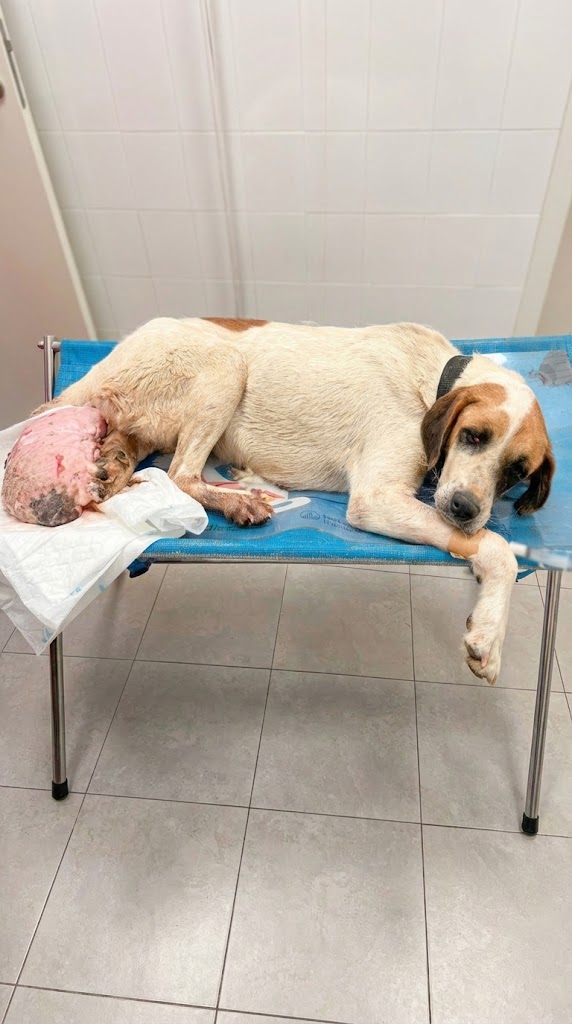
She was found crawling across open land, moving forward inch by inch, carrying a physical burden that no living creature should have to manage. A large tumor extended from her leg — large enough, and visually striking enough, that many people who encountered footage of her instinctively looked away.
When that footage first circulated online, the reaction wasn’t uniformly compassionate. A number of viewers found what they were seeing too unsettling to engage with. Some simply couldn’t bring themselves to watch.
What many of them missed, in turning away, was what existed underneath the visible suffering — a patient, gentle temperament that had apparently been waiting, for months, for someone willing to look closely enough to see it.
The Added Cruelty of Being Overlooked
The location of Alma’s tumor made her situation especially difficult. With every attempt to move, she had no choice but to place weight directly on it. Each step sent pain through her entire body.
Over time, her strength diminished to the point where walking became impossible, and she resorted to dragging herself across the ground instead.
By the time rescuers located her, she was exhausted in every sense — physically depleted and emotionally worn down by an extended period of being overlooked. The mass itself was exposed and raw, a visible record of how long her condition had gone unaddressed.
It’s an understandable human response to feel uncomfortable confronting suffering this visible and severe.
But looking away is an option Alma herself never had access to.
VIDEO: She Was Found Dragging Herself Across a Field — Watch Alma’s Rescue and the Decision Her Team Refused to Rush
Choosing the More Difficult Path
Of the many people who encountered Alma’s story online, only a relatively small number chose to stay engaged and actively support her.
The medical situation ahead of her is genuinely complicated. One available option would be amputation — a quicker, more straightforward path forward in some respects. Her rescue team has chosen not to take that route without first exploring alternatives.
They are currently waiting on CT scans and detailed imaging before finalizing any treatment decision. Their stated goal extends beyond simply saving her life — they are working to determine whether her leg, and her mobility, can be preserved as well.
One of her rescuers put it directly: when they say they’re going to try, they mean it fully.
They are working through every reasonable option before settling on a final course of treatment.
More Than a Medical Case
Alma’s situation isn’t only about the medicine involved, significant as that is.
It’s also about whether she is seen as a full, deserving life rather than something to look past because her condition is hard to view.
She doesn’t deserve to be ignored simply because her suffering is visually difficult. She has already endured an extended period of neglect and physical pain. What she needs now isn’t avoidance from the people who encounter her story.
It’s sustained attention and care.
She is safe for the time being. For what may be the first time in a long while, someone is actively choosing to stay with her — not despite her visible condition, but because her life is considered worth the effort regardless of how it looks.
Her rescue team has been clear in asking that people not turn away this time, and that anyone following her story stay engaged through whatever comes next.
What Alma’s Story Asks
Alma’s situation, still unresolved as treatment decisions continue, illustrates something worth sitting with.
Compassion often has to begin at exactly the point where discomfort starts — not after it has passed.
Strength can exist in an animal even while their body is visibly struggling.
And every life carries dignity worth protecting, particularly when that life is at its most vulnerable and least able to advocate for itself.
Alma is no longer alone in an open field, dragging herself forward with no one responding.
She is surrounded now by people actively working on her behalf, weighing careful medical decisions rather than rushing toward the easiest available option.
What happens next for her leg and her long-term mobility isn’t yet known. But for the first time in this story, she isn’t facing any of it without support.