Some stories don’t look like stories at first.
They look like garbage.
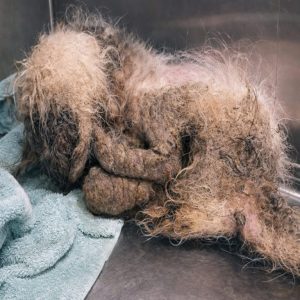
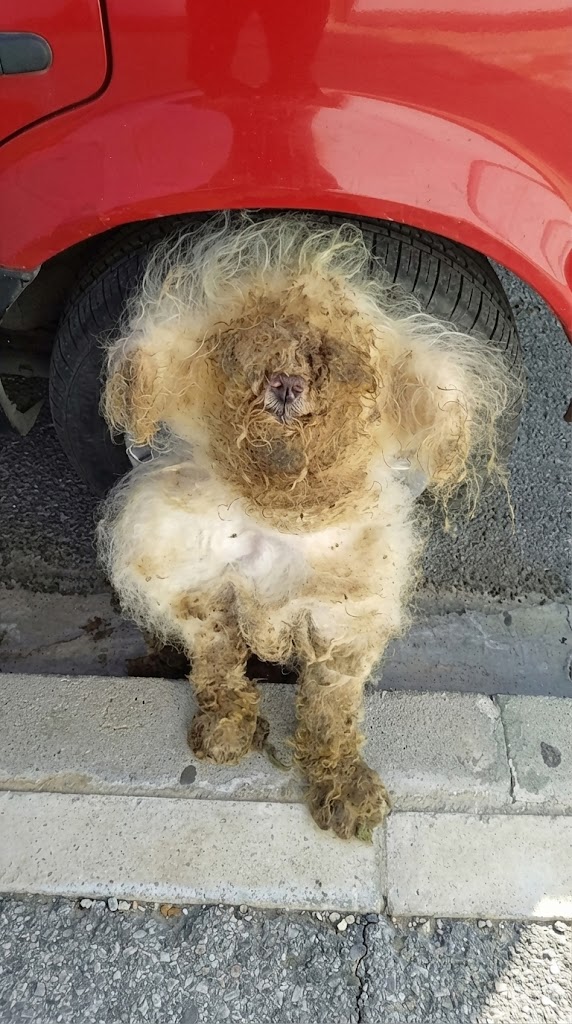
On a quiet sidewalk in Athens, Greece, something sat motionless near the curb — so misshapen, so thoroughly covered in filth, that most people who passed assumed it was simply abandoned debris. Mud, waste, and matted hair had fused together into a single mass with no recognizable shape.
Inside that mass, there was a living animal.
A photo of it began circulating on social media. A volunteer from a local stray rescue organization rushed to the location, expecting something difficult.
What they found went beyond that expectation.
It was a living creature buried beneath what rescuers later described as a kind of armor — compacted layers of fur, waste, and dirt so dense and fused together that no one could initially identify where the head ended and the rest of the body began.
Neighbors offered a quiet, devastating explanation.
The dog had belonged to an elderly woman who lived on that street. When she passed away, the people clearing out her apartment had carried him downstairs and left him on the sidewalk — treated, in that moment, like an unwanted piece of furniture rather than a living animal.
No one looked back.
Still Breathing, Beneath All of It
For nearly twenty hours after he was brought into care, the mass didn’t move. Didn’t whimper. Didn’t show any visible sign of life at all.
The smell was overpowering enough that other animals in the shelter avoided the area entirely. Volunteers could only remain in the room for short stretches at a time.
Then one rescuer carefully placed a hand near what they guessed might be the location of his mouth.
Something warm touched their skin.
A small, pink tongue.
He was alive.
And, somewhere beneath everything that had grown over him, still trying.
VIDEO: Everyone Thought He Was Trash — Watch the Five-Hour Process That Revealed Julian’s Face
A Face No One Had Seen in Years
It took a full team of professionals more than five hours to remove the layers that had built up over him.
Each careful cut revealed skin that hadn’t been exposed to light in a very long time.
Slowly, gradually, a face began to emerge.
A Poodle’s face.
Throughout the entire process, he didn’t resist. He didn’t cry out. He didn’t snap at the people working on him. He simply remained still — as though some part of him understood that an enormous weight was finally being lifted away.
They named him Julian.
Freedom, once it arrived, felt unfamiliar to his body.
Without the accumulated weight of the mats he had carried for so long, Julian struggled with ordinary walking. His body had adapted to compensate for a burden that was no longer there. He lifted his legs unusually high, as if still stepping over an obstacle that had defined his movement for years and had only just disappeared.
His past had shaped, quite literally, the way he moved through the world.
Not Perfect. Simply Free.
Julian is an older dog. He has cataracts. He has heart issues. His hearing isn’t what it once was.
And he is, in every way that matters, fully himself.
He sleeps wherever he decides he wants to. He looks for opportunities to sneak extra food. He gets grumpy sometimes. Occasionally, he snaps when he’s annoyed.
His rescuers are at peace with all of it.
They have been clear that their goal was never to turn him into a “miracle dog” or fit his story into something tidier than it actually is.
Their goal, as they describe it, is dignity — not perfection.
A Name. A Face. A Life.
Today, Julian’s fur has grown back — white, soft, and curling the way a Poodle’s coat naturally does.
No one looking at him now would mistake him for trash.
He has a name. A personality, fully intact and entirely his own. And a future that, however many years it includes, will be defined by being seen and cared for rather than overlooked.
What Julian’s Story Says
There is something in Julian’s rescue that extends beyond his individual circumstances.
Rescue, in cases like his, isn’t always about fixing something broken. Sometimes it is simply about recognizing that something living exists where most people assume there’s nothing at all.
Every animal, regardless of how unrecognizable circumstance has made them, deserves to be treated with dignity.
And the cruelest part of what happened to Julian wasn’t really the neglect itself, severe as it was.
It was being made invisible — sitting in plain view on a public sidewalk, and having that visibility mean nothing to the people who passed by.
Five hours of careful, patient work undid years of accumulated suffering.
Julian will not be invisible again.