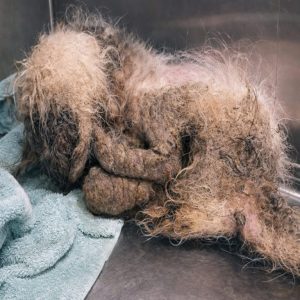
For a long time, Cala didn’t really live.
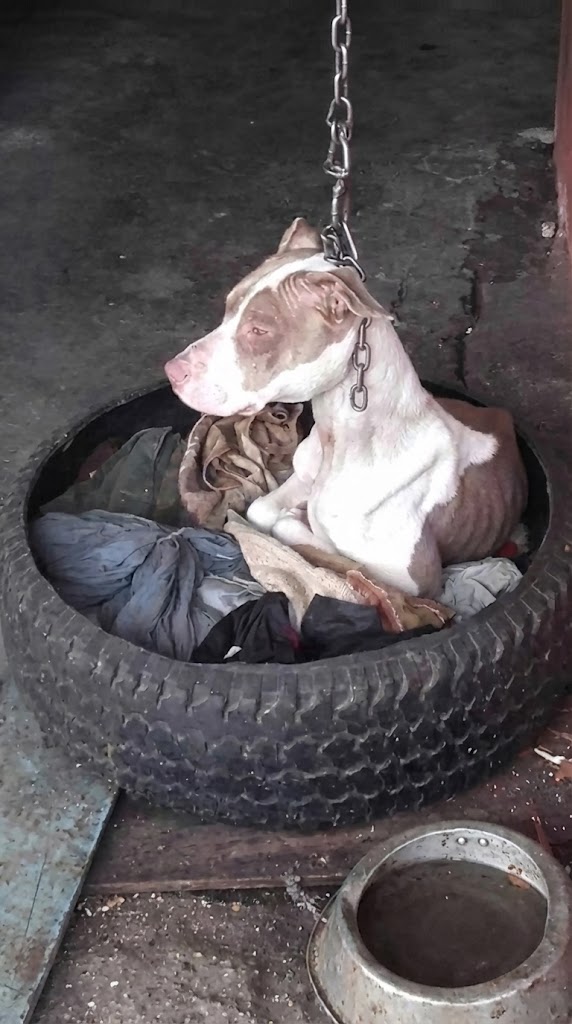
She existed — quietly, painfully, and largely unnoticed — in a forgotten corner of San Jose. She wasn’t treated as a companion. She was kept, the way an object is kept: present, but without consideration for what she might need beyond serving a function.
Her entire world was defined by the length of a short, heavy metal chain.
It was fastened tightly enough around her neck that even the most basic comfort — lowering her head to rest — was taken from her. When she tried to lie down on the torn rags beneath her, the chain wouldn’t allow it. Her head remained suspended by the weight of the metal, pulling at her neck continuously, day and night, with no relief.
A Life Without Dignity
To the person who kept her, Cala functioned as little more than a living alarm system.
Food arrived rarely. Actual care never arrived at all.
Her body deteriorated slowly. Her ribs became visible beneath her skin. Her breathing grew labored. Weakness settled over her the way a second chain might — less visible than the metal one, but just as confining.
Anyone passing by could see that she wasn’t simply hungry.
She was giving up.
Her eyes had stopped searching for kindness and had begun, instead, to wait for something else entirely — an ending, rather than a change.
Then someone looked more closely.
And chose not to keep walking.
Learning Trust Through Pain
When rescuers reached Cala, the full extent of what the chain had done became clear.
A deep, infected wound circled her neck — the physical record of years spent suspended by that metal. Treating it was not gentle, even with the most careful hands. Cleaning and disinfecting a wound that had been ignored for so long caused her real pain in the process of healing it.
She had also, in a sense, forgotten how to stand properly. Years of minimal movement had wasted away the muscle she would have needed for ordinary mobility. Even walking had to be relearned, step by step, with support.
She didn’t resist any of it. She didn’t cry out.
She simply endured.
VIDEO: Her Chain Was Too Short to Let Her Rest — Watch the Moment It Was Finally Cut
What Changed Slowly
Over time, something in Cala began to shift.
The dog who had flinched at every approach started, instead, to lean into contact. The same hands that had to clean and treat her painful wounds were now associated with something else too — warmth, food, soft and steady voices.
She stopped hiding.
She started actively seeking attention — turning toward people instead of away from them, in the unmistakable way of an animal that has decided, against considerable evidence to the contrary, that trust might be possible again.
When Everything Was Tested a Second Time
Just as Cala was beginning to settle into her new life, danger found her again.
Intruders broke into the sanctuary where she was staying and scattered poisoned food. Sixteen dogs lost their lives that night.
Cala ate the bait too.
She survived — but not without lasting consequences. The poison left her with neurological damage. Some movements became more difficult for her. Tremors appeared. Her balance, afterward, was no longer fully reliable.
Still, she lived.
The people who cared for her described it simply: she was too strong to be broken. After everything she had already endured — the hunger, the chain, the years of neglect — she did not let this final act of cruelty be the thing that ended her story.
The Life She Has Now
Today, Cala’s life bears almost no resemblance to where she started.
She lives somewhere now where hands reach for her to hold her, not to harm her. The frightened, defeated dog from the forgotten corner of San Jose isn’t who she is anymore.
In her place is something else: a playful, a little stubborn, somewhat spoiled dog who greets each day, by every account, like it’s a gift.
What Cala’s Story Says
Cala’s life makes a case for something simple, even if it took years of suffering to prove it.
That love can rebuild what cruelty worked hard to dismantle.
That an animal can be wounded as deeply as she was — physically, through years of neglect, and then again through poisoning — and still find its way back to trust.
That no creature is ever too broken to be worth the effort of trying.
She once carried her head in constant pain, suspended by a chain that gave her no rest.
Now she carries it with something closer to pride — not because the past didn’t happen, but because it no longer defines what’s possible for her now.
Sometimes the most significant battles are the quiet ones.
Cala’s was. And she won it.