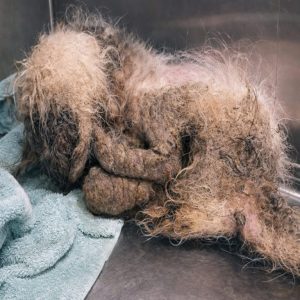
There is a stretch of road in Houston that locals have given a grim, unofficial name: the Corridor of Cruelty.
It is a place where abandoning an animal has become, in the words of those who live nearby, almost routine — where compassion is in short supply and animals are too often treated as something disposable, left behind without consideration of what happens next.
What happened to Jericho went further than that.
It wasn’t simple neglect. It was deliberate.
Hidden Beneath the Sofa
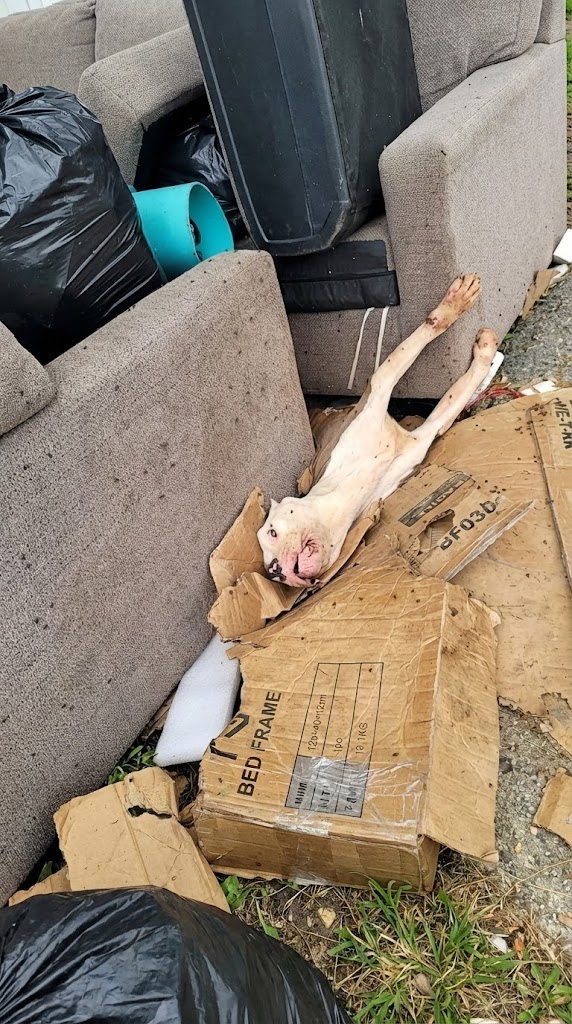
Jericho hadn’t just been abandoned somewhere visible.
He had been hidden beneath a large discarded sofa on the roadside — concealed in a way that suggested intention rather than carelessness. Only his head remained exposed, facing out toward the traffic that passed without knowing he was there.
The sofa functioned, in effect, as a trap. A barrier between him and any possibility of rescue, positioned in a way that seemed designed to ensure no one would notice him until it was too late.
A street feeder named Ja Nell Mitchell found him.
What she saw was devastating. Flies covering his body. The early presence of maggots. A frame so thin that every rib and bone was visible through his skin. His eyes had the emptied-out quality of an animal that had been failed by hunger, by fear, and by the absence of anyone coming for him, for long enough to lose the expectation that anyone would.
The Hour That Mattered Most
Freeing Jericho was not simple.
He was pinned beneath furniture heavy enough that any sudden or careless movement risked making his injuries worse. The rescue team worked for more than an hour, shifting the sofa gradually, inch by inch, trying to create space without causing him further harm.
He was trembling through all of it. Too weak to stand on his own. Flinching at each point of contact, as though uncertain whether kindness was something that still existed for him.
But underneath the fear, the team sensed something else — a quiet, persistent hope that someone had actually come. That this, finally, was not another disappointment.
VIDEO: He Was Hidden Beneath an Abandoned Sofa on the Roadside — Watch the Moment Jericho Was Finally Freed
What the Hospital Found
Jericho was taken immediately to an emergency veterinary hospital.
The initial concern was serious: he showed almost no sensation in his hind legs, raising the possibility of spinal damage that could have permanently affected his mobility.
The team prepared for difficult news.
It didn’t come the way they expected.
X-rays showed no visible fractures or spinal breaks. Internal scans — both cardiac and abdominal — revealed only minor concerns, nothing catastrophic. And on his very first night in care, with the support of a sling, Jericho managed a few unsteady steps.
The veterinary team was confident about one thing: Jericho had been suffering for a long time before he was found. Starvation had taken a serious toll on his body. But something in him had not given up — a persistence that showed itself clearly when he began eating on his own, an act that felt, in context, like a quiet declaration that he intended to keep going.
Four Days Later
The pace of Jericho’s stabilization surprised the people caring for him.
Just four days after his rescue, he was stable enough to leave the hospital and move into a foster home — a space defined by warmth, calm voices, and consistent care, in sharp contrast to everything that had defined his life up to that point.
The change in him since has been significant.
The dog who had been discarded like garbage beneath a roadside sofa is now described as joyful. Affectionate. Sweet in a way that seemed to emerge naturally once fear no longer occupied so much of his attention. He is gaining weight steadily. His strength continues to return. And, in what may be the most important shift of all, he is learning — gradually, through repetition and consistency — that not every human interaction leads to harm.
What Jericho Still Carries, and What He’s Leaving Behind
Jericho’s path forward still includes medical follow-up and continued recovery. The road is not finished.
But the place he came from — the corridor, the sofa, the hour spent trapped while rescuers worked to reach him — is now behind him in the way that matters most: it no longer defines his daily life.
In his foster home, he is safe. He is cared for. He is, by every account from the people now around him, exactly where he should have been all along.
His story carries a message that extends past his own rescue: that no living creature is disposable, regardless of how a stretch of road or the people who use it for abandonment might treat them. And that even after cruelty as deliberate as what Jericho experienced, sustained kindness can still reach an animal and bring it back.
It reached him.
And Jericho, against what the odds at the scene suggested, is still here to feel it.