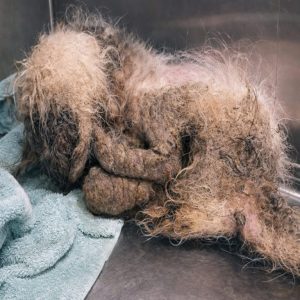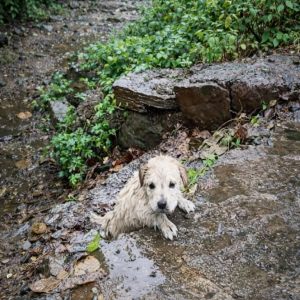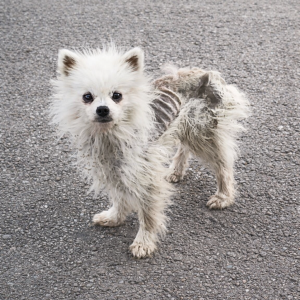
He arrived with two problems.
The first was visible: his back legs were not working. His spine had been damaged, his muscles were already losing condition, and without intervention, the window for recovery would close.
The second problem was harder.
When he was found, his hind legs had been loosely tied together. The source noted that no one knew why — whether someone had intended it as a kind of support or for another reason entirely. What it had left behind was not a physical injury but something less visible and more difficult to treat: a deep, wary relationship with human touch.
The team named him Comfy.
It was a hopeful name, chosen in the early days when he seemed calm. Still. Quiet in a way that the staff read, initially, as peace.
What the Calm Was Hiding
When the pain medication wore off and Comfy’s strength began returning, the stillness changed.
Anyone who approached him was met with growls. Sharp, sudden warnings that communicated clearly: do not come closer. Do not reach for me. Whatever hands have meant before, they have not meant safety.
He wasn’t aggressive in the way of a dog that wants to cause harm. The source was careful about this distinction. He was defensive — an animal that had associated human contact with restraint and pain, and was now doing what made sense given everything that association contained.
The team understood the distinction.
It did not make their situation easier.
The Problem That Had No Simple Answer
A paralyzed dog needs physiotherapy.
Not occasionally. Not when the dog feels ready for it. Consistently, with hands on the muscles and limbs, stimulating nerves, maintaining what function remains, working against the clock of atrophy that begins immediately when a body stops moving.
Without that touch, Comfy’s legs would continue to deteriorate past the point where recovery was possible.
But Comfy would not allow touch.
The team sat with this problem honestly. Forcing the therapy would break whatever fragile relationship existed and likely make the fear worse. Not doing it would mean his body lost its window for healing while they waited.
They made a choice.
They would not force it. They would do something harder: they would wait.
VIDEO: He Wouldn’t Let Anyone Near Him — Watch How Patience Unlocked Comfy’s Road to Recovery
What Patience Looked Like
Staff members began sitting near Comfy without approaching him.
They brought food and placed it within reach rather than offering it from close contact. They spoke in the room, keeping voices low and steady, building the simple evidence that their presence did not automatically precede something painful. They did not push at his boundaries. They waited at the edge of them, consistently, day after day.
Progress announced itself in the smallest possible increments.
A day when the growl didn’t come immediately.
A day when he didn’t move backward when someone sat nearby.
And then — the source described it as the moment the team recognized as the real turning point — his tail moved.
A small flick. Brief. Almost easy to miss.
But it was not defensive. It was not a warning. It was something else — a different kind of communication from the same dog who had been using growls and distance to keep the world at arm’s length.
The team received it carefully, without crowding it. They let it be what it was: a door, not yet open, but no longer locked.
When Touch Became Possible
Trust, once it began to build, built in the direction of the therapy that had always been necessary.
Comfy allowed a hand to rest near him. Then briefly on him. Then with more presence, more contact, more of the work that his muscles and nerves required. Each session that didn’t result in pain, that ended with him still present and not in distress, added to an accumulating account of evidence that contradicted what he had learned before.
The rehabilitation was not easy. His muscles had lost significant condition by the time his cooperation made consistent work possible. Balance was unstable. Some sessions ended with exhaustion that required rest before the next one could begin.
He did not stop. And the team did not stop.
Six Months
The source marked the six-month point as the moment the full shape of Comfy’s story revealed itself.
He stood.
On his own. With the hind legs that had been entirely unresponsive when he arrived, that had needed months of patient work to stimulate back toward function.
He stood, and then he took a step.
Uneven. Requiring his full concentration. But his.
More steps followed. And then, eventually, the thing that the source described as difficult to witness without being moved: Comfy ran.
Not cautiously. Not haltingly. With the particular joy of a dog that has rediscovered something it didn’t know it had been missing — the simple physical fact of moving freely through space, of legs doing what legs are for, of a body no longer defined by what it couldn’t do.
The staff began calling him the Joyful Jogger.
It fit.
What His Fear Was Always Protecting
There is something worth understanding about what Comfy’s defensiveness actually was.
It was not the absence of trust. It was trust that had been damaged — trust that had learned, through experience, to protect itself behind growls and distance and the refusal to allow approach.
That is different from a dog that cannot connect. It is a dog that connected before, was hurt by that connection in some way that the source did not fully know, and was now being careful with something that had previously cost it something.
The patience the team extended was not simply a training strategy. It was, in the most literal sense, the evidence Comfy needed to update what he knew.
Hands sit near him and nothing bad happens.
Then hands touch him and nothing bad happens.
Then hands work on his legs for weeks and months and he gets stronger.
That is the argument the team made, day after day, with their presence and their consistency and their refusal to push past what he could accept.
He listened to the argument.
Eventually, he believed it.
And once he believed it, he ran.