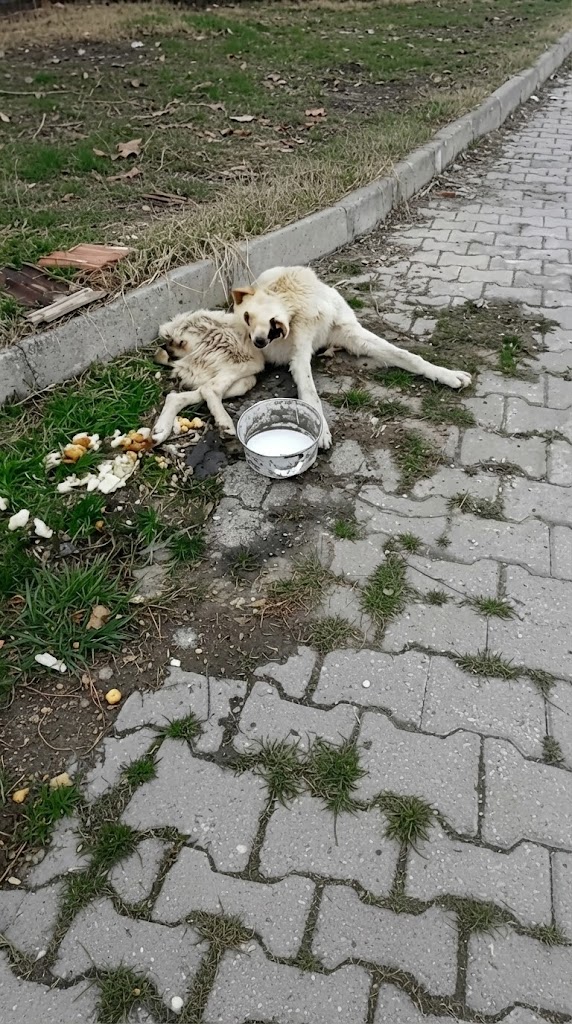
He was lying in the dirt when they found him.
Not moving. Barely conscious. His body pressed against the ground as though it had given up on the idea of rising again.
But he was still making a sound.
A faint, trembling cry — the kind that comes from something deep and involuntary, from a body in serious pain with very little left to give. The rescuers who heard it said afterward that the sound stayed with them. That it was the kind of thing you don’t forget.
No one had stopped before them.
The day had passed around him, and no one had stopped.
What They Found When They Got Close
His condition, on closer examination, was critical.
His nerves appeared badly damaged. His head was too heavy for him to lift. His body had gone rigid in a way that suggested the situation had been developing for hours. Panic showed in his eyes — awareness was still there, but it was fragile, flickering.
The signs pointed to serious trauma. The source described him as having been badly harmed and abandoned — left alone in an open space where the hours passed without anyone intervening.
The rescue team did not wait.
They named him Hope — a name that felt, in that moment, like something they needed as much as he did.
The Night That Could Have Gone Either Way
At the emergency clinic, the assessment was sobering.
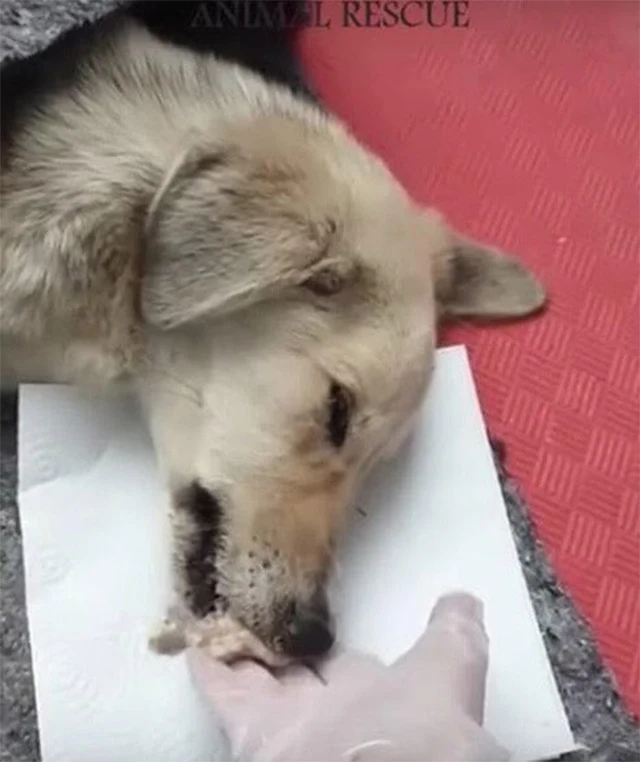
Hope was experiencing seizures. His fever was dangerously elevated. There was internal bleeding. The doctors who examined him that night could not offer reassurance about what the morning would bring.
The team stayed close.
After pain medication was administered, something small happened: Hope managed to swallow a few bites of food. Not much. Barely anything, by any normal measure.
But it was something. A signal that some part of him was still reaching toward the next moment.
The team held onto that.
They worked through the night. They adjusted, monitored, responded. And slowly — not dramatically, not all at once — Hope’s condition began to stabilize.
VIDEO: He Was Found Motionless and Fading — Watch Hope’s First Steps Back Toward Life
Day by Day, Inch by Inch
By day fifteen, the immediate danger had passed.
But passing the crisis point was not the same as recovery. Hope’s body remained weak and largely unresponsive. His legs, thin from the ordeal, trembled when he tried to use them. Attempts to stand ended on the floor, again and again.
What the source noted was his eyes.
They were alert. Present. Watching the people around him with an attention that communicated something clearly: he wanted to move. He was not done trying.
On day twenty, a wheelchair was introduced to support him during his recovery. It was unfamiliar and confusing at first — his body had lost its trust in its own ability to function, and a new device added another layer of uncertainty. But he adjusted. Gradually, with repetition and patience, he began to use it. Each session went a little further than the one before.
Then came day twenty-seven.
Without assistance — no wheelchair, no supporting hands — Hope stood up.
His steps were unsteady. He covered very little ground. But the people watching went quiet in the way that people go quiet when something genuinely unexpected happens in front of them.
He had done it himself.
Seven Weeks
The source marked the seven-week point as the moment the nature of Hope’s story fully revealed itself.
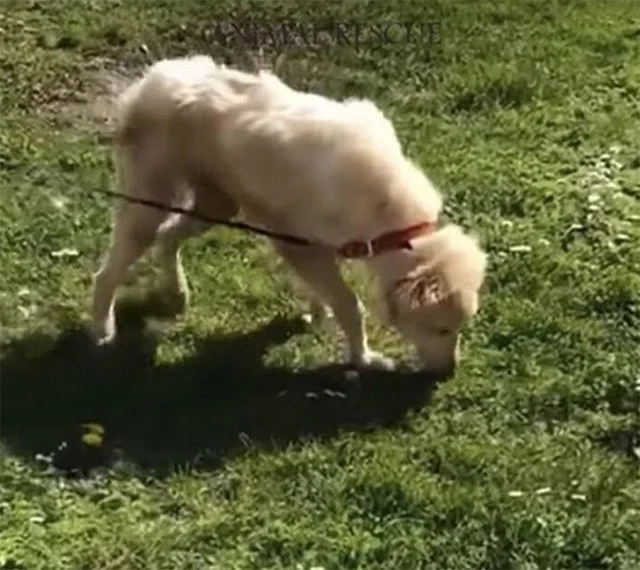
After seven weeks of consistent therapy, careful feeding, and the kind of patient daily attention that recovery requires, the dog who had been found unconscious in the dirt ran.
Not walked. Ran.
Across an open stretch of grass, moving freely, ears up, body carrying the kind of energy that belongs to a dog who is simply happy to be alive and moving and here.
The people present described it as impossible not to feel something watching him go.
The pain that had defined every early moment of his story was gone — or at least no longer visible. In its place was a dog who played, who moved toward people with openness, who seemed genuinely at ease in a way that nothing in his first days would have predicted.
Sixty Days In
At sixty days, Hope’s story was still being written.
The source confirmed that he was continuing to grow stronger — that each day brought more of what the seven-week mark had first revealed. The trembling had stilled. The seizures had not returned. His body, which had once seemed to be losing its hold on life, had found a rhythm.
He is not the same dog who was found lying in the dirt with a fading voice and no one stopping to listen.
That dog is still in there — in the sense that everything he endured is part of what he carries. But what is visible now is something else entirely.
What Hope Carries Forward
Recovery, for a dog like Hope, is not just a medical story.
It is a story about what persists when nearly everything has been taken — when the body is failing and the hours are passing and no one has come yet.
Something in Hope kept going.
Through the seizures and the fever and the days when standing was impossible. Through the confusion of a wheelchair and the long slow work of learning to trust his own legs again. Through all of it, something in him remained oriented toward life, toward movement, toward the next small thing that might be possible.
That is not nothing.
That is, in its quiet way, everything.
At sixty days, Hope is still becoming the dog he was always going to be — the one that was always underneath the pain and the dirt and the long hours no one came.
He is getting there.
One day at a time. One sprint at a time.