
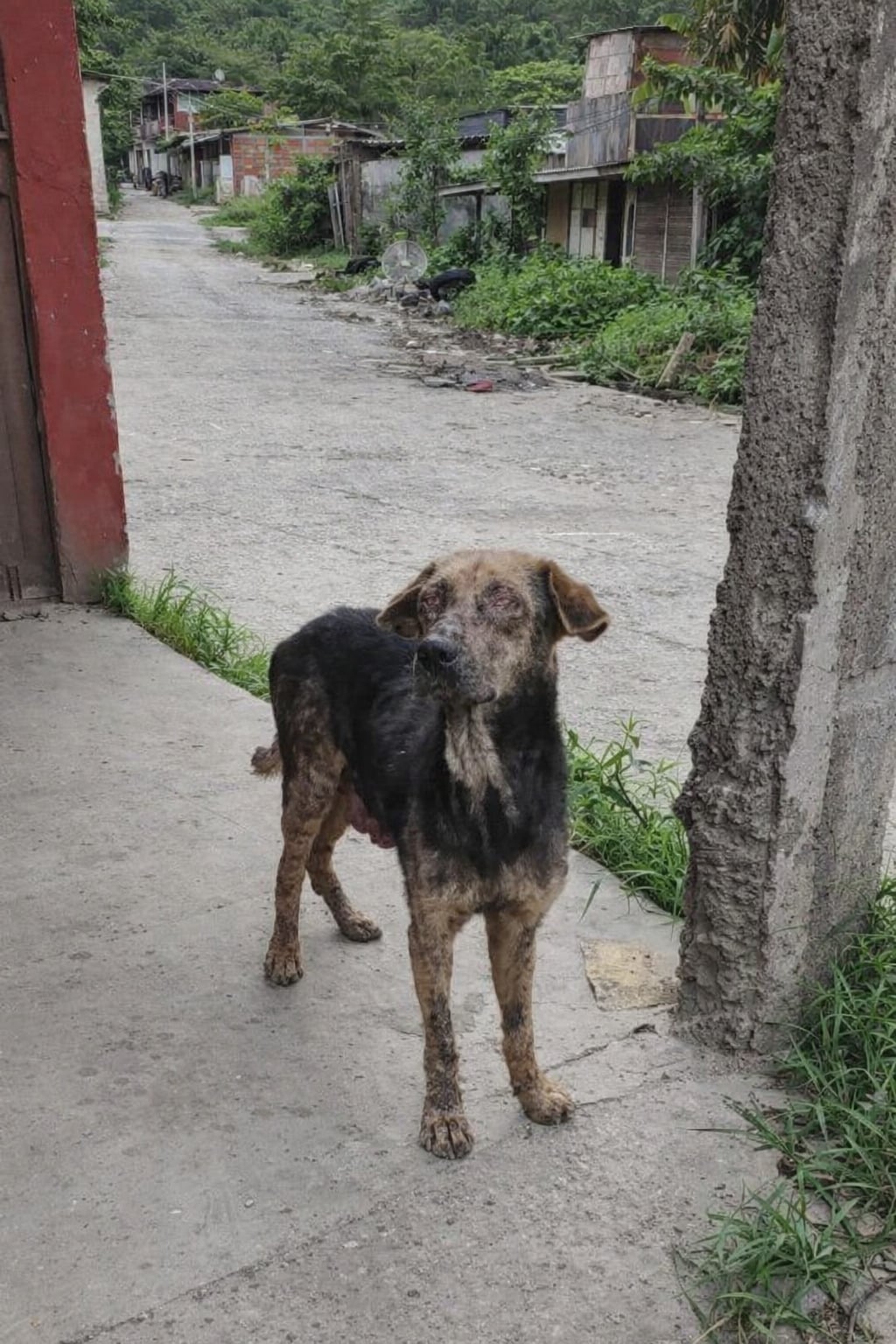
The dog seemed to have learned one rule about surviving on the street: when someone came close, make yourself as small and invisible as possible.
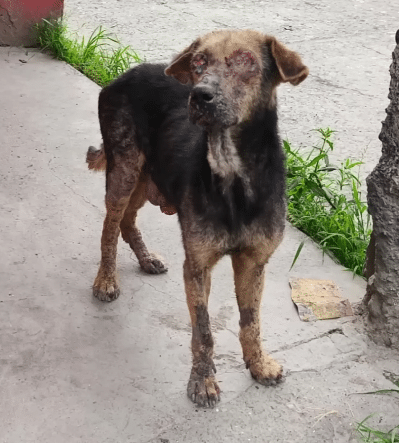
He stood beside a quiet road with his fragile body pressed near a faded red wall. His ribs were sharply visible beneath his skin, and much of his fur was missing. Large patches of exposed skin looked irritated and sore, suggesting he had been living with a serious skin condition for far too long.
But the most painful sight was his right eye.
It was badly swollen and red, the kind of injury or infection that clearly needed attention. Every part of him seemed to tell the same story—a dog who had been struggling without treatment, shelter, or anyone he could depend on.
When movement appeared nearby, he did not run toward it.
He backed away.
Slowly, carefully, he pushed himself closer to the wall as though the corner might protect him.
Then a man approached.
He Did Not Reach for the Dog
The rescuer wore a white shirt, a cap, and a face mask. He could have walked directly toward the dog and tried to catch him.
Instead, he stopped.
Then he lowered himself onto the pavement.
By kneeling, he made himself smaller and less threatening. There were no sudden movements and no attempt to corner the frightened animal. In his hand was something much more useful than a leash at that moment: food.
The dog watched cautiously.
Fear told him to stay away.
Hunger told him something different.
Eventually, hunger won.
One hesitant step brought him closer. Then another.
Soon, the starving dog was eating from the container while the rescuer remained beside him, quiet and patient.
Only after the dog became focused on the food did the man slowly raise a hand.
He touched the top of the dog's head.
Then his neck.
The dog's body immediately stiffened.
For an animal that may have survived by avoiding people, even a gentle touch could feel dangerous. The rescuer did not push harder. He simply stayed calm.
And then, almost imperceptibly, the dog's posture changed.
He stopped resisting.
A Tiny Moment of Trust Changed Everything
To someone watching casually, it might have looked like almost nothing.
The dog simply allowed the man's hand to remain on him.
But for a frightened stray, that quiet decision was enormous.
It meant that for a few seconds, fear was no longer completely in control.
The rescuer had not demanded trust from him. He had earned the first fragile piece of it by offering food before restraint and patience before control.
Once the dog was calm enough, the man carefully lifted his thin body into his arms.
The word “RESCUER” could be seen across the back of his shirt, along with the logo of Happy Animals Club in the Philippines.
Only minutes earlier, the dog had been trying to disappear against a wall.
Now someone was carrying him away from it.
A vehicle was waiting nearby with a transport crate already prepared. The dog was placed safely inside, and the roadside corner that had become his hiding place slowly disappeared from view.
For him, the journey away from that red wall was more than a change of location.
It was the beginning of being treated like a life worth saving.
From Survival to Medical Care
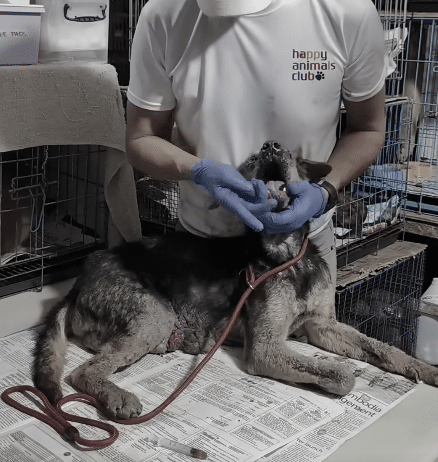
The next part of the rescue moved indoors, into what appeared to be a clinic or shelter environment.
Nearby cages and a work surface covered with newspaper suggested that the rescuers were prepared to assess and care for animals arriving from the streets.
The same man now wore blue medical gloves.
His approach remained just as careful as it had been outside.
He gently examined the dog's mouth and teeth while looking over his overall physical condition. The dog appeared exhausted and weak, but remarkably, he did not fight the examination.
There was something deeply moving about that change.
On the roadside, he had pressed himself against a wall because a person approaching felt like a threat.
Now human hands were checking his injuries rather than causing new ones.
He was no longer being forced to survive every moment alone.
For perhaps the first time in a long while, his only responsibility was to remain still while someone else worried about what happened next.
Less Than Thirty Seconds, but an Entire Life Can Change
The rescue footage is brief, lasting less than half a minute.
There is no elaborate spectacle.
No frantic chase.
No dramatic confrontation.
Yet the transformation taking place inside those few moments is impossible to miss.
At the beginning, there is a sick and frightened dog standing alone beside a road.
His body is painfully thin.
His skin is damaged.
One eye is swollen.
And when a human comes near, his instinct is to retreat.
Then someone chooses a different way to approach him.
Instead of grabbing, he kneels.
Instead of forcing contact, he offers food.
Instead of demanding obedience, he waits.
Only after the dog begins to feel safe does the rescuer touch him.
And only after that first small piece of trust appears does he carry him toward help.
That sequence matters.
For frightened animals, rescue is not always about moving faster or being stronger. Sometimes the first challenge is convincing an animal that the hands reaching toward him are finally there to help.
Compassion Can Begin With Something Very Small
The dog beside the red wall did not understand clinics, rescue organizations, transport crates, or medical treatment.
He understood hunger.
He understood fear.
And eventually, he understood one gentle hand that did not hurt him.
That was enough to begin.
The footage later points viewers toward the longer rescue story and ways to support future animal rescues, but the most powerful message has already been shown through the dog's behavior.
Compassion does not always arrive with noise.
Sometimes it looks like a person stopping when everyone else has continued walking.
Sometimes it is a container of food held patiently on a roadside.
Sometimes it is refusing to frighten an animal who has already been frightened enough.
And sometimes, the moment that changes everything is simply this:
A suffering dog backs himself against a wall, expecting another reason to be afraid.
A stranger sees him.
The stranger stops.
And instead of reaching down to take control, he kneels.


