
The large dog rested inside an old red plastic basket, barely moving as a man carried him into the shelter.
His golden-brown coat was dusty. His body looked exhausted. Yet when he lifted his head toward the people gathering around him, there was something remarkably gentle about his expression.
His name was Vàng.
He was a beautiful mix of Bắc Hà and German Shepherd, a dog whose strong appearance stood in painful contrast to the weakness that had overtaken his body.
When he was carefully placed on the floor, the rescuers began to understand just how difficult his life had become.
Vàng could not walk.
His front legs still worked, but his hind legs no longer supported him. To move even a short distance, he had to pull his body forward using only the strength remaining in his front limbs.
There was no dramatic struggle to announce his arrival.
No frightened barking.
No attempt to push anyone away.
Just a tired dog, moving slowly across the floor, looking toward unfamiliar people as though he was trying to understand what would happen next.
And despite everything, he still seemed willing to trust them.
The Quiet Arrival That Revealed His Struggle
At first glance, Vàng's size and thick coat might have suggested a healthy, powerful dog.
But the moment he tried to move, the reality became impossible to overlook.
His front paws reached forward. His body followed with difficulty. His back legs remained unable to carry his weight.
What should have been an ordinary movement required extraordinary effort.
For a dog accustomed to relying on four legs, losing the ability to stand changes almost every part of daily life.
Even reaching a nearby spot can become exhausting.
Vàng had reached that point.
The rescuers watched as he managed to pull himself across the floor, slowly covering a distance that another dog could have crossed in seconds.
There was something especially moving about his calmness.
He did not react aggressively to the strangers around him. He did not appear to resist their attention.
Instead, he remained quiet and observant, his tired eyes following the people who were now responsible for his care.
The shelter had welcomed dogs facing difficult circumstances before.
But seeing Vàng struggle through such a simple movement made his situation deeply affecting.
His arrival was not the beginning of his suffering.
It was the moment that suffering finally became visible to people who could try to help.
How an Illness Changed Everything
The man who brought Vàng to the shelter explained that the dog's condition had developed over time.
According to his account, Vàng had suffered a severe blood parasite infection.
Treatment had helped him survive that illness, but his physical difficulties did not end there.
His hind legs gradually became weaker.
Standing grew more difficult.
Walking became increasingly challenging until, eventually, he was no longer able to stand.
The illness appeared to have left lasting consequences, although the precise medical cause of his paralysis was not established in the account.
For Vàng, the practical result was unmistakable.
His front legs had become his only means of moving himself from one place to another.
The man also described the difficulties of caring for a dog with such extensive needs while managing long working hours and demanding personal circumstances.
As Vàng's mobility declined, providing the level of daily assistance he needed became increasingly difficult.
Eventually, his owner made the decision to bring him to the shelter.
It was an emotional surrender rather than a simple exchange of responsibility.
The man had seen Vàng through his illness. He knew how much the dog had changed. And he appeared to understand that his companion now required help beyond what he could consistently provide.
The shelter offered a possibility that had become difficult to maintain at home.
A place where Vàng could be watched over.
People who could help him move.
And a chance to explore whatever treatment options might still exist.
VIDEO: Unable to Use His Back Legs, Vàng Pulled Himself Across the Floor — Still Trusting the People Around Him
A Safe Place Where He No Longer Had to Struggle Alone
After Vàng arrived, volunteers carefully moved him into a quieter resting area.
This was an important first step.
His condition meant that simply moving around could demand considerable effort. Giving him a suitable place to rest helped reduce the need for constant struggling.
The shelter was not completely silent.
Other rescued dogs could be heard barking as they reacted to the unfamiliar arrival.
For Vàng, it was a new environment filled with unfamiliar sounds, animals, and people.
Yet he remained remarkably gentle.
He watched what was happening around him without showing aggression. His expression still reflected exhaustion, but he appeared receptive to the attention he was receiving.
There was no sudden improvement in his legs.
He did not stand up when he reached the resting area.
He did not begin walking simply because kind people were nearby.
The physical limitations that had brought him to the shelter remained.
But something about his circumstances had changed.
He was now surrounded by people prepared to assist him with the movements that had become so difficult.
That distinction matters.
For animals living with severe mobility problems, rescue is not always a single dramatic action. Sometimes it begins by recognizing that an animal cannot manage ordinary tasks without help.
It means understanding that comfort, safe surroundings, and consistent attention are important even when recovery remains uncertain.
Vàng could not explain what he needed.
His movements made some of those needs clear.
And the volunteers responded with care.
A Goodbye That Still Carried Love
One of the most touching parts of Vàng's arrival involved the man who had brought him there.
Surrendering an animal can sometimes be mistaken for a lack of affection.
But Vàng's circumstances were more complicated.
His owner had explained the pressures that made caring for him increasingly difficult. After bringing him to the shelter, the man did not simply leave without another thought.
Before departing, he promised to return with blankets and old clothing to help make Vàng more comfortable.
It was a modest offer.
No grand declaration.
No promise that everything would immediately improve.
Just a practical gesture directed toward a dog who could no longer move easily or find comfort without assistance.
The account does not confirm whether those items were later delivered.
Still, the promise itself reveals something important about the circumstances of Vàng's surrender.
His owner appeared to care about his comfort, even while acknowledging that he could no longer provide everything the dog required.
Sometimes compassion means continuing to care for an animal at home.
At other times, it means recognizing that additional help is necessary.
For Vàng, arriving at the shelter created an opportunity for that help to begin.
The volunteers now faced the challenge of determining what could realistically be done for him.
And they were not prepared to dismiss his future simply because he could not walk.
Searching for Answers Without Promising a Miracle
Once Vàng was settled, the shelter staff began documenting his condition and exploring possible ways to help.
They contacted veterinarians.
They sought advice from people experienced in animal rescue.
They also searched for veterinary clinics that might be willing and able to evaluate or treat dogs with paralysis.
Their hope was straightforward.
They wanted to see Vàng stand again someday.
But wanting a recovery and being able to promise one are very different things.
The source does not describe a confirmed veterinary diagnosis explaining his loss of mobility. It also does not establish that a particular treatment had been started or that his condition had improved.
Those uncertainties remained part of his story.
The volunteers could search for professional guidance, gather information, and advocate for his needs.
They could not guarantee that his back legs would regain their strength.
And Vàng's situation did not call for an exaggerated account of an overnight transformation.
His experience was more complicated, and more realistic, than that.
A serious illness had been followed by a progressive loss of mobility.
His owner had reached the limits of what he could manage.
The shelter had accepted responsibility for his immediate safety and was looking for possible medical assistance.
Each part of that process mattered, even without a dramatic conclusion.
Helping an animal with an uncertain prognosis requires patience.
It also requires accepting that meaningful care may not always produce the outcome everyone hopes for.
For Vàng, being able to stand again remained a dream rather than a confirmed achievement.
But his inability to walk did not make his need for comfort any less important.
The Gentle Spirit That Had Not Disappeared
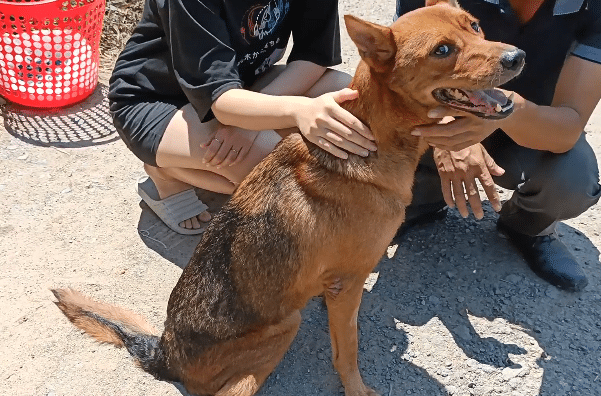
There was one quality that continued to stand out throughout Vàng's early time at the shelter.
His trust.
Despite the physical difficulties he had experienced, he remained gentle toward people.
When someone approached, he did not respond with hostility.
When volunteers attended to him, he appeared calm.
Even when he needed to drag himself along the ground, his manner toward the people around him remained remarkably soft.
It would be easy to describe him only through his paralysis.
To focus entirely on his weakened hind legs, the effort of moving, or the uncertainty surrounding his medical future.
But that would overlook an equally important part of who he was.
Vàng was not simply a dog who could no longer walk.
He was a living companion with a distinct temperament.
A dog who still watched the world with interest.
A dog who continued accepting human attention.
A dog whose physical condition had changed dramatically, while his gentle behavior remained evident.
Those qualities helped make his story memorable.
The shelter could see that his body needed assistance.
His behavior also showed that his relationship with people had not been lost.
There is no need to claim that he understood every act of kindness or knew exactly what the volunteers intended.
His calm responses were meaningful enough on their own.
He was in an unfamiliar place, surrounded by people and other rescued animals.
And he continued to meet that unfamiliarity with quiet trust.
A Peaceful Landscape, an Unfinished Journey
Near the end of the rescue video, the setting changes to a peaceful view of green rice fields surrounding the shelter.
It is a striking contrast to the earlier images of Vàng struggling to pull himself across the floor.
The landscape is open and calm.
The message accompanying those final moments encourages compassion for animals who cannot speak for themselves.
For Vàng, that message feels especially relevant.
He could not tell anyone how difficult movement had become.
He could not describe what it felt like to lose the use of his hind legs.
He could not ask a veterinarian to evaluate him or explain to his owner exactly what kind of assistance he needed.
Other people had to recognize those needs and act on his behalf.
His owner brought him somewhere he might receive more support.
The shelter volunteers gave him a place to rest.
And the staff began looking for professional guidance that might offer a clearer understanding of his condition.
None of those actions guaranteed a complete recovery.
But each represented a response to an animal whose needs could no longer be ignored.
Vàng's future remained open.
There was no confirmed moment when he rose onto all four legs again.
No documented return to walking.
No final announcement that his medical challenges had been overcome.
And that uncertainty deserves to be respected.
Sometimes Hope Begins With Being Cared For
When Vàng first arrived in the red plastic basket, his limitations were immediately apparent.
He was exhausted.
His hind legs could no longer support him.
Every attempt to move across the floor depended on the strength of his front legs.
Yet he remained calm and gentle with the people trying to help.
That image captures the heart of his story.
Not a miraculous recovery.
Not a perfectly resolved ending.
But a dog who had endured serious physical hardship and finally reached a place where others were willing to share the responsibility of caring for him.
Perhaps further veterinary evaluation would eventually reveal a treatment option.
Perhaps his mobility problems would remain a long-term part of his life.
The available account does not tell us which future awaited him.
What it does show is that his journey had entered a different chapter.
He had a safer place to rest.
Volunteers were paying attention to his condition.
And people were actively searching for ways to improve his situation.
For a dog who had been struggling to move through everyday life, those were meaningful changes.
Vàng still could not walk when his story was shared.
But he no longer had to face every difficult movement without someone nearby to help.
Sometimes rescue is the beginning of recovery.
Sometimes it is the beginning of a more comfortable life despite permanent limitations.
And sometimes its first, most important achievement is much simpler.
A vulnerable animal is finally seen, understood, and given the care he deserves.
For Vàng, that was already a reason to hope.


