
Some dogs arrive at a shelter frightened, restless, or desperate to escape.
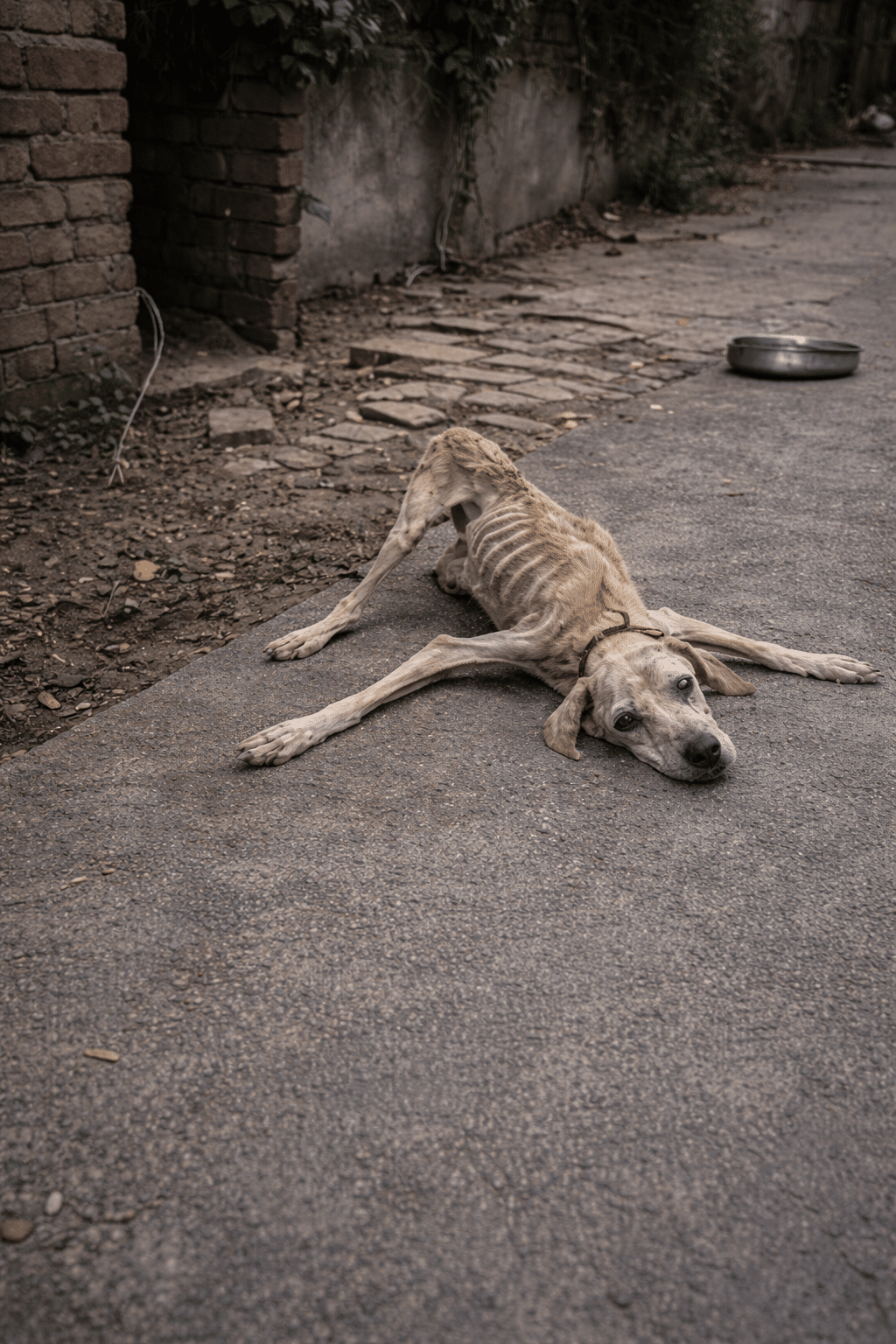
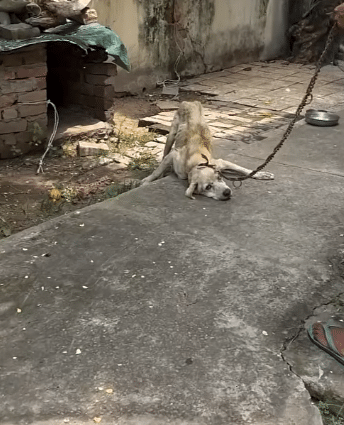
Caesar arrived almost without a reaction at all.
He was already an elderly dog when the person responsible for him decided not to keep him any longer. By the time rescuers reached him, his silence seemed to say as much as his fragile appearance.
He did not bark at the unfamiliar people around him.
He did not struggle when they came close.
He barely raised his head.
His body was extremely thin, but it was the absence of energy in his behavior that stayed with the people trying to help him. Caesar appeared withdrawn from everything happening around him, as though simply responding required more strength than he could give.
Before they could take him away, the rescuers had to pay his owner.
Only then could Caesar leave.
And with that quiet departure, the first of two remarkable rescue journeys began.
Caesar Finally Reached a Place That Asked Nothing From Him
At the veterinary clinic, Caesar's condition showed how urgently he needed care.
He had a serious infection affecting both eyes. Parasites were found on his weakened body, and he was dehydrated and exhausted.
There was no quick transformation waiting for him.
The first priority was simply to make him comfortable and begin addressing what could be treated.
His body was cleaned. The parasites were removed. His infection received care, and warm blankets gave him a place to rest without having to defend himself or endure more discomfort.
For several days, Caesar remained distant.
He had reached safety, but safety and trust are not always the same thing.
Caregivers continued providing regular meals, soft bedding, calm voices, and gentle handling. Nothing dramatic was demanded from him.
He was simply allowed to exist in a place where his needs mattered.
Gradually, the shelter began working on another challenge: helping Caesar move again.
Physical therapy started with a very small goal.
Stand for a few seconds.
Then try one step.
Then another.
There was no need to rush him. For an older dog who had arrived so weak, even the smallest movement represented progress.
One Walk Into the Garden Changed the Mood Around Him
Eventually, Caesar reached a moment that would have seemed almost impossible when he first arrived.
He walked into the garden.
There, surrounded by grass and unfamiliar scents, he lowered his nose and breathed in.
It was a simple thing for a healthy dog.
For Caesar, it marked something much larger.
He was no longer lying silently with almost no response to the world around him. He was exploring it again.
His expression began to soften. The distant look that had worried his rescuers was less pronounced. As he spent time outside, his relaxed face even seemed to form the beginning of a smile.
The change had not come through one dramatic event.
It had been built through food, warmth, medical attention, movement, patience, and repeated moments of safety.
VIDEO: Caesar Arrived Silent and Frail — Then He Walked Into the Garden Again
Soon, another important change came.
A family stepped forward for Caesar.
His age did not prevent them from seeing the companionship he could still offer. The senior dog who had arrived painfully thin and withdrawn was able to leave the shelter for a home of his own.
It could easily have been the closing chapter of an emotional rescue.
Instead, about two weeks later, the shelter received another phone call.
The caller was Caesar's former owner.
There was another dog.
His name was Volga.
The Second Dog Faced an Entirely Different Battle
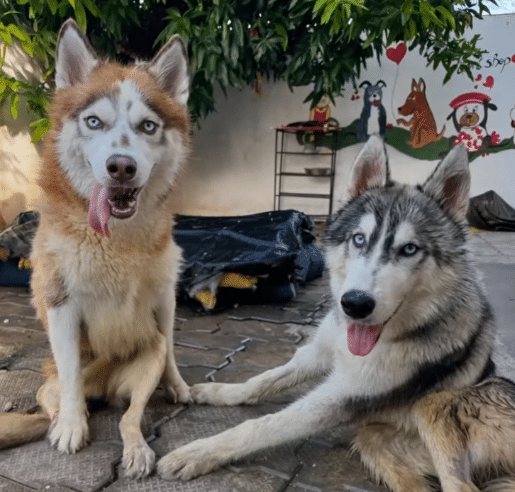
Volga was young, a Husky whose bright eyes contrasted sharply with the weakness of his body.
Unlike Caesar, whose recovery centered on age, illness, exhaustion, and gradual strengthening, Volga was dealing with a severe physical injury.
He could not properly support himself.
Veterinary examinations revealed that his spine was broken, with the injury believed to have resulted from blunt trauma.
His condition required emergency surgery.
The procedure was delicate, but it was successful.
Even so, surgery could not answer the biggest question surrounding Volga's future.
Would he ever walk normally again?
There was no certainty.
The shelter did not allow that uncertainty to become the limit of the life he could still have.
Recovery would need to focus not only on what Volga had lost, but also on what he could still learn to do.
Wheels Gave Volga a New Way Forward
A custom wheelchair was prepared for him.
At first, moving with it was unfamiliar.
Volga had to learn how to balance his body differently and understand what the wheels were doing behind him. His early attempts were awkward and hesitant.
But with time, those movements became steadier.
The equipment that initially seemed strange gradually became part of the way he explored his surroundings.
He moved through the yard.
He followed scents.
He lifted his head into the air and took in what was around him.
The goal was no longer to measure his life only by whether his injured body could move in the way it once had.
The wheelchair allowed him to participate again.
And during that adjustment, Volga gained something that no medical device could provide.
A friend.
Sky Stayed Beside Him While He Learned
Another dog named Sky became a regular companion to Volga.
Sky stayed near him as he moved around the shelter, rested close to him, and played at a pace Volga could manage.
That companionship mattered because adapting to a changed body did not have to mean being isolated from ordinary canine life.
Volga could still investigate the yard.
He could still interact with another dog.
He could still experience curiosity, movement, and play.
Day by day, his confidence with the wheelchair grew.
What had first required concentration began to look more natural.
His injury remained real. Nothing in his rescue story erased what had happened to his spine.
But the injury no longer defined every moment that followed.
The Shelter Saw Possibility Where Others Might Have Seen Limits
Caesar and Volga arrived at different stages of life and with very different needs.
One was an elderly dog who had become dangerously weak and emotionally withdrawn.
The other was a young Husky facing life after a serious spinal injury.
Neither recovery could be guaranteed when each dog first entered care.
Yet the shelter responded to both dogs in the same essential way.
It began with the life in front of them rather than with a judgment about how difficult that life might become.
For Caesar, that meant treating his infection, removing parasites, giving him nourishment and comfort, and helping him regain enough strength to stand and walk.
For Volga, it meant surgery, adaptation, and finding a way for him to move through the world even when his legs could not support him normally.
Their progress looked different because their needs were different.
That is often what meaningful rescue requires.
Not one solution for every animal.
But enough patience to discover what each animal still needs and what each one can still enjoy.
Two Phone Calls That Could Have Ended Very Differently
The shelter that once received Caesar as a silent, fragile senior eventually saw him leave with a family.
The same shelter later watched Volga roll through the yard beside other dogs, with Sky often close by.
The final picture is far removed from the stillness that surrounded Caesar's arrival or the helplessness of Volga's first days.
There is movement.
There is companionship.
There is room for dogs to behave like dogs again.
Caesar's age did not disappear because someone cared for him.
Volga's spinal injury was not undone by kindness.
Rescue could not rewrite everything that had already happened to either dog.
What it could change was what happened next.
Caesar was given comfort, treatment, gradual rehabilitation, and ultimately a home.
Volga was given surgery, mobility support, companionship, and the opportunity to keep participating in life despite his limitations.
Their stories began with two separate phone calls.
Both calls concerned dogs whose futures looked uncertain.
And both times, the answer from the shelter was the same in the way that mattered most.
Yes.
There was still room to help.
Sometimes a second chance does not mean returning an animal to exactly the life it had before.
Sometimes it means helping an old dog discover the grass beneath his feet again.
Sometimes it means giving a young Husky wheels and letting him race toward whatever comes next.
For Caesar and Volga, being given that chance was enough to turn two uncertain endings into two very different beginnings.


