
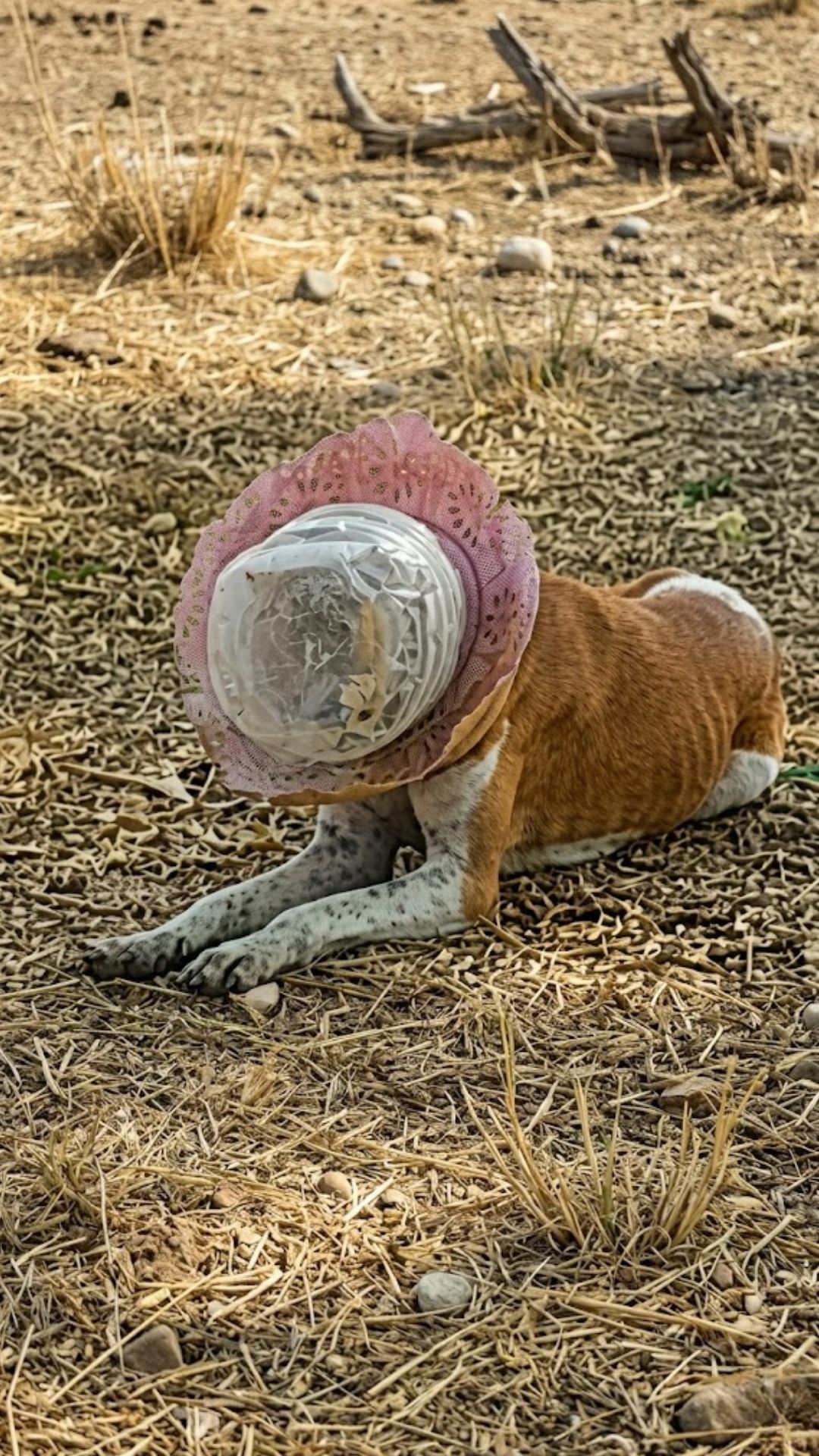
The plastic container covered her entire face, turning something as ordinary as discarded rubbish into a barrier she could not escape.
She could walk through the fields. She could hear people approaching. She could sense the world continuing around her.
But she could not eat or drink.
For ten days, a frightened stray dog wandered through a rural village approximately 160 kilometers from Hyderabad, India, with a rigid plastic container stuck over her head.
People could see her struggling.
They wanted to help.
Yet every attempt to get close sent her running away.
The most painful part was that this was not the first time she had become trapped in plastic. She had already been freed from one container, only to find herself caught in another.
And now, with her strength fading, the people trying to save her were running out of time.
The First Escape That Never Truly Set Her Free
The dog's troubles began during an ordinary search for food.
Like many animals surviving on the streets, she depended on whatever scraps she could find. Discarded containers sometimes held traces of food, making them tempting to a hungry animal.
At some point, she pushed her head into a plastic pot.
But when she tried to pull away, the container would not come off.
The opening had caught around her neck.
Unable to remove it herself, she was left with a frightening problem. The same object she had approached in search of food had become something she could not escape.
Fortunately, local residents noticed.
They intervened and managed to restrain her long enough to break away the plastic container.
For a moment, the danger appeared to be over.
Her face was free again.
But the rescue had not removed everything.
A thick, uneven ring from the broken container remained around her neck. It fitted tightly enough that she could not slip out of it on her own.
The villagers had succeeded in removing the larger obstruction, but this remaining piece would soon create another problem.
It was a small detail with enormous consequences.
Because the dog was still living on the streets, she eventually had to continue searching for food.
And during that search, another discarded container caught her attention.
How a Second Container Became an Even Greater Danger
The next accident was especially unfortunate.
When the dog placed her head inside another plastic container, the rigid ring still caught around her neck prevented the new container from sliding free.
Instead of simply getting stuck, the two pieces of plastic became locked together.
The remaining ring from the first accident acted as a barrier, holding the second container firmly over her head.
This time, her entire face was enclosed.
She could not reach food.
She could not drink water.
And she could not remove the obstruction, no matter how she moved.
The situation became increasingly serious as the days passed.
When villagers saw her moving through the countryside, they could hardly recognize the animal beneath the plastic.
From a distance, the container concealed her face and gave her an unusual silhouette as she wandered through the fields.
People attempted to approach her, hoping to catch her and remove the obstruction.
But the dog was frightened.
Each time someone moved toward her, she escaped before they could reach her.
She disappeared into vegetation and kept her distance from anyone trying to help.
Her fear was understandable. She could not know that the people pursuing her wanted to end her suffering.
To her, being surrounded or restrained was another threat.
And that instinct to run made an already difficult rescue even harder.
A Village Refused to Leave Her Behind
As the days continued, concern among the villagers grew.
They had already seen how difficult it was to catch her during the first incident. Now the second container made the situation more urgent.
She had reportedly spent ten days unable to eat or drink normally.
Her strength was declining.
The residents understood that their own attempts were not enough.
Rather than abandoning the effort, they shared an appeal online, seeking help from people with experience rescuing frightened animals.
Their message eventually reached the Animal Warriors Conservation Society.
The organization received information about a stray dog trapped inside a plastic container for an extended period.
The distance was considerable.
The village was approximately 160 kilometers from Hyderabad.
But the rescue team decided to make the journey.
By the time they reached the area, darkness had fallen.
The dog was still missing among the surrounding fields and bushes.
Finding an animal that was actively avoiding people would be difficult even in daylight. In the dark, with thick vegetation providing hiding places, the challenge became greater.
The rescuers began searching with flashlights.
They moved through the countryside, checking areas where the dog might have taken shelter and listening for movement.
But she remained out of sight.
There was no immediate success.
They had traveled a long distance to help an animal they could not yet reach.
Still, they continued their efforts.
The next opportunity would come with the morning light.
At Daybreak, the Search Finally Led to Her
When daylight returned, the rescuers located the dog inside a dense patch of bushes.
She was curled up among the vegetation.
The plastic container was still firmly attached to her head.
By then, her condition had visibly deteriorated. Her body was thin, her ribs could be seen, and her movements were slow.
After so many days struggling to survive, she appeared to have very little energy left.
Yet the rescuers could not assume that weakness would make her easy to catch.
She had repeatedly escaped from people before.
Even a frightened and exhausted animal can suddenly flee when strangers approach.
The team therefore needed to act carefully.
They positioned themselves around the bushes, using quiet communication and controlled movements to avoid alarming her prematurely.
Their immediate goal was simple.
Secure the dog before she could disappear again.
Only then could they safely remove the plastic.
The team prepared a net.
They waited for the right opportunity.
And when the moment came, they acted together.
The net came down.
At last, the dog was secured.
After ten days of failed attempts to reach her, the greatest obstacle to her rescue had finally been overcome.
VIDEO: After Ten Days Trapped Inside Plastic, Watch Rescuers Finally Free Her Head
Two Pieces of Plastic Stood Between Her and Freedom
Catching the dog was only the beginning.
The rescuers still had to remove the plastic without causing further harm.
The outer container was rigid, and the remaining ring around her neck had made the obstruction especially difficult to dislodge.
Simply pulling on the container was not a safe solution.
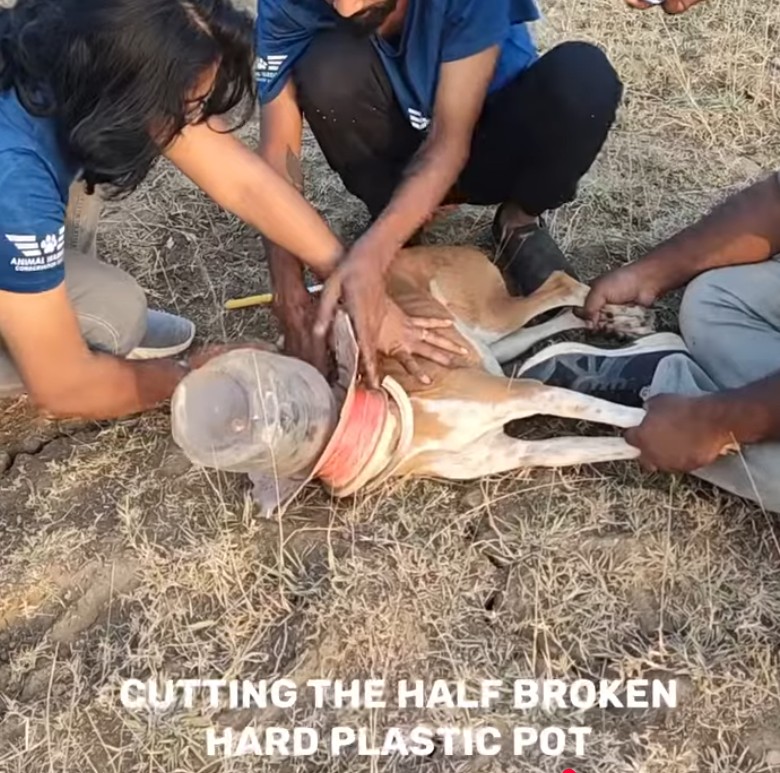
The rescuers held her securely while preparing to cut through the material.
It was a delicate moment.
The dog had spent days trying to escape the object surrounding her head. Now strangers were close enough to touch it, and she had no way of understanding what they were about to do.
The team worked carefully with cutting tools.
First, they broke open the outer container.
The plastic that had covered her face finally separated.
But one more piece remained.
The rigid ring from the first accident was still around her neck.
The rescuers cut through that obstruction too.
And with its removal, both pieces of plastic were finally gone.
Nothing remained covering her face.
Nothing remained trapped around her neck.
After ten days, she was free of the containers that had prevented her from eating and drinking.
It was an extraordinary change brought about by a series of careful, practical actions.
A net.
A secure hold.
A cutting tool.
And people who had refused to give up on her.
For the first time since the second accident, the dog could move her head without the plastic surrounding it.
There was no dramatic struggle after the final piece came away.
According to the account, she did not growl or fight.
Instead, she shook her head.
Then she ran.
This time, however, she was not running with a container covering her face.
She was leaving the rescue site free of both plastic traps.
The Freedom That Had Seemed Almost Impossible
The final moments of the rescue were simple.
There was no lengthy reunion or elaborate celebration described.
The dog shook off the experience and moved away from the people who had helped her.
Her departure marked the end of the immediate danger that had brought the rescuers to the village.
For the villagers who had watched her struggle, it was the outcome they had been trying to achieve.
And for the Animal Warriors Conservation Society, it was the result of a difficult journey followed by a careful search and capture.
What happened to the dog afterward was not documented in the provided account.
There is no confirmed information about a veterinary examination, a recovery period, or whether she later found a permanent home.
After such a prolonged period without normal access to food and water, her overall health would still have been a serious concern.
But one important fact was clear.
The physical obstruction that had kept her trapped was finally removed.
She no longer had the second container over her face.
And the ring left behind from the first accident was gone as well.
Her rescue did not require an extraordinary invention or a complicated procedure.
It required someone to notice her situation, recognize that she needed specialized help, and keep trying until she could be reached.
The villagers made the call for assistance.
The rescuers answered.
Together, they changed the outcome of a dangerous situation that the dog could never have solved by herself.
A Small Piece of Rubbish Can Become a Serious Threat
One of the most troubling aspects of this story is how ordinary the objects involved were.
They were plastic containers.
Items that people use, discard, and often stop thinking about.
Yet for a hungry stray animal, a container carrying the scent or remains of food can become an invitation to investigate.
A narrow opening may allow an animal's head to enter but make it difficult to withdraw.
And when discarded material breaks, the remaining pieces may create additional hazards.
In this dog's case, the ring left from the first container directly contributed to her becoming trapped again.
What initially appeared to be a successful rescue was therefore only a partial solution.
It is a reminder of why removing every dangerous piece of material matters when helping an animal caught in discarded waste.
The broader lesson extends beyond this one village.
Plastic rubbish left in places where animals search for food can create risks that are not immediately obvious to the people who throw it away.
Containers, rings, and similar objects may seem harmless when lying on the ground.
But an animal does not understand how those objects are shaped or why they may be difficult to escape.
A simple act of responsible disposal can help prevent situations like this from developing.
And when an animal is already trapped, experienced rescuers may be essential—especially if fear makes the animal impossible to approach safely.
Ten Days of Struggle, One Determined Rescue
The numbers from this rescue are difficult to forget.
Ten days spent trapped inside the second plastic container.
Two separate accidents involving discarded plastic.
A rescue team traveling approximately 160 kilometers to reach a frightened stray.
And one careful operation that finally removed both obstructions.
But the most meaningful part of the story is not the distance traveled or the time that passed.
It is the decision made by the people who saw her struggling.
They could not catch her themselves.
They had already tried.
Still, they did not treat her suffering as something they were powerless to address.
They reached out.
They asked for help.
And when help arrived, the rescuers continued searching even after their nighttime efforts failed.
By morning, they had found her hiding among the bushes.
Soon afterward, the plastic was gone.
The dog who had spent ten days moving through the countryside with her face enclosed could finally leave that terrible situation behind.
Her longer-term recovery remains unknown, and her story should not be given an ending that has not been confirmed.
But the rescue itself offers a meaningful example of compassion in action.
Sometimes helping an animal is not as simple as offering food or reaching out a hand.
Sometimes kindness means recognizing that a frightened creature needs more help than one person can provide.
It means calling someone with the right experience.
It means searching again after an unsuccessful night.
And it means paying attention to the small dangers that human waste can leave behind.
This stray dog's ordeal began with two discarded plastic containers.
It ended with both containers removed because people cared enough to keep trying.
For an animal that had been unable to free herself, that second chance began the moment someone refused to look away.


