
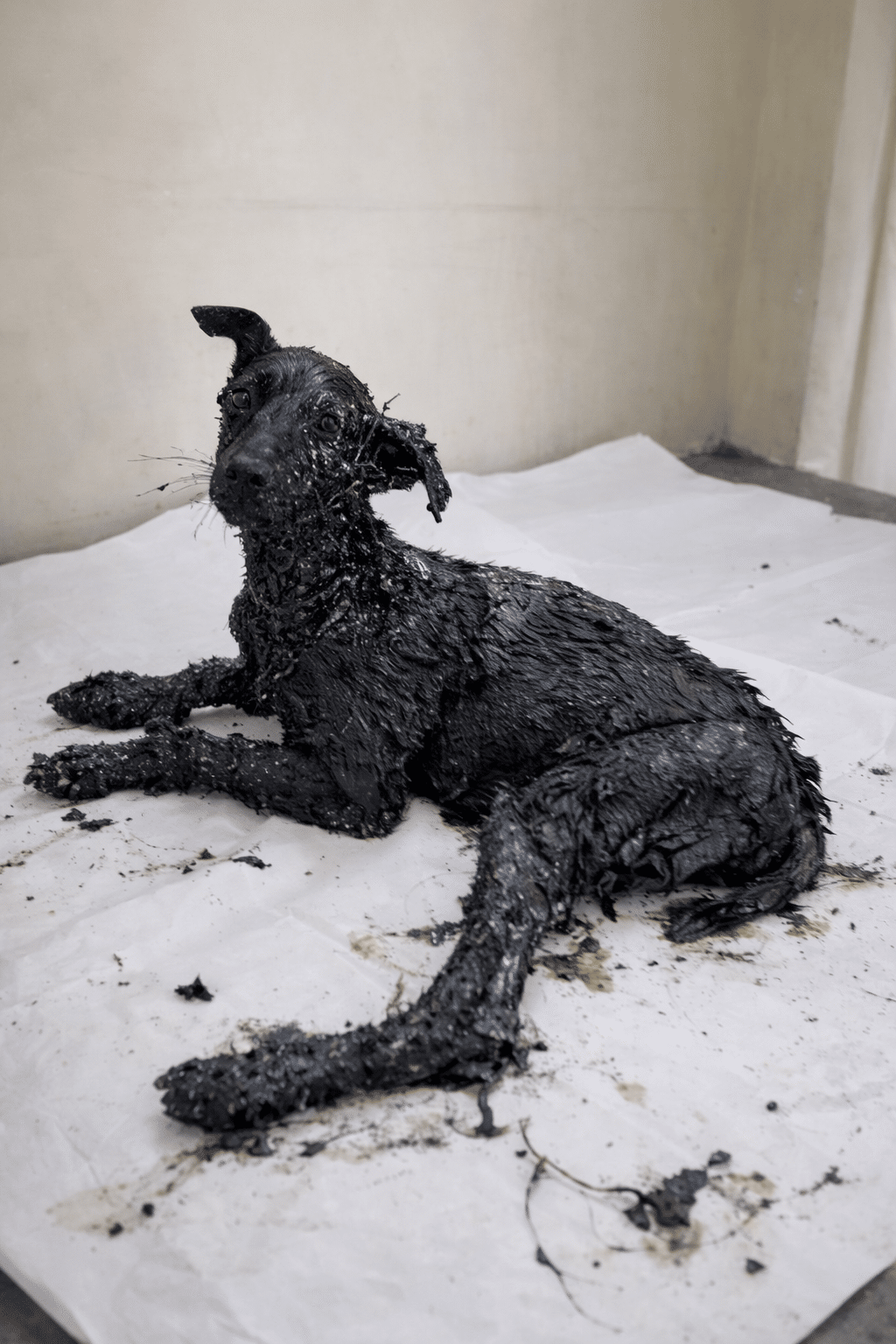
At first, there was almost nothing to distinguish the puppy from the dark surface around him.
His small body was coated in thick black bitumen. His legs could no longer move freely, his fur had disappeared beneath the sticky layer, and only his eyes made it clear that there was a living animal trapped there.
Those eyes were what finally caught someone's attention.
And from that moment, his story began to change.
One Wrong Step Left Him Completely Trapped
The little black puppy had been near a construction area before the accident happened.
Exactly how long he had been wandering there, or what had brought him so close to the dangerous pit, was unknown. He may have been searching for food or simply moving through an unfamiliar place.
Then he stepped into the bitumen.
The substance clung immediately to his fur and body. When he tried to free himself, the sticky material only spread farther across his legs, chest, and coat.
Every attempt to move made escape more difficult.
Before long, the puppy was almost completely immobilized.
The black coating surrounded him so thoroughly that his natural shape was difficult to recognize. He could not simply shake it away or pull himself free.
He was small, exhausted, and stuck in a place where someone could easily have passed without noticing him.
That was perhaps the most frightening part of his situation.
He did not need only strength.
He needed someone to see him.
A Passerby Looked Closely Enough to See His Eyes
Someone eventually noticed a dark shape inside the pit.
At first glance, it could easily have been mistaken for part of the construction debris or the black material itself.
Then the passerby looked again.
There were eyes staring back.
That small detail transformed an indistinct shape into an animal clearly in need of help.
The passerby did not leave him there.
The puppy was taken to the veterinary clinic operated by the Nirbhaya Foundation, where the difficult task of removing the bitumen could begin.
When he arrived, he was shaking and unusually quiet.
He had already spent his energy trying to escape something his body could not overcome on its own.
Now, instead of struggling against the hardened coating, he was surrounded by people trying to free him from it.
But this was not a rescue that could be rushed.
Freeing Him Required Patience, Not Force
Bitumen could not simply be washed from the puppy's coat like ordinary dirt.
The hardened material had become attached to his fur and skin. Pulling or scrubbing too aggressively risked causing further discomfort and damaging the sensitive skin underneath.
The caregivers therefore began slowly.
They applied oil to the hardened areas, working it carefully into the sticky coating so it could gradually soften and loosen.
There was no quick solution.
Small sections had to be treated one at a time.
The process continued patiently as more of the dark layer began to release from his body.
VIDEO: Beneath the Hardened Bitumen, His Bright Eyes Slowly Began to Appear Again
Some areas were too heavily coated to be freed gently with oil alone. Where the bitumen had completely sealed sections of fur, the caregivers carefully trimmed that fur away.
Everything had to be done with control.
A sudden pull could hurt him. Moving too quickly could make an already frightening experience even more stressful.
So they worked slowly and handled him gently.
Throughout the process, the puppy remained remarkably still.
He had no way of understanding the details of what was happening, but the hands touching him now were not trapping him further.
They were gradually giving him his body back.
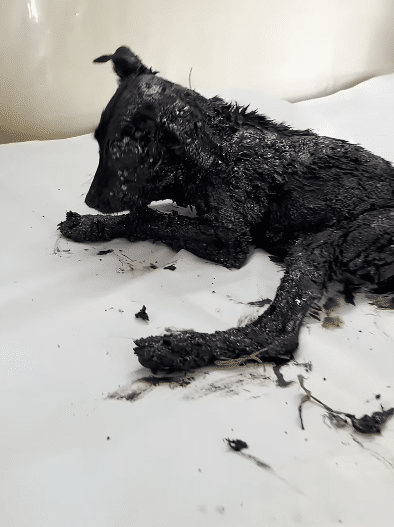
Bit by bit, the black shell disappeared.
First, more of his face became visible.
Then sections of his natural fur.
Then the shape of the small puppy underneath began to emerge.
The change was not dramatic because of a single moment.
It happened through dozens of careful, patient movements.
And each one brought him a little closer to freedom.
Underneath the Black Coating Was a Fragile Puppy
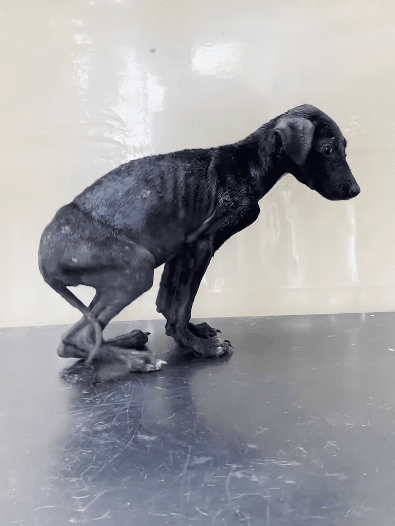
As more bitumen was removed, the condition of the puppy underneath became clearer.
He was thin.
His ribs were faintly visible, and his body showed the exhaustion of what he had endured.
Yet there was also an unmistakable change.
His breathing became calmer.
His eyes, initially filled with fear and uncertainty, began to look brighter as the heavy coating disappeared.
For the first time since he had been found, his natural fur could be seen again.
The puppy who had arrived looking almost like an unmoving black shape gradually became recognizable as himself.
Small.
Fragile.
But free from the material that had held him in place.
Removing the bitumen was only the first stage.
His body had endured prolonged contact with the sticky substance, and he had arrived weak and shaken. He still needed warmth, nourishment, gentle skin care, and time to regain his strength.
Nothing about that recovery needed to happen quickly.
For a puppy who had recently been unable to move at all, even the smallest signs of progress mattered.
Strength Returned in Small, Quiet Moments
The days after the rescue were focused on allowing him to recover.
At first, even standing appeared difficult.
He was no longer physically trapped by the bitumen, but freedom did not immediately mean strength.
His body needed time.
With regular food and care, that strength slowly began to return.
He started lifting his head with more energy.
Then came the day when he managed to stand on his own.
It was a simple movement, something most dogs perform without anyone noticing.
For this puppy, it represented an enormous difference from the motionless figure discovered in the construction pit.
Standing was followed by cautious steps.
The movements were not confident at first.
He was still recovering, and there was no reason to rush him.
But he was moving under his own power again.
The same legs that had been fixed in place by thick bitumen were carrying him forward.
Then another small sign appeared.
His tail moved.
At first, it was only a slight wag.
But sometimes recovery is easiest to see in details that would normally seem ordinary.
A raised head.
A few steps.
A small tail wag.
Each suggested that his world was beginning to feel different.
Gentle Care Helped Fear Give Way to Trust
Physical recovery was only part of the change.
When the puppy first reached the clinic, he had been shaking and quiet. Being trapped had left him in a vulnerable position, unable to move away from anything around him.
During the long cleaning process, people had to remain close to his body for an extended period of time.
They applied oil.
They worked through his fur.
They trimmed the areas that could not be cleaned safely.
And they continued speaking softly and handling him with care.
That patience mattered.
As the days passed, the puppy became more comfortable around the people caring for him.
His posture changed.
His eyes appeared less fearful.
Instead of simply enduring human touch, he eventually began leaning toward it.
There was no single dramatic instant when fear vanished.
Trust returned the same way the bitumen had been removed.
Slowly.
A little at a time.
The Puppy in the Pit Was Almost Unrecognizable From the One Who Recovered
Near the beginning of his rescue, the puppy could barely be distinguished from the hardened black material surrounding him.
By the later stages of his recovery, the contrast was remarkable.
His coat was clean.
His eyes were alert.
He could stand and move freely.
Most importantly, he no longer appeared frozen by fear.
The puppy who had once been unable to lift himself from the pit could now approach his caregivers and accept their affection.
There was no dramatic object or complicated technology behind the transformation.
It began because someone noticed him.
Then people were willing to spend the time necessary to help without causing further harm.
Oil was applied patiently.
Hardened sections were loosened little by little.
Fur that could not be safely cleaned was carefully trimmed.
Food, warmth, rest, and gentle attention followed.
None of those actions seem extraordinary on their own.
Together, they gave a trapped puppy another chance.
Sometimes Rescue Begins With Simply Refusing to Walk Past
Construction areas can be busy and visually chaotic.
Against dark bitumen, a small black puppy could easily have disappeared into the surroundings.
If the passerby had not looked closely, the story might have been very different.
Instead, one person noticed his eyes.
That moment led him to the Nirbhaya Foundation's veterinary clinic and into the hands of people willing to spend hours carefully removing what had trapped him.
Animals cannot explain what happened to them.
They cannot point toward danger or describe how long they have been afraid.
Sometimes all they can do is remain there, waiting for someone to notice that something is wrong.
This puppy was fortunate that someone did.
His recovery is a reminder that compassion does not always begin with a dramatic rescue.
Sometimes it begins with a second glance.
A decision to stop.
And the willingness to help one small life that might otherwise have remained unseen.
Find out what happened next in the first comment below.


