
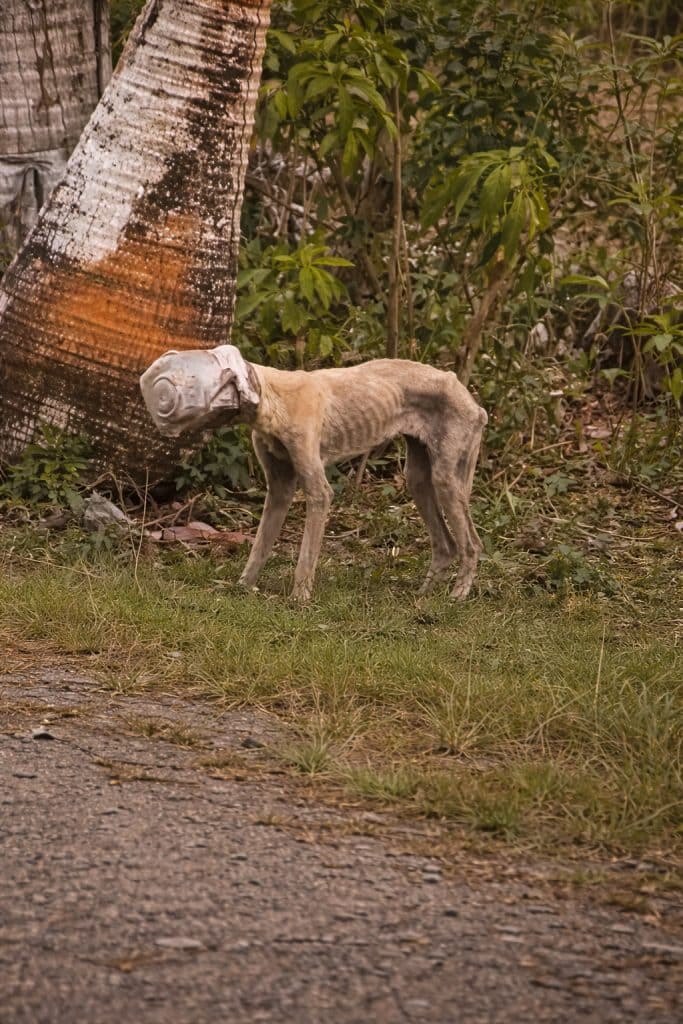
A plastic bucket covered Winnie's head when rescuers found her beside the road.
Her body was painfully thin. She appeared exhausted, barely responding to the people who approached her. The bucket prevented her from seeing her surroundings and made finding food or water almost impossible.
But there was something even more troubling than her physical condition.
Winnie did not try to escape.
She did not bark or struggle when help arrived.
Instead, she remained unusually still, as though she no longer had the strength to react to what was happening around her.
For the rescuers from the Boonie Flight Project, this was the beginning of a journey that would require much more than removing a piece of plastic.
They could free Winnie from the bucket.
Helping her feel safe in the world again would take considerably longer.
The Dog Who Could No Longer See the World
No one knew exactly how long Winnie had been trapped.
The plastic bucket had become lodged around her head, leaving her unable to see properly or reach the things she needed to survive.
What should have been ordinary parts of a dog's daily life had become enormous challenges.
Finding a drink.
Searching for food.
Moving through an unfamiliar environment.
Even recognizing when another animal or person was nearby.
Her physical condition showed just how serious the situation had become.
Winnie's body was severely underweight, and her strength appeared almost completely depleted.
By the time the Boonie Flight Project rescuers reached her, she was lying beside the road, barely moving.
A frightened dog might normally pull away from approaching strangers. Another might growl or struggle against unfamiliar hands.
Winnie did neither.
Her lack of resistance was especially concerning because she was clearly in no condition to protect herself.
The team understood that the bucket had to come off as soon as possible.
Yet even this seemingly simple task required care.
Winnie was weak, frightened, and unable to understand what the people around her intended to do.
The rescuers needed to move gently.
They were not simply removing an obstacle.
They were helping an exhausted animal experience the outside world again.
A Careful Rescue and an Unexpected Reaction
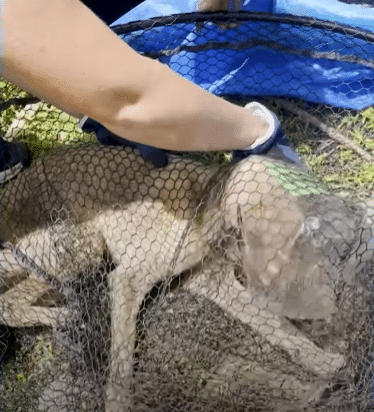
One rescuer held Winnie steady while another worked to loosen the plastic around her head.
There was no dramatic struggle.
Winnie remained quiet as they carefully freed her.
Then the bucket finally came away.
For the first time in an unknown period, nothing blocked her view.
She could see the people helping her.
She could see the space around her.
The physical barrier that had kept her isolated was gone.
It would have been comforting to see Winnie immediately wag her tail or approach the rescuers with excitement.
But that was not what happened.
Instead, she retreated.
She moved into a corner, curled herself into a small shape, and avoided looking directly at the people nearby.
The bucket was gone, but her fear remained.
That reaction revealed something important about the rescue.
Winnie had been given a chance to recover physically, but she was not yet ready to accept her new circumstances with confidence.
Being free and feeling safe were two different things.
For Winnie, the second would take time.
VIDEO: Winnie Was Found With a Bucket Trapped Over Her Head — Watch Her Journey From Fear to Freedom
A Quiet Home Where Nothing Was Expected of Her
After the rescue, Winnie received a medical examination.
The findings offered a measure of reassurance.
Although she was suffering from severe dehydration and malnutrition, the examination did not reveal any life-threatening injuries.
Her body needed nourishment, rest, and an opportunity to regain its strength.
But the people caring for her also recognized that her emotional recovery could not be rushed.
Winnie was placed in a calm foster home.
There, she would have the opportunity to adjust to ordinary surroundings without being pressured to interact before she was ready.
It was a major change from the roadside where she had been found.
She now had access to shelter, comfort, and people who wanted to help her.
Yet those improvements did not immediately make her confident.
During her first days in foster care, Winnie spent much of her time hiding in the bathroom.
The small, enclosed space seemed to offer the security she could not yet find elsewhere.
Unfamiliar noises startled her.
Open areas made her uneasy.
Even the kindness surrounding her was something she needed time to understand.
Her caregivers did not demand affection.
They allowed her to remain where she felt comfortable.
For a dog struggling with fear, that patience mattered.
Winnie did not have to become playful overnight.
She did not have to approach strangers or accept attention simply because someone wanted to comfort her.
She was allowed to move at her own pace.
And gradually, her behavior began to change.
The Small Discoveries That Helped Winnie Trust Again
Recovery did not arrive through one extraordinary moment.
It appeared in small changes to Winnie's daily routine.
At first, the bathroom remained her preferred hiding place.
But the comfort available elsewhere in the foster home slowly began to interest her.
There was a soft blanket.
A peaceful room.
A couch where she could rest.
These were ordinary things, but for Winnie, learning to enjoy them represented meaningful progress.
She began venturing beyond the place where she had been hiding.
Each step into a more open space suggested that her surroundings were becoming a little less frightening.
Her caregivers continued offering patience rather than pressure.
There was no need to hurry.
Physical recovery and emotional adjustment were happening together, but not necessarily at the same speed.
A dog could begin regaining strength while still finding everyday experiences overwhelming.
Winnie's progress reflected that difference.
The medical examination had provided encouraging news about her physical condition.
Her behavior, however, showed that rebuilding trust would require consistent care.
Fortunately, Winnie had something else working in her favor.
She was not the only animal in her foster environment.
The other animals around her provided examples of a kind of life she had not yet learned to embrace.
They accepted gentle attention.
They relaxed around people.
They behaved as though their surroundings were safe.
Winnie watched.
And with time, watching became participating.
The First Joyful Wiggles That Changed Everything
As the weeks passed, Winnie's curiosity continued to grow.
She observed the other animals interacting comfortably with the people who cared for them.
Their relaxed behavior offered a contrast to her own cautious approach.
Nothing forced her to follow their example.
But little by little, she began showing signs that she was willing to try.
Then came a particularly meaningful change.
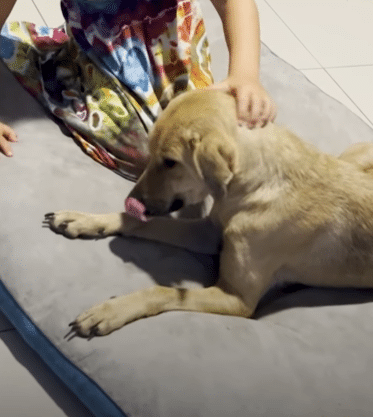
Winnie started wiggling her body with happiness.
Not just a hesitant movement or a cautious response.
Her excitement spread from her nose all the way to her tail.
For the people who had seen her lying weak and unresponsive beside the road, this was an extraordinary difference.
The dog who had once barely reacted to human presence was beginning to express joy.
She was becoming more comfortable with the people and animals around her.
Her recovery was no longer visible only in her physical strength.
It could also be seen in the way she moved.
The way she responded.
The way she began engaging with everyday life.
Those happy wiggles were important because they came naturally.
No one had demanded them.
They were simply a sign that Winnie was feeling increasingly secure.
After everything she had experienced, that was a remarkable step forward.
Still, another major change was approaching.
Winnie would soon leave the foster environment where she had made so much progress.
And starting again would bring challenges of its own.
A New Family, but Old Fears Still Followed
After nearly two and a half months of recovery, Winnie was healthy enough to travel to her permanent home.
A woman named Mary was ready to welcome her.
This was the future her rescuers and caregivers had been working toward.
Winnie would no longer be a dog struggling to survive beside a road.
She would have a home and a person committed to caring for her.
But arriving somewhere safe did not mean that all her fears disappeared.
The transition introduced another unfamiliar environment.
Different surroundings.
A new routine.
A new person to learn about.
For Winnie, these changes were difficult.
Despite the confidence she had gained during foster care, she began hiding again.
She spent long periods inside her crate, reluctant to venture out.
It might have seemed discouraging after the progress she had already made.
But her behavior was a reminder that recovery does not always move forward without setbacks.
An animal can become comfortable in one environment and still struggle when everything changes.
Winnie had learned that her foster home was safe.
Now she needed to discover whether Mary's home could offer that same reassurance.
Fortunately, Mary was not the only one waiting for Winnie.
Another dog named Maple would become an important part of her new life.
Maple Showed Winnie What Feeling Safe Could Look Like
Maple did not need to do anything extraordinary to help Winnie.
Her influence came from the simple way she lived.
She played.
She rested peacefully.
She interacted with the people around her without showing the same hesitation that Winnie experienced.
And Winnie paid attention.
Rather than being pushed into unfamiliar situations, she had the opportunity to observe another dog enjoying the environment around her.
Maple's behavior gave Winnie a model of everyday confidence.
When Maple relaxed, Winnie could see that there was no immediate reason for alarm.
When Maple played, Winnie could witness the pleasure of moving freely.
When Maple trusted Mary and the people around them, Winnie saw another example of comfortable companionship.
This process was gradual.
There was no single moment when every remaining fear suddenly vanished.
Instead, Winnie began following Maple's example.
She became increasingly willing to participate in activities that once might have frightened her.
The confidence she had developed during foster care began returning in her new home.
And this time, she was building it alongside a companion who seemed perfectly comfortable with the world.
Maple offered something valuable without demanding anything in return.
A steady example.
A reassuring presence.
A reminder, through ordinary behavior, that life could be enjoyed rather than feared.
For Winnie, those lessons helped make her permanent home feel like a place where she belonged.
From Hiding in Fear to Running Across the Yard
Today, Winnie's life looks dramatically different from the day rescuers found her.
The frail dog who once lay beside the road with a bucket covering her head now runs confidently across the yard.
She spends her days with Mary and Maple.
The surroundings that once seemed unfamiliar have become part of her everyday life.
Instead of retreating from every new experience, Winnie has learned to enjoy the freedom available to her.
Her journey has included several distinct stages.
First came the rescue itself, when the Boonie Flight Project team removed the bucket and gave her access to safety.
Then came the quiet work of physical recovery and rebuilding trust in foster care.
Later, she faced the challenge of adjusting to Mary's home.
And through her friendship with Maple, she continued developing the confidence needed to feel comfortable there.
None of those stages was unnecessary.
Removing the bucket changed Winnie's immediate circumstances, but it could not erase her fear.
Medical care helped address her physical condition, but emotional healing required patience.
Foster care gave her an opportunity to discover comfort.
Her permanent home provided the stability of a lasting family.
And Maple helped show her how to enjoy that life.
The transformation was not instant.
It was built gradually, through many small experiences of safety.
The Freedom Winnie Needed Was More Than the Ability to See
One of the most moving parts of Winnie's story is the difference between the day she was rescued and the life she now enjoys.
When the plastic bucket finally came off, she could see the world again.
But she was still afraid of it.
She backed away from people who wanted to help.
She hid even after reaching a safe environment.
And when she moved to her permanent home, she needed time to rebuild her confidence once more.
Those reactions did not make her recovery any less meaningful.
They showed why rescue is often only the first step.
Some animals need more than immediate protection.
They need repeated experiences that allow them to become comfortable with kindness.
They need people willing to respect their uncertainty.
And sometimes, as Maple demonstrated, they benefit from the quiet companionship of another animal.
Winnie eventually discovered all of those things.
Her story began with a dog who could barely respond to the people standing beside her.
Today, she is able to run, play, and share a loving home with Mary and Maple.
The bucket that once separated her from the outside world is no longer part of her life.
Neither is the constant fear that once shaped her behavior.
What remains is a dog who was given enough time to recover, enough patience to learn, and enough love to feel at home.
Winnie did not simply regain her sight of the world.
She finally had the chance to discover how wonderful living in it could be.


