
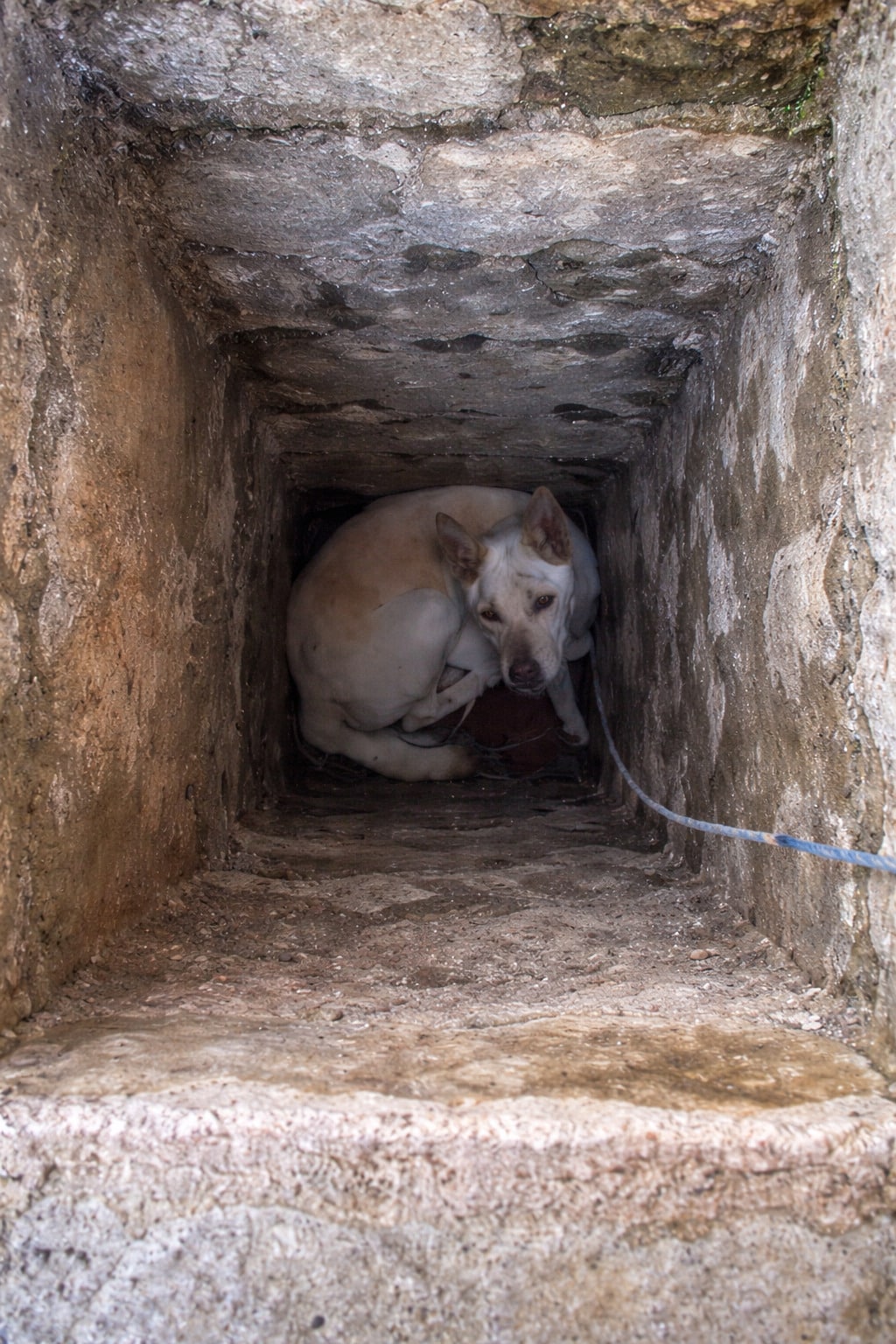
A small white dog was moving frantically at the bottom of a narrow pit beside the road.
From above, there was no easy path down and no way for him to climb back out on his own. The confined space offered almost no room to escape, and every failed attempt only seemed to increase his distress.
What might have been easy to miss from the roadside had become a dangerous situation beneath the surface.
Fear Took Over in the Confined Space
The dog was trapped in a place that gave him very few choices.
He circled inside the pit, growling and snapping as fear took over. His behavior made one thing clear: approaching him carelessly could make the situation worse.
He was not standing calmly and waiting to be lifted.
He was frightened, confused, and defensive.
Each movement used more of his energy. Yet the steep walls surrounding him left no obvious route upward.
The challenge was no longer simply getting a dog out of a hole. Whoever attempted the rescue would have to work around his fear as carefully as they worked around the physical danger of the pit itself.
Rescuers Knew They Could Not Rush
When rescuers from Animal Warriors Conservation Society reached the roadside pit, they immediately faced a difficult problem.
Getting close enough to grab the dog directly was not a safe option. In his distressed state, he could injure himself while struggling or react defensively toward anyone attempting to reach him.
So the rescuers prepared to work from above.
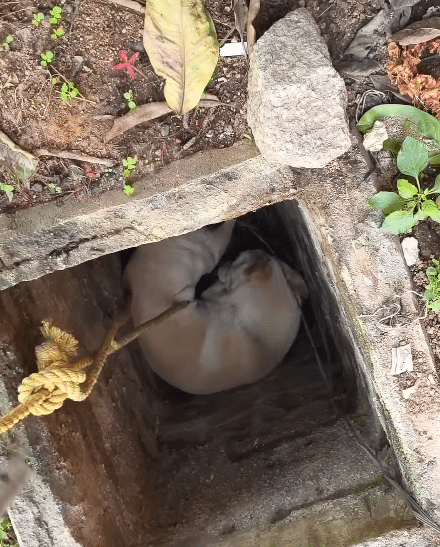
They used control poles, ropes, and safety equipment, relying on distance and careful coordination rather than force.
There was no dramatic leap into the pit.
Instead, the rescue depended on patience.
A looped rope was gradually lowered toward the dog while the team carefully controlled its position. Their voices carried down into the confined space as they tried to keep the process as calm as possible.
Every adjustment mattered.
A movement made too quickly could frighten him further. A poorly positioned loop might fail to secure him. The team had to wait for the right moment rather than simply pulling at the first opportunity.
VIDEO: Trapped Deep Below the Roadside, His Rescue Required Patience and Precision
The Most Delicate Part Was Getting Him Secured
From the edge of the pit, the rescuers continued guiding the loop.
The dog remained restless below them.
For him, the rope and equipment were simply more unfamiliar objects entering an already frightening space. He could not understand why people were reaching toward him or what they were trying to do.
That uncertainty made restraint essential.
The goal was to secure him without turning his fear into a more dangerous struggle.
Little by little, the loop was moved into position.
Then came the turning point.
The rope was tightened carefully enough to hold him, and the rescuers finally had a way to begin bringing him upward.
Even then, the danger had not completely passed.
The dog still had to be lifted through the narrow opening while the team kept him supported and controlled. Their movements had to remain coordinated until he was safely clear of the pit.
It was a short distance compared with many rescues, but in such a confined setting, those final moments required complete attention.
His Paws Finally Reached Solid Ground
Once the dog reached the surface, the entire situation changed.
For the first time since becoming trapped, there was open ground beneath his paws.
The rescuers removed the rope.
And the dog ran.
Only moments earlier, he had been circling inside a pit with nowhere to go. Now there was nothing surrounding him and no narrow wall blocking his path.
He moved quickly away from the place that had trapped him and disappeared down the road.
There was no prolonged celebration or staged reunion.
His immediate response was simply to leave.
After the fear and confinement of the pit, being able to run freely again was its own kind of ending.
The Rescue Did Not End When He Ran Away
The team still had one important concern.
The pit remained beside the road.
If one dog had fallen into it, another animal could potentially face the same danger. Leaving the opening unchanged would mean the rescue had solved only the immediate problem.
The rescuers therefore reported the hazard to local authorities so it could be covered or sealed.
That final step was quieter than pulling the dog to safety, but it mattered.
Animal rescue is sometimes about responding to the life directly in front of you.
It can also mean noticing the danger that caused the emergency and trying to prevent the same situation from happening again.
A Small Rescue With a Larger Lesson
Nothing about this rescue depended on dramatic medical treatment or a long recovery story.
The dog was trapped.
He was frightened.
And a careful team found a way to get him out.
The circumstances also showed why patience can be as important as speed.
A frightened animal may not understand that the people approaching are there to help. Defensive behavior can come from confusion and fear, especially when the animal has no space to retreat.
The rescuers from Animal Warriors Conservation Society responded by adjusting their approach to the situation in front of them.
They kept their distance.
They used the tools available to them.
They waited until the dog could be secured safely.
And only then did they lift him out.
By the time he ran down the road, the most important part had already happened.
A life that had been trapped below the roadside was back on solid ground.
And before the team left, they took one more step to make sure the same hidden danger would not simply be waiting for the next animal to fall.


