
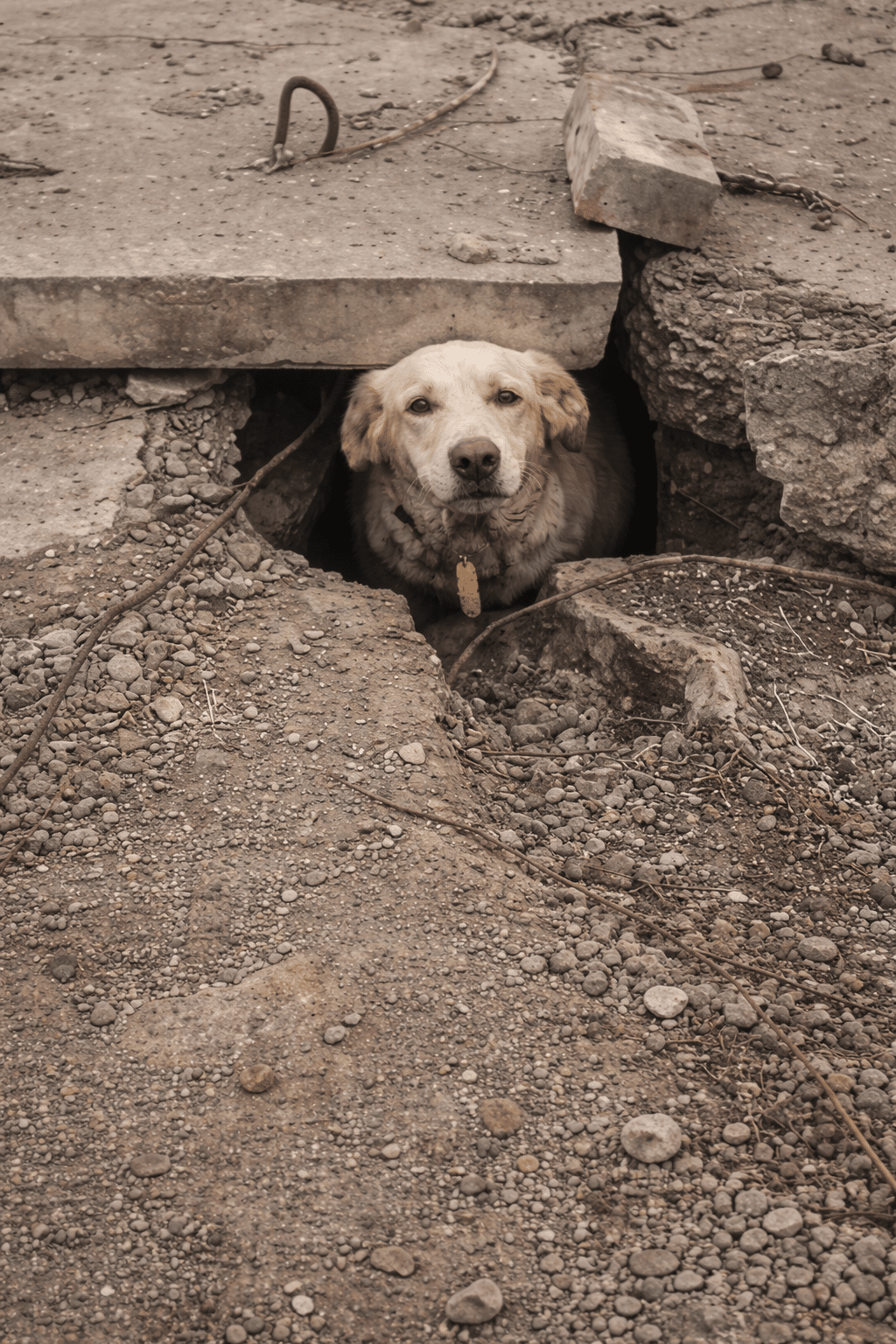
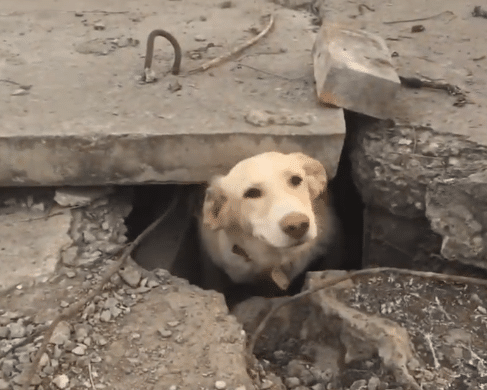
The heavy manhole cover stood between Shustrik and the chance to walk freely again.
Beneath it, a small, injured dog was trapped, unable to escape without help. By the time people discovered him, he was in a frightening situation that he could not possibly resolve on his own.
There was no simple way to lift the cover. It was too heavy for one person.
But something important happened that day.
People passing by stopped. Instead of continuing on their way, they joined the effort to free the little dog.
And when the cover was finally raised, Shustrik was given something he desperately needed.
A chance.
What followed would become a much longer journey than anyone might have expected. Getting him out of danger was only the beginning. His injured body needed serious medical attention, and the trust he seemed to have lost would take even longer to rebuild.
The Strangers Who Refused to Leave Him Behind
The first obstacle was painfully clear.
Shustrik was trapped beneath a heavy manhole cover, and the people trying to rescue him could not lift it without assistance.
There was no quick solution. The weight required several people to work together.
As more passersby joined the effort, an ordinary moment became a collective act of kindness.
These people did not need to know Shustrik's history. They did not need to know how he had ended up there or how long he had been struggling.
They could see that he needed help.
Together, they managed to raise the cover and bring him onto solid ground.
For a dog who had been unable to escape, that change was enormous.
Yet Shustrik did not respond with the kind of immediate excitement someone might expect from an animal that had just been rescued.
He stood quietly.
His body appeared fragile, and there was little sign of relief in his expression.
He was finally out of danger, but he still seemed uncertain about what was happening around him.
The people had opened the way to safety.
Now they needed to understand how badly he was hurt.
Hunger Could Not Overcome His Fear
Food was offered to Shustrik soon after his rescue.
It was clear that he was hungry. Under ordinary circumstances, a starving dog might be expected to approach food eagerly.
But Shustrik hesitated.
Even something as simple as eating seemed difficult when he was surrounded by unfamiliar people and animals.
When another dog named Nala approached, Shustrik moved away rather than settling down to eat.
That reaction revealed something important about his condition.
His needs were not limited to food or physical safety. He also appeared deeply unsure of his surroundings.
The people caring for him could offer nourishment, but they could not immediately make him feel secure enough to accept it.
There was another problem that could not be ignored.
One of Shustrik's hind legs was trembling constantly.
The movement was not a brief reaction that disappeared once he was safe. His leg struggled to support even small movements, making it clear that he needed urgent veterinary attention.
The rescue had removed him from the place where he was trapped.
It had not removed the pain that came with him.
And soon, the people helping him would learn just how serious that injury was.
A Difficult Operation and an Uncertain Road Ahead
Shustrik was taken to a veterinary clinic without delay.
There, X-rays revealed a severe fracture. The medical team also identified weakness in the bone, which made an already difficult injury more complicated to treat.
It was not something that could simply be managed with rest.
Shustrik needed surgery.
The procedure lasted more than three hours, requiring careful work from the veterinarians.
To stabilize the injured leg, they placed an external metal fixation frame. This device was intended to hold the damaged bone in position while healing took place.
For Shustrik, the operation was a crucial step toward recovery.
But it was not a promise that everything would immediately return to normal.
His leg had suffered a serious injury, and the veterinarians understood that restoring his ability to move would demand time and careful attention.
A successful operation was only one part of the process.
The next challenge would be helping a fragile dog regain his strength while the repaired bone healed.
And beyond the medical treatment, there was still the frightened animal who had backed away from food and companionship.
His recovery would have to make room for both.
VIDEO: Trapped Beneath a Heavy Manhole Cover, Shustrik Fought His Way Back to Walking Freely
The video captures an important part of Shustrik's journey toward moving comfortably again.
For a dog whose injured leg once struggled to support him, the possibility of walking without pain carried extraordinary meaning.
Every improvement represented more than physical progress.
It meant that the effort to save him was becoming a chance to live differently.
Two Months of Care, Patience, and Quiet Companionship
Following surgery, Shustrik continued his recovery at an animal rescue shelter.
The environment offered something he had badly needed: dependable care and a place where he could recover without being rushed.
His daily life now included familiar routines, gentle attention, and the presence of other animals.
Among them was Busya.
Busya became a quiet companion during Shustrik's difficult recovery, staying close as he worked through the slow process of healing.
Their companionship was one of the gentler parts of a journey that had begun with fear and injury.
Shustrik was no longer alone beneath a heavy cover.
He was surrounded by people who were willing to help him through the less dramatic but equally important days that followed.
Recovery rarely looks as impressive as a rescue.
There is no single moment when every difficulty disappears.
Instead, there are repeated acts of care, periods of waiting, and the gradual return of abilities that once seemed uncertain.
For Shustrik, the metal frame remained part of that process for two months.
When the time came, he returned to the veterinary clinic to have it removed.
It was a significant milestone.
The treatment had helped his body make progress, but he had not yet regained all his strength.
He remained thin.
His appetite and physical condition still needed improvement.
Removing the frame was not the end of his recovery. It was another step toward living without the limitations that his injury had imposed.
The shelter continued to provide the stability he needed.
And slowly, the changes became visible in ways that had little to do with medical equipment.
When a Frightened Dog Began to Trust Again
Even after Shustrik's physical condition improved, his behavior remained cautious.
During walks, he moved slowly.
At times, he seemed withdrawn, as though he was still trying to become comfortable with the world around him.
His body was making progress, but his confidence did not return at the same pace.
That difference matters.
An animal can receive successful medical treatment and still need time to feel secure.
A safe environment does not always erase fear immediately.
For Shustrik, trust had to develop gradually.
The people around him continued offering consistent care. There was no expectation that he should suddenly become playful or affectionate simply because his surgery was behind him.
Then the smaller changes began.
His tail started moving again.
He became more willing to follow people rather than keeping his distance.
These were not dramatic transformations that happened all at once.
They were quiet signs that Shustrik was becoming more comfortable in his surroundings.
A wagging tail might seem ordinary when seen in a happy, healthy dog.
For Shustrik, it meant something different.
It was a visible contrast to the fragile animal who had stood silently after being pulled to safety.
The dog who once retreated from an approaching companion was beginning to seek connection.
The dog whose injured leg had struggled to support him was learning to move with greater confidence.
Each change built upon the care that had come before it.
Finding His Place Among Other Animals
As Shustrik grew more comfortable at the shelter, his relationships with the other animals developed as well.
He began forming bonds instead of keeping himself apart.
His behavior became gentle and observant. At times, he even appeared protective toward animals smaller than himself.
It was a remarkable contrast to his earliest days in care.
When Shustrik was first offered food, the approach of Nala had been enough to make him withdraw.
Now, companionship was becoming a natural part of his life.
Busya's quiet presence during his recovery had been one part of that journey.
The wider shelter environment gave him further opportunities to feel comfortable around others.
No one could know exactly what Shustrik remembered about the time before his rescue.
His full history was not explained.
But his changing behavior showed that he was responding to the safety and consistency surrounding him.
He no longer appeared to see every interaction as a reason to retreat.
He could share space with other animals.
He could follow familiar people.
He could participate in the ordinary life of the shelter.
For a dog who had once been trapped and unable to move freely, these simple experiences carried real significance.
Recovery was becoming more than the healing of a fractured bone.
It was also the return of everyday comforts.
The Moment He Finally Ran Without Fear
Near the end of Shustrik's story, there is a scene that brings the long recovery into focus.
He is running across an open grassy area.
His movements are steady.
There is no visible limp and no sign of the hesitation that once accompanied his attempts to walk.
He moves freely, no longer held back by the injured leg that had required hours of surgery and months of care.
It is a simple sight.
A dog running on grass.
For countless dogs, that would be an ordinary part of life. For Shustrik, it represents how far he has come.
The same animal who once stood frightened and fragile after being rescued is now able to move confidently through an open space.
The external fixation frame is gone.
The trembling leg is no longer defining his movements.
And the cautious dog who initially struggled to accept kindness has grown more comfortable with people and other animals.
The contrast is difficult to miss.
Shustrik's rescue began with several strangers working together to lift something he could never have moved himself.
His recovery continued because other people were willing to take responsibility for what happened afterward.
The veterinarians treated his injury.
Shelter caregivers supported his rehabilitation.
Animal companions, including Busya, became part of the safer life he was learning to accept.
None of those contributions replaced the others.
Together, they gave Shustrik the opportunity to reach this moment.
The Life That Began After the Rescue
It would be easy to describe Shustrik's story as the day a group of strangers lifted a manhole cover and saved an injured dog.
That moment was certainly important.
Without those people stopping to help, he might not have received the medical care he urgently needed.
But the most meaningful part of his journey did not end when he reached solid ground.
It continued through a difficult operation, two months with a metal frame supporting his injured leg, and the patient care that followed.
It continued when he was still too thin and needed to rebuild his strength.
It continued through slow walks and the gradual return of his confidence.
And it became visible in the small moments when he began wagging his tail, following people, and forming bonds with the animals around him.
There is no confirmed adoption at the end of this story, and there is no need to invent one.
What is visible is already meaningful.
Shustrik recovered enough to run steadily and freely, surrounded by the care and companionship that helped him reach that point.
His journey reminds us that rescuing an animal is not always a single extraordinary act.
Sometimes, it begins when strangers stop long enough to notice a life in danger.
Sometimes, it continues through hours of medical treatment.
And often, its deepest meaning appears in the quiet days afterward, when patience helps a frightened animal discover that safety can last.
Shustrik was given more than a way out from beneath a heavy cover.
He was given time to heal.
Time to trust.
And finally, the freedom to run again.


