
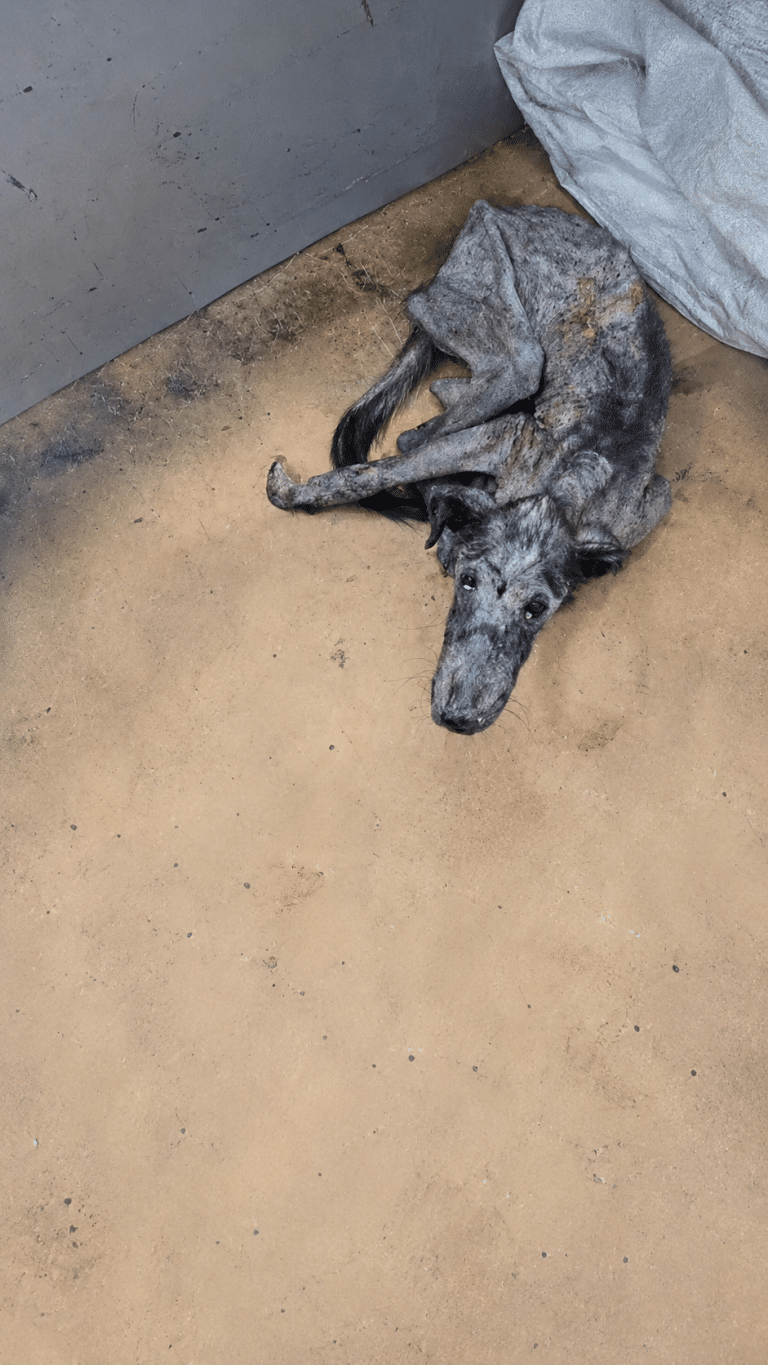
The dog was so thin that even taking a few steps appeared to require enormous effort.
Beside a dusty road, his fragile body moved forward on unsteady legs. His ribs stood out beneath his damaged coat, and large areas of missing fur revealed how much his health had suffered.
Yet whenever a person approached, he tried to get away.
He had almost no strength left, but he still wanted to run.
That instinct would eventually give him a name: Runner.
It was a fitting name for a dog whose first response to an unfamiliar human was to keep moving, even when his body could barely manage it.
What Runner could not have known was that one ordinary drive was about to change the course of his life.
The Fragile Dog Beside the Road
The man who discovered Runner was traveling during a vacation.
It had been a quiet drive until he noticed something moving near the roadside. From a distance, the small movement was difficult to identify. It almost resembled loose material shifting through the dirt.
Then he realized it was a dog.
As he looked more closely, the seriousness of the situation became clear.
Runner was severely underweight. His body showed the unmistakable effects of prolonged hardship, with prominent bones, unhealthy skin, and patches where his fur had disappeared.
He appeared exhausted.
His movements were slow and uncertain, as though every step demanded energy he no longer had to spare.
But he remained wary of anyone coming near.
The contrast was difficult to ignore.
Here was an animal desperately in need of assistance, yet too frightened to understand that the approaching stranger might be his best chance of receiving it.
Runner's history was unknown.
There was no clear account of how long he had been surviving outdoors, where he had come from, or what circumstances had brought him to such a vulnerable condition.
Only the evidence of his poor health was visible.
He needed food, water, medical attention, and somewhere safe to recover.
Most importantly, he needed someone willing to approach him with patience instead of making his fear worse.
That person had finally arrived.
When Hunger and Fear Pulled Him in Different Directions
Getting close to Runner was not as simple as offering a helping hand.
Although severely weakened, he continued trying to move away whenever someone approached.
Fear appeared to be stronger than his physical exhaustion.
The man understood that rushing toward him would accomplish little. Runner needed an opportunity to recognize that the person nearby was not a threat.
Food became an important first step.
When something to eat was placed before him, Runner responded immediately.
He ate with the urgency of an animal that had experienced serious hunger. His condition suggested that adequate nourishment had been missing from his life for a considerable period.
For the first time during this encounter, his need for food overcame some of his hesitation.
But eating did not suddenly restore his strength.
Afterward, Runner remained profoundly tired.
There was no energetic greeting or excited display of affection. He was still a deeply unwell dog whose body had been pushed far beyond a healthy limit.
This was more than a matter of giving a hungry animal a meal.
Runner needed sustained care.
The man continued approaching him carefully, gradually earning enough trust to bring him away from the roadside.
It was the beginning of a rescue that required more than one compassionate moment.
Because getting Runner somewhere safe was only the first step.
Helping him become healthy again would take time, consistency, and medical supervision.
VIDEO: Too Weak to Keep Walking Comfortably, Runner Still Tried to Run From the Man Who Came to Help
A Safe Place Was Only the Beginning
At the veterinary clinic, Runner's condition required careful attention.
He was suffering from severe malnutrition, dehydration, and significant skin problems. His body had been deprived of the nourishment and care needed to remain healthy.
Veterinary staff began addressing those immediate concerns.
Rehydration had to be managed carefully. His skin needed treatment, and his meals had to be introduced in controlled amounts.
After prolonged starvation, simply providing unlimited food would not necessarily have been safe.
Recovery required a measured approach.
Instead of expecting Runner to regain his health immediately, those caring for him focused on giving his weakened body the support it could handle.
Food was provided according to a controlled routine.
His condition was monitored.
Medication and treatment helped address his skin problems.
And each day brought another opportunity for his body to respond.
For Runner, this was an entirely different kind of existence.
Before his rescue, the next meal had been uncertain. The roadside offered no reliable protection from the environment, and his physical condition showed just how difficult survival had become.
Now there were people paying attention to his needs.
There was a place to rest.
There was regular food.
And there was a plan to help him recover.
Those changes may sound ordinary for a well-cared-for pet.
For Runner, they represented a completely new beginning.
Yet while his physical needs were being addressed, another challenge remained.
His fear of people had not disappeared simply because he was safe.
The Slow Discovery That Kindness Could Last
Runner's early behavior showed how cautious he remained around human contact.
He watched people closely and reacted nervously to their movements. Being near someone was not automatically comforting to him.
Even gentle attention could make him uncertain.
His caregivers therefore had to do more than provide treatment.
They needed to give him time.
Trust is difficult to rush, especially when an animal has become accustomed to protecting itself through avoidance.
A soft bed could provide physical comfort, but it could not immediately erase his hesitation.
A full food bowl could satisfy hunger, but it could not instantly make unfamiliar people seem safe.
Those lessons had to develop through repeated experiences.
And gradually, Runner began to change.
His surroundings became more predictable. Meals arrived regularly, gentle voices replaced the uncertainty of the roadside, and he was able to rest without constantly searching for somewhere else to go.
The smallest shifts in behavior mattered.
A dog who once tried to escape every approaching person was beginning to tolerate human presence.
The same animal who had been too exhausted to show excitement was being given the chance to experience a little more comfort each day.
Nothing about this stage required a dramatic breakthrough.
There was no single moment when everything suddenly became easy.
Instead, his progress emerged through the quiet repetition of being cared for.
Day after day, he received what had been missing.
And slowly, that consistency began to make a difference.
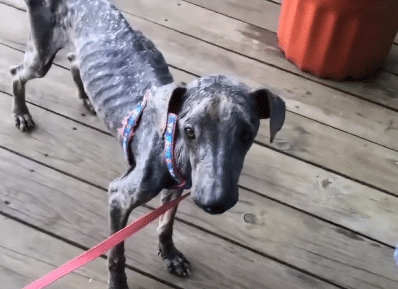
The Dog Beneath the Fear Began to Emerge
As the weeks passed, Runner's recovery became increasingly visible.
The dog who had once looked painfully fragile began gaining healthy weight.
His skin improved.
New fur started growing in areas that had previously been affected.
His body gradually developed the strength needed for more comfortable movement.
The physical difference was substantial.
But his growing confidence revealed something equally important.
Runner was becoming interested in the world around him.
Rather than focusing primarily on keeping his distance from people, he started exploring.
Toys captured his attention.
Affection, once something he had approached with uncertainty, became something he actively welcomed.
And a playful personality began emerging from behind the fear that had shaped his earliest days in care.
It was a side of Runner that the man who found him could hardly have recognized during their first roadside encounter.
Back then, Runner had been using the little energy he possessed simply to keep himself moving.
Now he had enough strength to enjoy movement.
That distinction changed everything.
Walking was no longer just something he struggled to do.
Exploring became enjoyable.
Playing became possible.
Being close to people became a source of comfort rather than something to avoid.
His recovery was not simply restoring what starvation had taken from his body.
It was allowing his personality to emerge.
And Runner was far from finished discovering what life could offer.
From Shaky Steps to Running Across the Sand
One of the most memorable parts of Runner's new life began at the beach.
The contrast with his first appearance was extraordinary.
The dog who had once struggled to move along a dusty roadside could now race freely across open sand.
His legs, previously weakened by malnutrition, carried him with enthusiasm.
Instead of trying to escape an approaching stranger, he ran because running had become enjoyable.
He chased waves along the shore.
He splashed through the water.
He explored the beach with an energy that seemed almost impossible to connect with the fragile dog he had once been.
And then came another unexpected experience.
Runner learned to balance beside his owner on a surfboard.
The image of him enjoying the ocean was particularly meaningful when compared with the dog first discovered during that vacation drive.
At the beginning, his body had been so depleted that even basic movement seemed difficult.
Now he could participate in adventures that required strength, coordination, and confidence.
The beach became one of the clearest expressions of his transformation.
But it was not the only place where his renewed enthusiasm appeared.
Runner also explored forests and experienced snowy surroundings, where he played with other dogs.
Each new environment offered another opportunity to use the strength he had regained.
There was variety in his days now.
There was companionship.
There was room for curiosity.
And there was a level of freedom that had been absent from the life he was living when he was discovered.
The name Runner had taken on a new meaning.
Once, it described a frightened dog attempting to get away from anyone who came close.
Now, it suited an energetic companion who could run toward experiences he enjoyed.
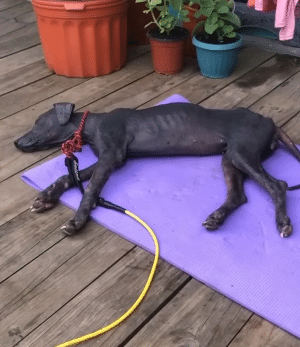
A Second Chance That Changed More Than His Health
Looking at Runner after his recovery, the difference is difficult to overstate.
His body no longer carries the same visible signs of severe malnutrition.
His coat has recovered, his energy has returned, and the fear that once dominated his interactions has gradually given way to confidence.
He has become an affectionate, active dog with a strong interest in the people and surroundings that make up his new life.
The transformation did not happen because of one meal or one visit to a veterinarian.
It came through a longer process.
There was the initial decision to stop beside the road.
There was the patience required to approach an animal who did not understand that help had arrived.
There was veterinary care, careful feeding, treatment for his damaged skin, and the gradual rebuilding of his strength.
And there was the equally important work of helping Runner become comfortable around people again.
Each part mattered.
Without that first roadside encounter, Runner's future would have remained uncertain.
Without ongoing care, the seriousness of his physical condition could not have been adequately addressed.
Without patience, his fear might have continued to limit his ability to enjoy the safety he had been given.
His story shows why rescue involves so much more than removing an animal from immediate danger.
It also means creating the conditions in which recovery can continue.
For Runner, that meant the difference between a life centered on getting through another day and one filled with companionship and discovery.
He No Longer Runs Because He Is Afraid
There is something especially moving about the way Runner's story has come full circle.
When he was first found, running was his instinctive response to uncertainty.
Even when he was dangerously thin, frightened, and exhausted, he tried to move away from human contact.
His body could barely support the effort.
But he kept trying.
Today, Runner still loves to run.
Only now, his movements tell a different story.
He races across beaches, plays with other dogs, enjoys new surroundings, and seeks affection from the people who care for him.
The physical ability to run has become an expression of health and happiness rather than fear.
And perhaps that is the most meaningful part of his journey.
Runner did not simply survive an extremely difficult period.
He recovered enough to enjoy the ordinary pleasures that every loved companion animal deserves.
A comfortable place to rest.
Food that arrives reliably.
People whose presence brings reassurance.
Time to play, explore, and experience the world without the constant pressure of survival.
The man who noticed movement beside the road could not have known exactly what the future would hold for the fragile dog he was approaching.
But choosing to stop gave Runner an opportunity he desperately needed.
And through patient care, that opportunity grew into a completely different life.
Runner still lives up to his name.
The difference is that he is no longer running away from the possibility of being hurt.
He is running freely, with the strength to enjoy every step.
That is what his second chance has made possible.


