
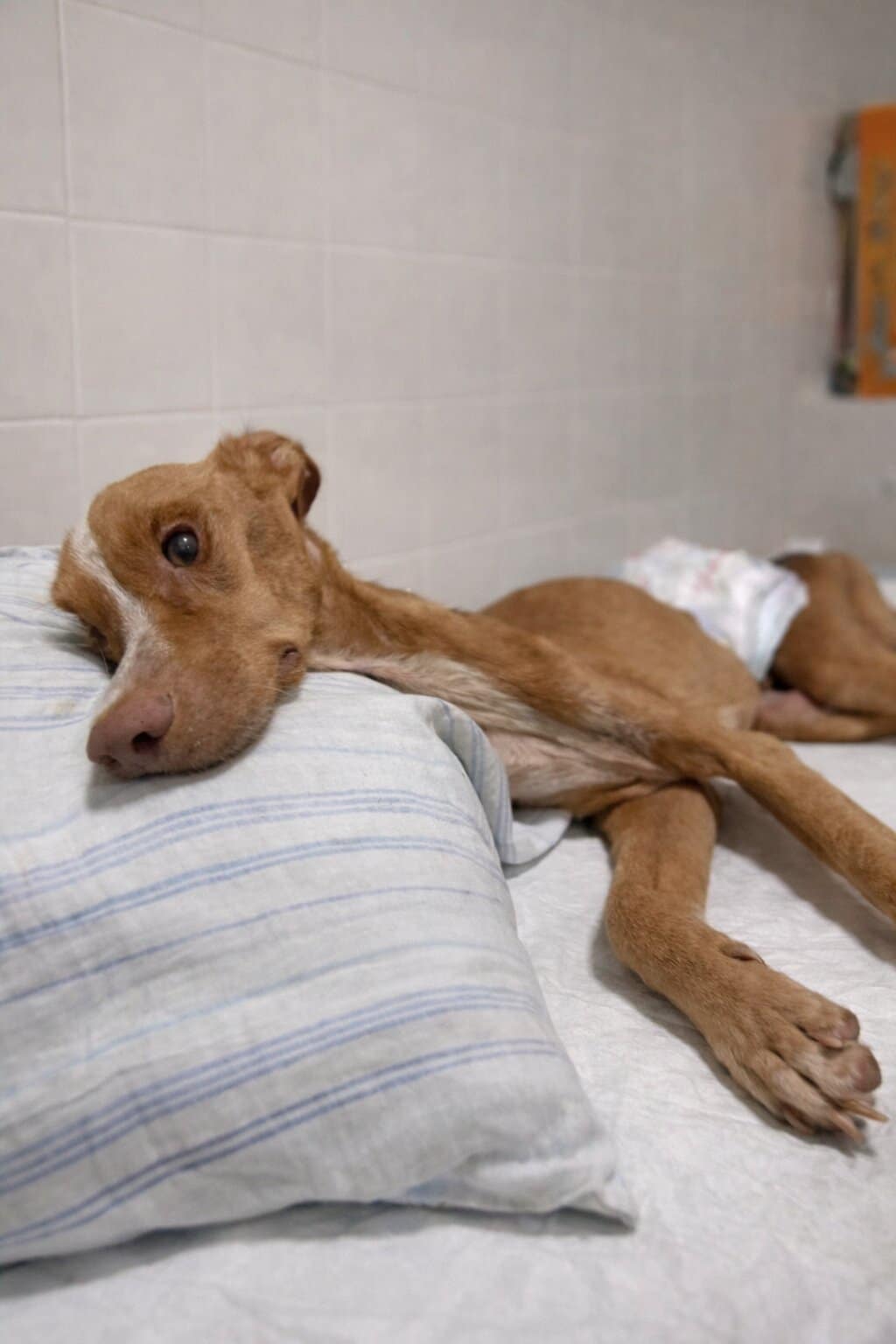
Caramelo was lying near the side of a road when Grazi noticed him.
His small body trembled. His breathing was labored, and the fur covering his thin frame was patchy and dirty. He appeared to have almost no strength left.
There was nothing remarkable about the roadside itself. Yet the sight of this fragile dog made it impossible for Grazi to simply continue on her way.
She stopped.
What she found was an animal in desperate need of help, a dog whose condition suggested that even the simplest movements had become exhausting.
There was no way to know how long Caramelo had been struggling before that encounter.
What mattered was that someone had finally seen him.
And Grazi chose not to leave him behind.
That decision marked the beginning of a recovery that would require far more than a single act of rescue.
Caramelo would need careful feeding, veterinary attention, physical rehabilitation, and an extraordinary amount of patience before he could begin enjoying the ordinary freedoms most dogs take for granted.
At the time, even standing seemed impossibly far away.
The Fragile Dog Who Could Barely Keep Going
When Caramelo reached the veterinary clinic, the severity of his condition became clearer.
He was dangerously underweight.
His ribs were visible beneath his skin, and his body had been weakened to the point that ordinary activities demanded more energy than he seemed able to provide.
Eating was one of the first challenges.
For most healthy dogs, approaching a bowl and taking a meal requires little thought. For Caramelo, even this basic activity was beyond his strength.
He could not feed himself.
Instead, the people caring for him had to provide food gradually, helping him take in what he needed without placing additional strain on his already exhausted body.
There was no dramatic improvement after that first feeding.
No sudden burst of energy.
No immediate return to normal behavior.
There was simply the slow work of supporting an animal whose body needed time to recover.
Caramelo also received fluids to help maintain his condition.
Every part of his care required attention because he had so little strength to spare.
His caregivers watched for the smallest signs of improvement.
A little more movement.
A slightly better response.
The ability to tolerate another careful feeding.
These were not the kinds of achievements that would seem extraordinary in a healthy dog.
For Caramelo, they were meaningful steps toward stability.
The uncertainty surrounding his condition made the early period especially difficult.
Although he had been brought to a place where he could receive help, his recovery was far from guaranteed.
The people caring for him could provide treatment and support.
They could not force his exhausted body to heal faster than it was able.
That would become one of the most important lessons of his journey.
Caramelo needed time.
And this time, he had people willing to give it to him.
When His Weakness Revealed a Deeper Problem
As the initial care continued, it became apparent that Caramelo's difficulties extended beyond being severely underweight.
He was suffering from a serious illness that had affected his physical functioning.
The source does not identify the illness by name, but its consequences were unmistakable.
His body trembled.
His movements were limited.
And at one stage, he lost the ability to use his legs.
For a dog that had already struggled to eat and breathe comfortably, this was another major obstacle.
Caramelo could no longer stand or support himself normally.
Moving from one position to another became a challenge.
The simple possibility of walking seemed increasingly distant.
But his caregivers continued working with him.
The focus was no longer only on keeping him nourished and stable. It was also on helping his weakened body gradually regain the ability to move.
His care included gentle exercises and physical therapy.
Nothing about the process could be rushed.
The goal was not to demand movements his body could not yet perform.
It was to support him while he slowly recovered the strength and coordination he had lost.
For Caramelo, that meant beginning with the smallest possible efforts.
Before there could be walking, there would have to be movement.
Before movement could become steady, there would have to be strength.
And before any of those things could happen, he needed to remain supported through the difficult days when progress was barely visible.
VIDEO: He Was Too Weak to Eat or Stand — Watch Caramelo's Remarkable Journey Toward Recovery
The Smallest Movements Became His Greatest Achievements
Recovery rarely follows a perfect schedule.
Caramelo's experience was a reminder of how uneven the process can be, especially when an animal has been severely weakened by illness.
For a while, the improvements were so modest that someone unfamiliar with his condition might not have recognized their importance.
Then came a significant change.
Caramelo began moving his tongue again.
It was a small physical action, but it opened the door to something he had been unable to do earlier.
He started eating on his own.
For the people who had been helping him take every meal, this was an important milestone.
Food was no longer something that always had to be delivered to him by hand.
He was beginning to participate in his own recovery.
That moment did not mean all his difficulties had disappeared.
His legs were still weak.
His ability to move remained limited.
But it showed that his body was responding.
And that mattered.
A few days later, another improvement followed.
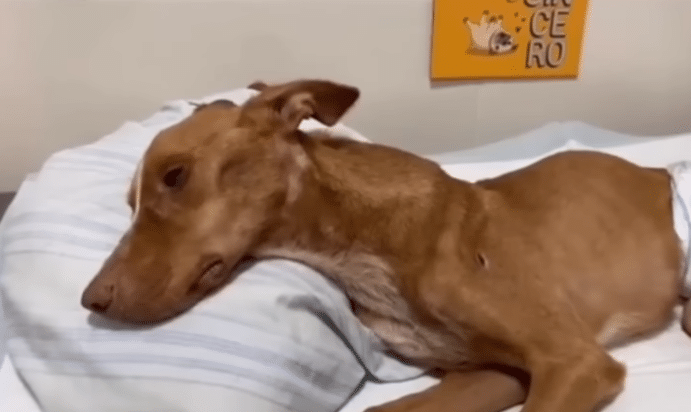
Caramelo managed to sit upright.
Not with the ease of a healthy, energetic dog, but with enough control to demonstrate that some of his lost strength was returning.
Sitting may seem insignificant compared with walking or running.
Yet for a dog who had been unable to support himself, it represented an important change.
It meant he was beginning to hold his own body in a position that had previously been beyond his ability.
Then came an even gentler sign of progress.
His tail began to wag.
A small movement.
A familiar expression of canine responsiveness.
For those following his recovery, it offered something that medical care alone could not fully capture: a glimpse of the lively dog who might emerge once his body became stronger.
Caramelo was not simply surviving another day.
He was beginning to respond to the world around him.
Learning to Trust His Legs Again
As the weeks continued, Caramelo's rehabilitation remained a gradual process.
His physical therapy and gentle exercises helped support his return to movement.
There were no shortcuts.
A dog who has lost the ability to use his legs cannot be expected to recover normal mobility through determination alone.
His body needed the opportunity to rebuild its strength.
For Caramelo, the process required steady care, continued encouragement, and movements suited to what he could manage.
Alongside the work of rehabilitation, other changes were becoming visible.
His eyes appeared brighter.
The exhausted look that had marked his early days began to fade.
He showed more energy.
His coat, once patchy and dirty, gradually became fuller and healthier.
These changes were meaningful because they reflected how different his condition had become since his arrival at the clinic.
The frail dog found beside the road had needed assistance with almost every basic activity.
Now, little by little, his body was becoming capable of more.
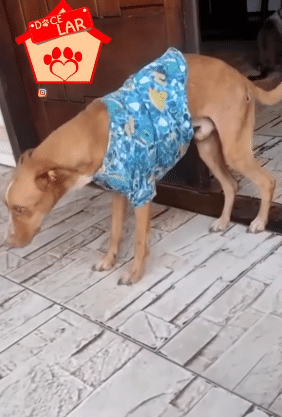
During his recovery, Caramelo also began wearing small clothes to help keep him warm.
It was a simple comfort, but one that belonged to a very different stage of his life.
He was no longer just the struggling figure Grazi had discovered.
He was a dog receiving consistent care as he regained his health.
Still, one important challenge remained.
Standing.
The ability to rise onto his legs would be essential before he could move independently again.
At first, Caramelo could manage it only briefly.
A few seconds of supporting his own weight represented a genuine achievement.
He was not yet ready to walk confidently.
His legs remained unsteady, and his movements were limited.
But those early attempts mattered because they marked the transition from being unable to stand at all to beginning to support himself.
Gradually, those moments of balance became the foundation for something more.
Caramelo started learning to walk again.
His first steps were uncertain.
The distances were short.
His movement lacked the confidence and coordination that healthy dogs usually display without effort.
But he was moving on his own legs.
Each step represented progress from a condition that had once left him almost completely dependent on assistance.
And those steps began to add up.
The Dog Beneath the Illness Began to Emerge
As weeks became months, the changes in Caramelo were no longer limited to his physical condition.
His behavior began to reflect his growing strength.
The dog who had once appeared exhausted by nearly every movement started showing curiosity about his surroundings.
He became more interested in what was happening around him.
He greeted people with increasing energy and enthusiasm.
These were natural behaviors for a dog, but they carried special meaning in Caramelo's case.
During the earliest stage of his recovery, so much of his energy had been devoted to simply getting through the day.
Eating required help.
Movement was difficult.
Standing was impossible for a period.
There had been little opportunity for the ordinary excitement of exploring and interacting with others.
As his strength returned, those experiences became part of his life again.
His growing confidence was especially noticeable.
Instead of appearing overwhelmed by physical weakness, he began responding to his surroundings with interest.
His eyes were brighter.
His coat looked healthier.
His movements became more capable.
And the dog who had once been unable to sit or stand was gradually discovering what he could do with his recovered strength.
It was not a transformation achieved in a single dramatic moment.
It came through many small improvements.
The first independent meal.
The ability to sit.
The movement of his tail.
The first seconds standing.
The first uncertain steps.
Together, those milestones formed the story of a dog slowly reclaiming his mobility.
For Grazi and those involved in his care, Caramelo's progress showed the value of remaining committed even when recovery was slow.
Their efforts did not erase the serious condition in which he had been found.
But they helped make a different future possible.
The Moment He Could Finally Run Freely
One of the most meaningful moments in Caramelo's journey came when he was able to spend time outside on the grass.
Sunlight reached the ground around him.
There was room to move.
And unlike the fragile dog who had once lain beside the road struggling to breathe, Caramelo now had the strength to explore.
At first, he paused.
Then he began moving across the open space.
The change was extraordinary when compared with his early condition.
This was the same dog who had once been unable to eat without assistance.
The same dog whose illness had left him unable to use his legs.
The same dog who had needed weeks of careful support before he could begin standing and walking again.
Now, he could run.
His tail was raised, and his movements showed the confidence that had developed during his recovery.
The grass beneath his paws offered a simple pleasure that had once seemed out of reach.
He was no longer limited to the tiny efforts that had defined his early rehabilitation.
He could move through the world with freedom.
For anyone who had witnessed the beginning of his journey, that contrast was powerful.
Caramelo had not been rescued and immediately returned to health.
His progress had required repeated care and a willingness to accept that even the smallest improvement was worthwhile.
Running on the grass was the visible result of all those earlier steps.
It was a moment that made the long process of recovery easier to understand.
Every assisted meal had mattered.
Every gentle exercise had mattered.
Every attempt to sit or stand had mattered.
The ordinary sight of a dog running outdoors had become something deeply meaningful.
One Person's Decision Made Room for a Different Life
Caramelo's story began with a difficult sight.
A thin, trembling dog lay beside a road, barely able to breathe comfortably.
He had no strength to feed himself.
Later, his illness would leave him unable to use his legs.
His recovery demanded sustained attention through periods when improvement came slowly.
Yet the story did not end with those limitations.
It continued because Grazi stopped to help, and because the care that followed gave Caramelo the opportunity to heal at his own pace.
There is an important difference between rescuing an animal from immediate danger and helping that animal recover.
The first may begin with a single decision.
The second often requires patience that extends far beyond the moment of rescue.
For Caramelo, that patience became essential.
His caregivers did not have the certainty of knowing how quickly he would improve.
They could only continue meeting his needs and responding to the progress his body made.
Slowly, the changes became undeniable.
He could eat independently.
He could sit.
He could stand.
He could walk.
And eventually, he could run.
There is no need to describe his recovery as an instant miracle.
Its meaning is found in the ordinary actions that gradually became possible again.
A meal eaten without assistance.
A tail wag.
A few uncertain steps.
A run across the grass.
These simple experiences are part of everyday life for countless dogs.
For Caramelo, each one represented something regained.
His journey also reminds us why animals with serious illnesses or difficult rehabilitation needs should not be judged only by how they appear at their weakest.
Their condition may demand considerable care, and outcomes cannot always be predicted.
But when treatment, patience, and appropriate support are available, meaningful recovery can sometimes follow.
Caramelo's confirmed progress offers a moving example of that possibility.
The story began with a dog who could barely continue.
It ended with a dog able to enjoy movement, curiosity, and the freedom of being outdoors.
And between those two moments was the decision that made everything else possible.
Grazi saw him.
She stayed.
And Caramelo was given the chance not only to survive, but to experience life again.


