
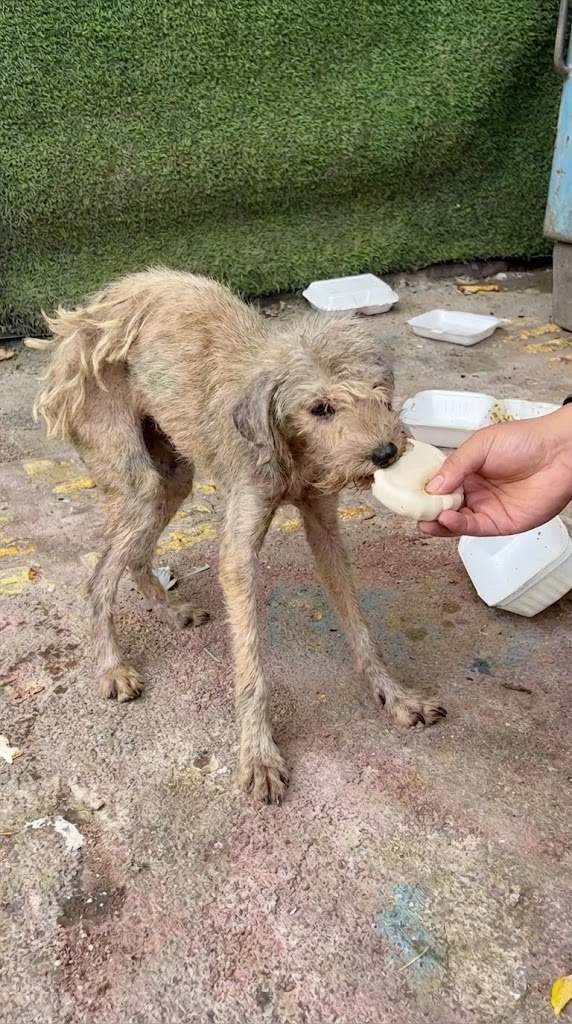
Near the edge of a road, a small, fragile figure lay curled up, almost blending into the surroundings.
At first glance, it was difficult to recognize him as a dog.
His body had become so thin that his ribs and other bones were clearly visible beneath his neglected coat. His legs trembled when he tried to stand, and even the simplest movement appeared to demand more strength than he had left.
Yet when someone noticed him, he did not flee.
He raised his head and looked toward the person approaching.
There was something unusually gentle about that moment. Here was a dog who had clearly endured a prolonged period without enough food, yet he still appeared willing to accept attention from a human being.
He had no known name, no clear history, and no way to explain how he had ended up in such a condition.
But he was alive.
And that meant there was still an opportunity to help him.
A Fragile Life Almost Overlooked Beside the Road
The dog's physical condition told the most immediate part of his story.
His frame was extremely narrow. His coat hung loosely over his body, offering little concealment for the prominent bones underneath. The familiar outline of a healthy dog had nearly disappeared beneath the effects of severe weight loss.
Even his breed was difficult to identify.
There was another detail that made his appearance especially unusual.
He had no tail.
The source of that loss remained unknown. There was no information about whether it resulted from an accident, an earlier injury, or some other event in his past.
It was simply another unanswered question about a dog whose history had been lost.
But the most urgent concern was not what had happened before.
It was what would happen next.
His legs struggled to support him. He appeared exhausted, and his body offered little evidence that he had been receiving adequate nourishment.
Still, he remained remarkably calm around the people who approached.
He did not attempt to hide or run away. Instead, he looked toward them with an expression that seemed almost searching.
Perhaps he had once been accustomed to human company. Perhaps he had learned to approach people in search of food.
No one could know for certain.
What was clear was that he needed immediate care, and that the people who found him were willing to provide it.
The First Meal Was More Than a Bowl of Food
The first turning point came when food was placed in front of him.
For a dog in such a weakened condition, even eating was not an effortless task.
At first, he approached the food hesitantly.
He took small bites, pausing between them, as though his body needed time to respond to the unfamiliar opportunity.
Then his behavior began to change.
He ate more eagerly.
The small buns offered to him disappeared one after another as his appetite became increasingly apparent.
It was a striking contrast.
Only moments earlier, he had appeared barely capable of supporting his own weight. Now, with food directly in front of him, he showed a determination that had not been obvious when he was lying beside the road.
The people helping him could finally see just how hungry he was.
His eagerness did not reveal exactly how long he had gone without adequate meals. That part of his history remained unknown.
But it made the seriousness of his condition impossible to overlook.
A simple meal had become an important moment in his rescue.
For the first time since he was found, hunger was being answered with care rather than uncertainty.
And this was only the beginning.
VIDEO: Too Weak to Stand, He Finally Receives the Food He Desperately Needed
Watching him eat reveals something that photographs of his thin body alone cannot fully express.
Despite his weakness, he still had an appetite.
He still responded to nourishment.
He still had the instinct to keep going.
Food could not instantly restore the strength he had lost. His physical recovery would require much more than one meal.
But that first feeding marked a meaningful change in his circumstances.
He was no longer searching for whatever he might find beside the road.
Someone had noticed him.
Someone had given him food.
And someone was prepared to continue caring for him after the meal was finished.
A Safe Place, but a Body That Needed Careful Attention
After being brought home, the dog entered a different stage of his rescue.
The immediate danger of being left alone beside the road had passed. However, his weakened condition still raised serious concerns.
Tests were conducted to check for dangerous viruses and infections.
The reported results were reassuring.
No dangerous viral illness or life-threatening infection was detected.
This was welcome news, but it did not mean he was already healthy.
His body remained severely depleted.
The lack of adequate nourishment had left him without the physical reserves needed for ordinary activity. Even with food now available, rebuilding his condition would take patience.
Recovery could not be measured by how eagerly he had eaten his first meal.
He needed consistent nutrition and careful attention.
The people caring for him began providing warm milk mixed with nutritional supplements.
Yet another difficulty appeared.
He did not immediately seem to understand what to do with the milk.
For many dogs, drinking is a simple, familiar activity. For this severely weakened animal, even that ordinary task required time and encouragement.
It was a quiet reminder of how far his condition had deteriorated.
He was not simply a little underweight.
He was a dog whose most basic physical needs had gone unmet for so long that ordinary nourishment had become part of a gradual process of rebuilding.
There would be no instant transformation.
A full stomach did not immediately produce stronger legs.
A safe place did not erase the visible effects of prolonged deprivation.
But each step of care addressed something he had been missing.
Nutrition replaced the uncertainty of finding food.
Attention replaced being overlooked.
And instead of facing his weakness alone, he now had people looking after him.
Beneath His Tangled Fur, the Full Extent of His Weakness Became Clear
As the dog received care, another problem needed attention.
His coat was heavily tangled and neglected.
The thick, matted fur had become part of his appearance, hiding some of the true condition of the body beneath it.
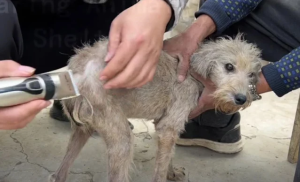
Eventually, the decision was made to remove the coat.
His fur was shaved completely.
Without it, the effects of his prolonged undernourishment became even more apparent.
He looked smaller than before.
His narrow frame was fully visible, and there was little left to soften the outline of his bones.
The transformation was not yet the cheerful before-and-after picture often associated with animal rescue.
Instead, it revealed just how much rebuilding lay ahead.
The shaving was an important part of his early care, but it could not solve the underlying problem.
His body still needed nourishment.
His muscles still needed time to regain strength.
And the people helping him had to recognize that his recovery would be gradual.
There was something especially moving about seeing him without the tangled coat.
The fur had been a visible sign of how neglected his condition had become. Removing it allowed his caregivers to begin addressing his cleanliness and comfort more directly.
Yet he remained the same quiet dog who had looked up at someone from the roadside.
His outward appearance was changing.
His gentle behavior remained.
The First Bath Required a Different Kind of Trust
After his coat was removed, it was time for another unfamiliar experience.
A bath.
To a healthy dog accustomed to regular care, washing might be an ordinary part of life.
For this dog, the experience was clearly unsettling.
As water touched his body, he trembled.
He appeared uncertain about what was happening, and his fragile frame made the moment particularly delicate.
But he did not struggle against the people bathing him.
He remained still.
His quietness did not necessarily mean that he understood everything being done for him. His weakness and uncertainty were still important parts of the situation.
What mattered was that he was being handled with care.
The bath was not a cure for his extreme weight loss, but it represented another important change.
The dirt and neglect that had covered him were being washed away.
For once, human attention meant that his needs were being met.
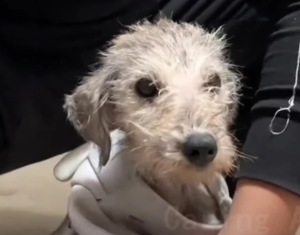
His appearance after the bath offered a clearer picture of the dog beneath the matted fur.
He was clean.
He was still very thin.
And there was no reason to pretend that the difficult part of his recovery was already over.
Yet the difference in his circumstances was significant.
Before, he had been lying near a road, struggling with weakness and hunger.
Now, he was in a place where he could receive food, cleaning, and continued care.
These may sound like small things.
But for an animal that had been living without reliable nourishment or comfort, they represented the foundation of a safer life.
Healing Could Not Happen All at Once
One of the most important parts of this rescue is understanding what had not yet changed.
The dog had not suddenly regained a healthy weight.
His strength had not returned overnight.
His missing tail remained an unexplained part of his history.
And there was still no complete account of how he had come to be abandoned or alone beside the road.
Those uncertainties did not disappear just because he had been rescued.
What changed was the support available to him.
He now had people responsible for providing his meals and monitoring his condition.
He no longer had to depend entirely on finding food outside.
His severe thinness remained a concern, but it was being addressed through ongoing care rather than left to worsen without help.
Recovery from such a weakened state is not simply about appearance.
A dog needs sufficient nourishment and physical strength to perform ordinary activities comfortably. Standing, walking, eating, and responding to his surroundings are all parts of daily life that can become difficult when the body is severely depleted.
For this particular dog, those difficulties had been visible from the beginning.
His shaking legs had shown how challenging standing could be.
His hesitant first bites had shown how much effort even feeding might require.
His trembling during the bath had shown that care could still be unfamiliar and unsettling.
None of these moments needed to be dramatic to matter.
They were reminders that rescue involves more than removing an animal from danger.
It also involves recognizing what that animal can manage and responding with patience.
The people caring for him could not undo his past.
But they could make his present more secure.
And with every ordinary act of care, they gave him something he had been missing: consistency.
No Longer Just a Dog by the Roadside
By the latest update in his story, the dog was clean, safe, and receiving care.
He still needed to gain weight and rebuild his strength.
His physical transformation was far from complete.
But there was already a visible difference in the life surrounding him.
The dog who had once struggled to stand near the edge of a road no longer had to search desperately for scraps.
He could receive meals from people looking after him.
His body remained fragile, yet his circumstances had become more hopeful.
The change in his eyes was especially meaningful to those following his rescue.
The same dog who had looked toward a stranger from the roadside now appeared brighter and more at ease.
It was not proof that every effect of his earlier hardship had disappeared.
It was simply a sign that his experience of the world was beginning to change.
Food was no longer something he had to find by chance.
Care was no longer absent.
And the people around him were giving him an opportunity to recover without facing the process alone.
There is still much about his life that remains unknown.
No one has explained why he was so severely underweight, how he lost his tail, or how long he had been surviving in that condition.
His story does not need invented answers to those questions.
The details that are known are meaningful enough.
A dog was found in desperate need of nourishment.
Someone chose to help.
He was fed, brought somewhere safe, checked for illness, and given the care needed to begin rebuilding his health.
That is the change at the heart of his rescue.
Not a sudden cure.
Not a perfect ending.
Just the opportunity to live without being overlooked.
And for a dog who had been so weak that standing was a struggle, that opportunity means everything.
His road to recovery is still ahead of him.
But now, he does not have to face it alone.


