
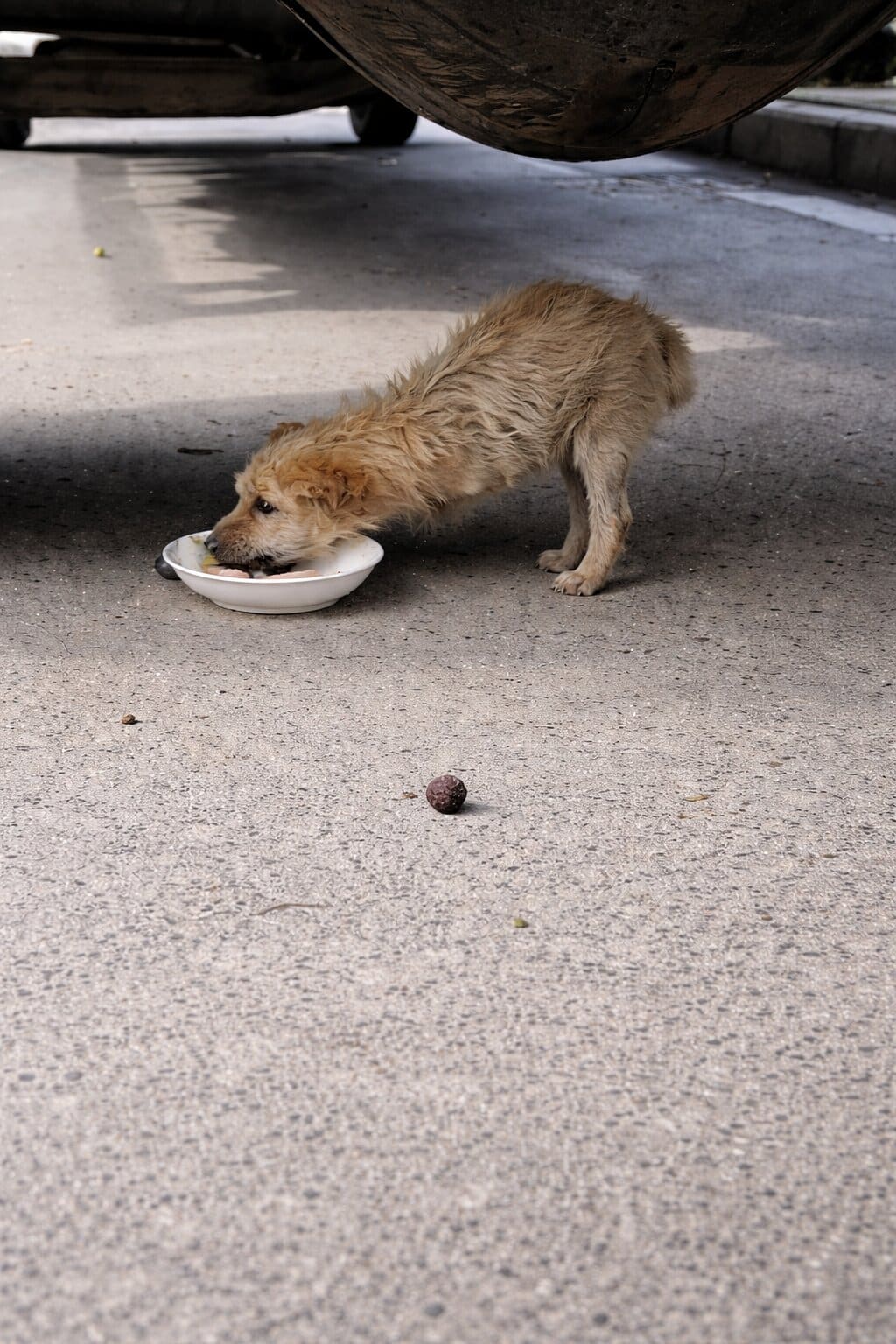
The first images of DJ were difficult to forget.
A small dog was tied to a tree, his thin body trembling as he tried to move across the ground. His front legs pulled him forward, but his hind legs did not respond. After only a short effort, he would collapse again.
He could barely move.
And with a rope keeping him beside the tree, there was little chance that he could reach safety on his own.
For one rescuer who saw the video, watching from a distance was not enough. Reaching the dog meant traveling nearly 500 kilometers, but the journey began anyway.
DJ had no idea that someone was already coming for him.
A Long Journey to Reach One Small Dog
When help finally arrived, DJ was still weak and frightened.
The rope was carefully removed from the tree. He trembled as rescuers approached, seemingly unsure what these unfamiliar people intended to do.
His body offered few options for escape. His back legs could not support him, and even ordinary movement required enormous effort.
Yet when he was gently lifted, DJ did not fight.
That quiet moment became the beginning of a completely different life.
He was carried away from the place where he had been left and taken to veterinary care, where the immediate priorities were simple: fluids, proper food, warmth, rest, and a safe environment.
For a dog whose world had recently been reduced to the ground around one tree, those basic comforts mattered.
But his inability to walk remained a serious concern.
Veterinarians needed to understand what was happening inside his body before anyone could know how much recovery might be possible.
Tests Began to Explain Why DJ Could Not Walk
Over the following days, DJ underwent important examinations, including MRI and CT scans.
The findings suggested that he had likely experienced canine distemper in the past. According to the source, the viral illness appeared to have left neurological complications that affected his movement.
DJ frequently trembled. He had poor control over parts of his body, and paralysis affected his hind legs.
There was another challenge as well.
One of his front legs had a congenital deformity, meaning that even the limbs he could still use normally were not working under ideal conditions.
His future mobility was uncertain.
But now, for the first time in this journey, he had people prepared to help him work toward it.
VIDEO: Tied to a Tree and Unable to Walk, DJ’s Fight for a Second Chance Began
Trust Had to Come Before Progress
Physical treatment was only one part of DJ's recovery.
At first, he remained cautious around people. After everything he had experienced, closeness did not immediately feel comfortable.
So his caregivers did not rush him.
There were regular meals.
Gentle voices.
Patient hands.
A safe place where no one expected him to understand everything immediately.
Gradually, DJ began responding to that consistency.
The frightened little dog who had once trembled beneath a tree started allowing people closer. Familiar faces became less threatening. Care became part of his routine.
Then, only a few days after his rescue, the next stage began.
Rehabilitation.
DJ could not simply be encouraged to stand and walk. His hind legs still could not properly support him, and his front-leg deformity added another difficulty.
The rescue team needed to give him a different way to move.
They introduced a small wheelchair that supported the back of his body. Early on, they even used a tiny cart originally intended for a cat.
For DJ, however, having wheels did not instantly create freedom.
He still had to learn what to do with them.
Falling Was Part of Learning
The first attempts were awkward.
DJ would lose his balance.
He would stumble.
Sometimes he simply stopped, apparently uncertain about how to coordinate his body with the unfamiliar support behind him.
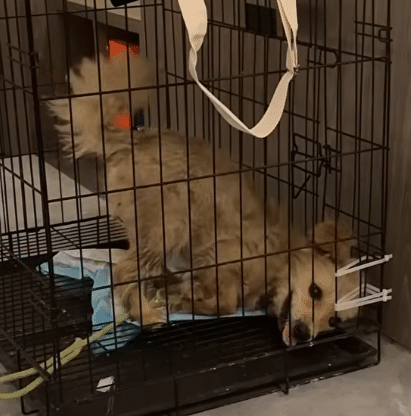
But the wheelchair gave him something he had not had before: the possibility of moving farther under his own power.
So the attempts continued.
Again and again, caregivers worked patiently beside him.
DJ received physical rehabilitation intended to stimulate and support his muscles. According to the source, his routine included infrared therapy, daily exercises, and supportive herbal treatments.
There was no sudden transformation.
Progress appeared in small pieces.
His appetite improved.
His body slowly gained weight.
His coat became fuller.
More energy returned.
Those changes mattered, but something else was becoming equally noticeable.
DJ was beginning to enjoy life around him.
He became more playful and increasingly comfortable with the people who cared for him. The fear that had defined his earliest days was no longer the only thing visible in his behavior.
And during his rehabilitation, DJ gained companionship from animals facing challenges of their own.
One of them was a dog named Tie Niu.
The two shared space and daily routines, and Tie Niu became DJ's closest canine friend.
DJ's recovery was still demanding, but he was no longer going through it alone.
Wheels Became a Path to Freedom
Days became weeks.
Weeks became months.
By around Day 70, the difference in DJ was becoming much easier to see.
The dog who had once struggled to drag himself a short distance could now move confidently in his wheelchair.
Instead of treating the device as something unfamiliar, he had learned how to use it as an extension of his body.
He could explore.
He could pick up speed.
He could follow the world instead of watching it from one spot.
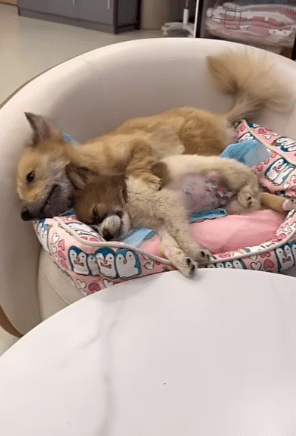
Around Day 82, that movement looked increasingly joyful.
DJ began running with his wheelchair, showing an energy that seemed almost impossible to connect with the trembling dog first seen tied beside the tree.
The wheelchair had not erased his physical limitations.
It had given him a way to live beyond them while his rehabilitation continued.
And the people caring for him continued working toward something more.
They wanted to see whether his own legs might eventually respond.
There were no guarantees.
So they kept doing the patient work.
Exercises.
Support.
Practice.
Another attempt.
Another day.
Then DJ Began Using His Own Legs
By approximately Day 180, something the rescue team had spent months working toward finally began to happen.
DJ started using his legs again.
The first movements were not fast or effortless.
His steps were careful.
His balance still required concentration.
But he was moving on his own legs rather than depending entirely on the wheelchair.
For everyone who had followed his journey from the beginning, the contrast was remarkable.
Months earlier, DJ had been tied to a tree with hind legs that would not carry him.
Now those legs were helping him move forward.
The progress had not come from one dramatic moment.
It had been built through hundreds of much smaller ones.
Every rehabilitation session.
Every fall followed by another attempt.
Every meal that helped restore his strength.
Every day of learning that the people around him were there to care for him rather than frighten him.
DJ had needed time.
Fortunately, someone had been willing to give it to him.
The Dog Beneath the Tree Was No Longer Trapped
Today, DJ lives in a safe environment surrounded by people and animals who care for him.
His life is far removed from the first video that brought attention to his situation.
He is described as happy, energetic, curious, and eager to engage with the world around him.
His story is powerful not because recovery happened quickly.
It did not.
DJ's progress took months of rehabilitation, repeated attempts, medical attention, supportive equipment, and patient care.
There were physical challenges that could not simply be wished away.
But once DJ was given safety and support, he kept participating in his own recovery.
First he learned to trust.
Then he learned to move with wheels.
Eventually, he began finding his own steps again.
The distance between those moments was enormous.
So was the distance traveled by the person who decided that a dog seen struggling in a video was worth driving nearly 500 kilometers to save.
DJ could not free himself from that tree.
Someone had to reach him first.
After that, he showed just how much determination could still remain inside a body that had been through so much.
A rope once limited his world to a few feet of ground.
Now DJ can move toward whatever catches his curiosity.
For him, that may be the clearest meaning of a second chance:
not simply being rescued, but finally being given the freedom to keep moving forward.


