
Some forms of abandonment happen so quietly that almost no one knows an animal is suffering.
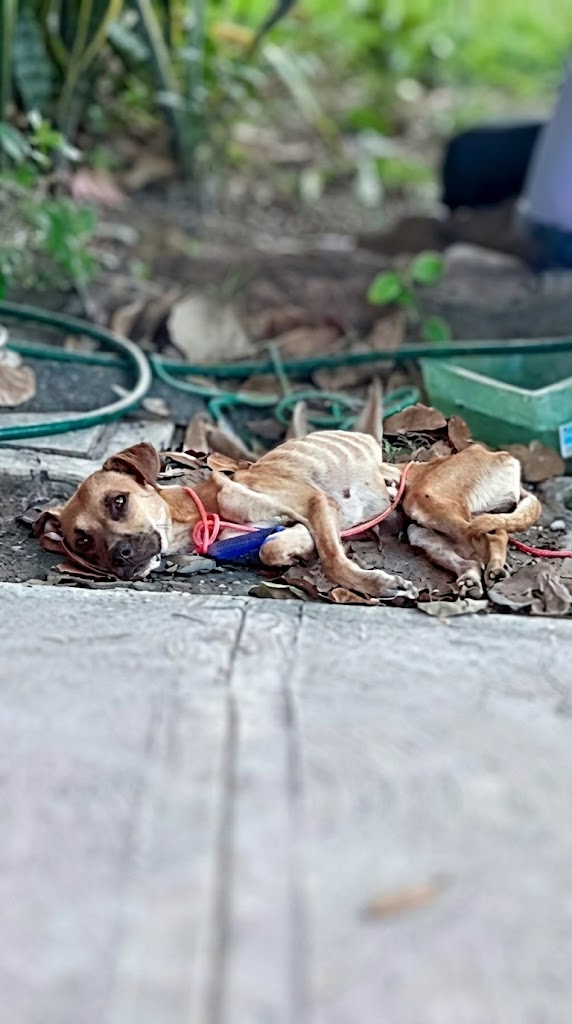
Eva was found tied to a tree, far enough from the road that she could easily have remained unnoticed. She was sick, weak, and had been left there without the treatment her condition clearly required.
There was no dramatic rescue scene waiting to unfold.
Only a dog whose body had reached the point where it could barely keep going.
When Her Legs Would No Longer Hold Her
By the time Eva was discovered, dehydration and weakness had taken a serious toll.
Her body was thin. Her energy was almost gone. Even responding to the people around her seemed difficult.
Most alarming of all, Eva could not stand.
She could not walk.
At first, there was no simple explanation for why.
There were no obvious broken bones or visible injuries that immediately accounted for the loss of strength in her legs. From the outside, the cause remained hidden.
What was clear was that Eva needed more than food, water, and rest.
Something deeper was affecting her ability to move.
The dog who had already been left without help now needed people willing to keep searching for an answer.
That search eventually revealed how serious her condition truly was.
The Injury Hidden Inside Her Spine
Veterinary examinations continued until an MRI provided the information that could not be seen from the outside.
Eva had damage to her spinal cord.
According to the source, the area was inflamed and two vertebrae had been affected. Veterinarians believed the damage was consistent with blunt-force trauma, possibly from a car accident.
Whatever had happened before she was found, the result was severe enough to explain why her legs could no longer support her.
It also meant there would be no simple path back.
Eva's condition required careful management and a long period of rehabilitation.
For the people caring for her, the goal became less about finding an instant solution and more about giving her body every reasonable opportunity to recover.
And for Eva, that meant beginning again with movements most dogs never have to think about.
VIDEO: Eva Was Found Unable to Stand — Then Her Long Fight to Walk Again Began
Recovery Became a Daily Commitment
Surgery was not considered an option for Eva.
There would be no single procedure that suddenly restored her mobility.
Instead, her days became centered on rehabilitation.
Her care included gentle massage, electrical stimulation, pain management, and repeated physical work designed to encourage her body to regain strength.
Progress was not immediate.
Eva would attempt to push herself upward.
Sometimes she managed to rise only briefly before losing her balance again.
Then she would try once more.
Those early efforts did not look dramatic. There were no sudden transformations or overnight breakthroughs.
There was simply repetition.
Movement.
Rest.
Another attempt.
For a dog who had once been left without treatment, having people continue to work with her day after day became one of the most important changes in her life.
The outcome was still uncertain, but Eva was no longer facing that uncertainty alone.
Small Changes Began to Matter
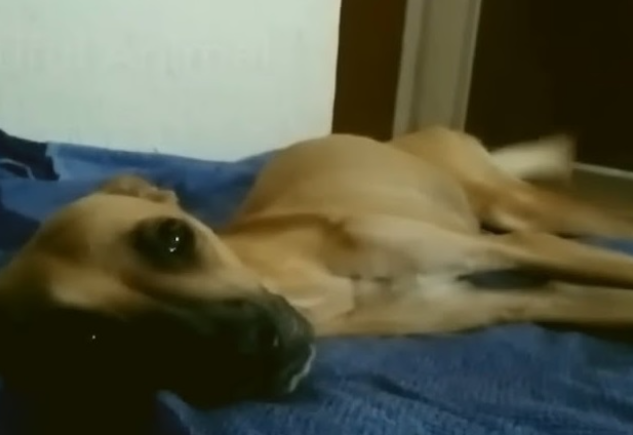
As her rehabilitation continued, Eva received plasma therapy once a week.
The treatment did not produce an instant recovery, but over time her condition began to change.
Her discomfort appeared to ease.
Her body became more capable of responding to the exercises.
Then came a moment everyone caring for her had been hoping to see.
Eva took several steps.
They were not smooth.
They were not strong.
And they did not carry her very far.
But Eva had moved under her own power.
After so many attempts to rise only to fall again, those few steps represented something much larger than distance.
They showed that her body was beginning to respond.
Her back legs gradually gained strength, at one stage appearing stronger than her front legs. Her movement remained imperfect, but perfection was never the standard.
Every bit of control mattered.
Every extra step mattered.
Each sign of improvement gave the rehabilitation team another reason to continue.
Eva had spent enough of her life without someone investing time in her.
Now, patience became part of her treatment.
In the Water, Movement Felt Different
One part of Eva's recovery seemed to bring her particular comfort: being in the water.
There, her body was supported in a way it could not be on solid ground.
The pressure of standing was reduced.
Movement became easier.
Instead of fighting gravity with every attempt, Eva could exercise with greater freedom.
Water gave her a place to practice what her injured body was slowly relearning.
For a dog whose life had reportedly been defined by restraint since she was young, that freedom of movement carried special meaning.
She could move forward.
She could use her legs.
She could explore what her recovering body was still capable of doing.
Her rehabilitation remained gradual, but the difference between the Eva who arrived unable to stand and the Eva now moving through the water was impossible to ignore.
The progress had not come from one extraordinary moment.
It had come from many ordinary ones repeated consistently.
Another massage.
Another therapy session.
Another attempt to stand.
Another step.
Another day of not giving up on her.
The Freedom She Had Never Known
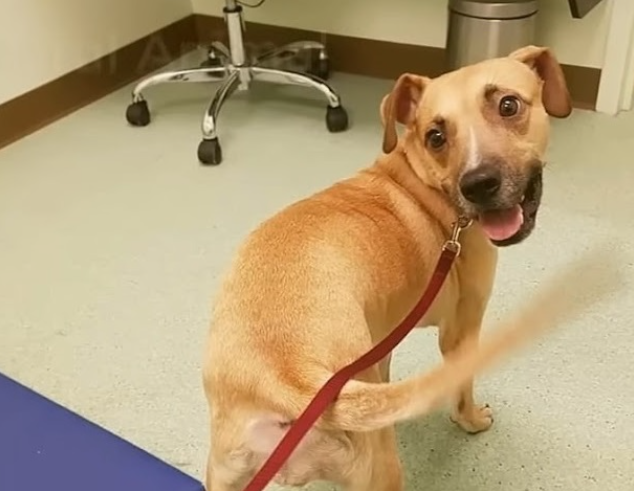
Eventually, Eva became strong enough to leave the hospital.
She could walk for longer distances than before.
She began exploring the world around her.
Her expression also seemed to change as her life expanded beyond treatment and survival.
But one detail about her past made those new experiences especially significant.
According to the source, Eva had been chained since she was a puppy.
Freedom was not something she had simply lost after an injury.
It was something she had barely experienced at all.
That made every new opportunity different.
Walking farther was not merely physical rehabilitation.
Exploring was not simply exercise.
Swimming was more than therapy.
These were experiences that had been missing from her life for years.
Her recovery could not erase what had happened before she was found.
It could, however, change what came next.
And Eva's next chapter would take her far from the place where she had once been tied and forgotten.
A Family Waiting in Canada
Eva was eventually adopted.
Her new home was in Canada, where she joined a family prepared to continue the work that had helped her regain so much mobility.
They gave her room to explore and a larger pool where she could continue enjoying the water.
Her rehabilitation did not suddenly stop because she had found a home.
Her family continued helping her exercise and build strength, giving her the consistency she still needed.
For Eva, adoption meant something more fundamental as well.
There was now a place where she belonged.
A place where care was expected rather than uncertain.
A place where her physical limitations did not make her disposable.
The dog who had once been tied to a tree now had people planning their days around helping her become stronger.
That contrast is what gives Eva's journey its emotional weight.
Her life did not change because one dramatic act erased everything that came before.
It changed through a series of choices.
Someone found her.
Someone sought answers when she could not walk.
Veterinary professionals identified the spinal damage.
People committed themselves to her rehabilitation.
And eventually, a family chose to continue caring for her.
Each decision moved her farther from the life she had known.
What Eva Slowly Took Back
Eva's story is not one of instant transformation.
Her spinal injury was serious.
Her rehabilitation demanded time.
She fell while learning to stand.
Her first steps were uncertain.
Progress arrived slowly enough that it could easily have been overlooked by anyone expecting a dramatic recovery.
But those small gains accumulated.
A dog who could not stand began taking steps.
A dog whose movement was severely limited became stronger.
A dog who had reportedly spent her life chained discovered the sensation of moving freely through water.
And a dog once abandoned because she was sick eventually found a home where her continued care mattered.
There is something important in that kind of rescue.
Saving an animal is not always a single moment of lifting her from danger.
Sometimes rescue continues long after the first day.
It happens during the difficult therapy session.
During the failed attempt to stand.
During the next attempt.
During the weeks when improvement is measured in inches rather than miles.
Eva was not given her old life back.
Instead, she was given the opportunity to experience a different one.
One with movement.
One with care.
One with water to swim in and space to explore.
And, finally, one in which being vulnerable no longer meant being left behind.


