
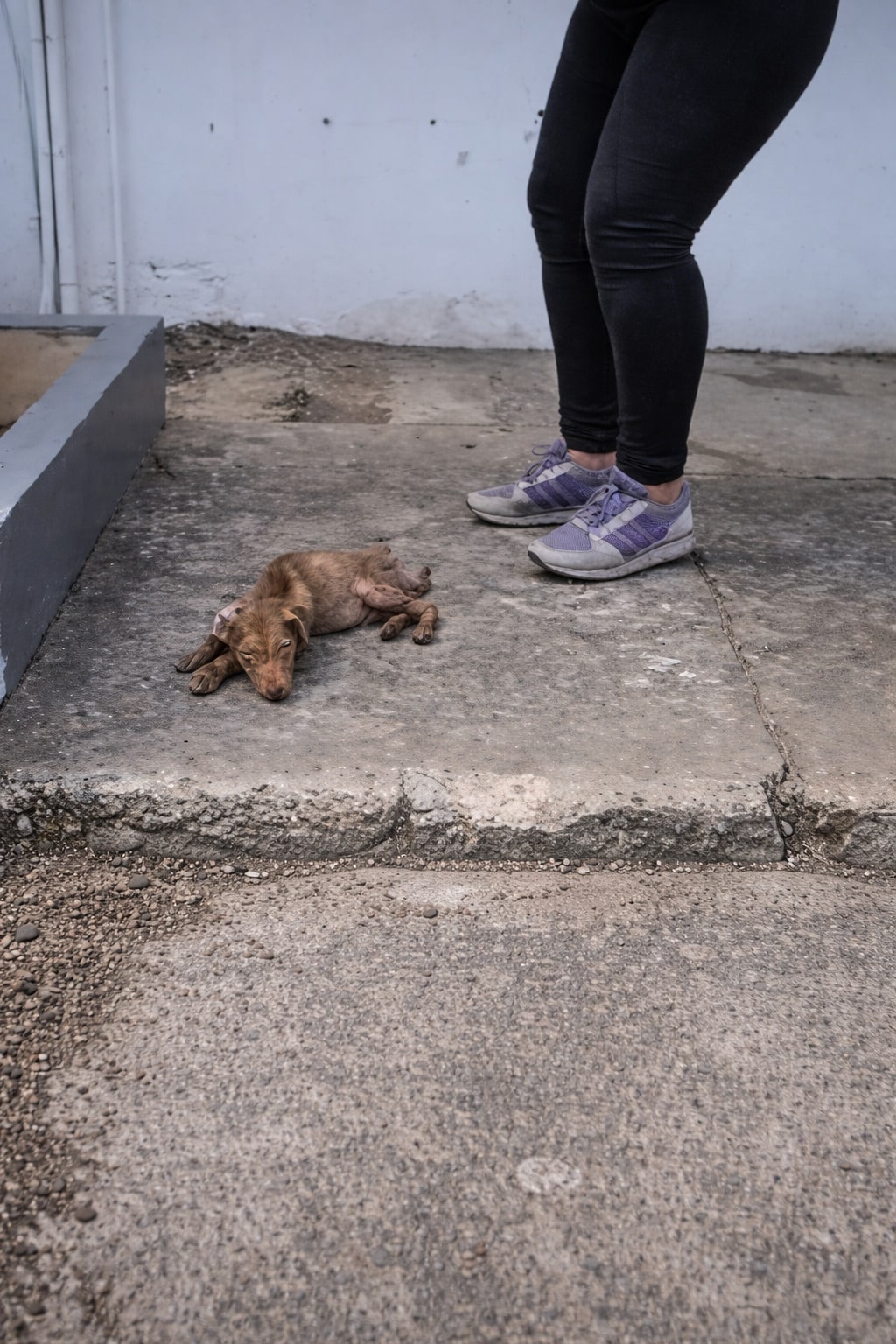
When rescuers first saw the tiny puppy, he could barely support his own weight.
His body was painfully thin. Much of his fur was missing, and his irritated skin showed just how much his health had suffered. Even the simplest movement appeared to demand more strength than he could comfortably give.
He was only a few months old.
At an age when a puppy should have been discovering the world through play and curiosity, this little dog was struggling with something far more immediate.
He needed to survive.
The people who found him could see that his condition was serious. What they could not yet know was whether the care he was about to receive would be enough.
But they were willing to try.
And that decision marked the beginning of a very different life for a puppy who would soon be known as Fenix.
A Small Puppy Facing an Enormous Struggle
There was something particularly difficult about seeing Fenix in those early moments.
He was so young, yet his physical condition suggested that he had already experienced considerable hardship.
His ribs and other bones were visible beneath his thin frame. Large areas of his coat had disappeared, leaving his skin irritated and vulnerable. His eyes appeared tired, and standing for even a short period was a challenge.
The source of his earlier suffering was not fully explained.
What was clear was the condition in which rescuers discovered him.
He needed medical attention, proper nourishment, and the kind of steady care that his weakened body could not provide for itself.
For a growing puppy, nutrition supports almost every part of development. Without adequate nourishment, even ordinary activities can become exhausting.
Fenix had reached a point where maintaining his strength was difficult.
There was little energy left for the playful behavior normally associated with puppies.
He could not simply be given a meal and expected to recover overnight.
His situation required much more.
The first important change was that he was no longer facing those difficulties without help.
Someone had noticed him.
Someone had recognized how urgently he needed care.
And instead of leaving his future to chance, they brought him to a veterinary clinic.
It was there that the seriousness of his condition became even clearer.
A Name Chosen Before Anyone Knew the Ending
At the clinic, the people caring for the puppy decided he needed a name.
They chose Fenix.
The name carried the idea of rising again, much like a phoenix associated with renewal and a new beginning.
It was not a celebration of a recovery that had already happened.
At that point, Fenix was still extremely fragile.
His future remained uncertain, and there was no guarantee that treatment would succeed.
The name represented what everyone hoped might become possible.
A second chance.
A return to strength.
A life that could eventually hold something beyond discomfort and exhaustion.
For the medical team, however, hope had to be accompanied by immediate action.
Veterinary examinations revealed dangerous malnutrition, a severely compromised immune system, and an infection affecting his small body.
These problems placed him at considerable risk.
The first 48 hours were especially important.
During that period, the people responsible for his care would have to watch closely for changes in his condition.
Even with treatment underway, there was no quick solution.
A puppy in such a weakened state needed support without placing additional demands on a body already struggling to function.
So the team began carefully.
They provided warm fluids, medication, and small portions of food.
Each part of the treatment addressed a different need.
Hydration mattered.
Managing his infection mattered.
Restoring nourishment mattered.
But above all, Fenix needed time.
Time for his body to respond.
Time for the treatment to begin making a difference.
Time to show whether he still had enough strength to move toward recovery.
The following hours would test both his physical resilience and the patience of those trying to help him.
Forty-Eight Hours When Every Improvement Mattered
Recovery did not announce itself with a sudden transformation.
There was no immediate moment when Fenix rose to his feet and appeared healthy again.
Instead, his earliest progress came through careful monitoring and small changes.
The veterinary team continued his treatment while watching for signs that his body was responding.
His condition demanded attention because even modest setbacks could have been significant.
For the people looking after him, the first objective was not to see him running or playing.
It was simply to help him become stable enough to continue healing.
There is a particular kind of patience involved in caring for a severely weakened animal.
Progress cannot always be measured through obvious movement or dramatic behavior.
Sometimes it is reflected in the ability to tolerate a little nourishment.
Sometimes it is the absence of further deterioration.
And sometimes it is a small response that would barely attract attention in a healthy animal.
Fenix's treatment began to produce those quieter signs of progress.
The rescue and recovery journey shows how much can change when a vulnerable puppy receives consistent care.
VIDEO: Fenix Was Too Weak to Stand — Watch His Journey From Critical Illness to a Second Chance
For Fenix, the most meaningful changes were still ahead.
He had survived the earliest critical period, but his recovery would require continued care.
There was no reason to rush the process.
His body needed to rebuild strength gradually.
And the people around him needed to recognize progress for what it was, however small.
The First Meal That Changed the Mood
One of the earliest encouraging developments came when Fenix began eating a little food by himself.
It was not a large meal.
It was not proof that every medical problem had disappeared.
But it was an important step.
Until then, feeding had been part of the careful support required to keep him going. Seeing him take food independently gave his caregivers another reason to believe that he was moving in the right direction.
A simple action had become a meaningful achievement.
For a healthy puppy, eating is an ordinary part of the day.
For Fenix, it represented something much bigger.
His body was beginning to participate in its own recovery.
Then another small change appeared.
His tail moved.
Only slightly.
It was the kind of movement that could easily pass unnoticed when watching an energetic dog.
But Fenix had not been energetic.
He had arrived weak, uncomfortable, and barely able to maintain his balance.
Against that background, a small movement carried considerable meaning.
He was beginning to respond to the world around him.
He was not yet the playful companion he might someday become.
He was still a patient who needed close attention.
But there was a difference between the puppy who had first arrived at the clinic and the one now showing these early signs of improvement.
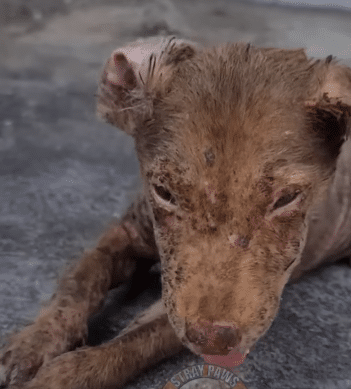
His caregivers continued working through the ordinary but essential parts of recovery.
Medication.
Careful feeding.
Monitoring.
Patience.
The routine was not glamorous, but it was necessary.
A severely weakened animal does not rebuild its health through one good day.
Fenix needed many more of them.
And gradually, he began to have them.
The Frightened Puppy Slowly Became Curious Again
As the days passed, Fenix's condition began to stabilize.
His skin showed signs of healing, and his strength gradually improved.
The changes were not limited to his physical appearance.
His behavior began to change as well.
He became more alert to what was happening around him.
Rather than remaining largely withdrawn, he started watching people moving through the clinic.
He reacted to voices.
He noticed activity.
These were ordinary behaviors for a puppy, but they had been largely absent when Fenix was at his weakest.
Their return suggested that his world was beginning to expand again.
Earlier, much of his limited energy had been devoted to simply getting through each day.
Now there was room for curiosity.
He could pay attention to the people who cared for him.
He could respond to their presence.
He could begin showing some of the personality that his poor health had previously hidden.
By the second week, the difference had become more noticeable.
Fenix remained physically delicate, but he was increasingly interested in companionship.
He followed clinic staff with his eyes.
He sought attention.
And eventually, he began playing for short periods.
That development was especially meaningful.
Playfulness is such a familiar part of puppyhood that it can be easy to overlook its importance.
For Fenix, however, the return of play was part of a much larger recovery.
He was no longer defined solely by the condition in which he had been found.
He was beginning to behave like a young dog who wanted to explore, interact, and enjoy the attention of others.
His body was still healing.
But his personality was becoming easier to see.
And as his strength returned, the possibility of a future outside the clinic became increasingly real.
Someone Saw More Than a Puppy Who Had Been Sick
Weeks after his rescue, Fenix reached another turning point.
Someone saw him and recognized the possibility of making him part of a family.
This was different from receiving temporary medical care.
The clinic had helped him through a dangerous period and supported his gradual recovery.
Now there was an opportunity for the stability of a permanent home.
A home where he would not be known primarily as a patient.
A place where his needs could be met consistently, day after day.
The person who welcomed Fenix into their life gave him an environment built around safety, patience, and affection.
These were not dramatic changes in themselves.
They were the ordinary things every companion animal deserves.
Reliable care.
A secure place to live.
Someone willing to pay attention.
For a puppy whose earliest known circumstances had been so difficult, those ordinary things represented an extraordinary improvement.

Fenix's new life was not about erasing what had happened before.
His early condition remained part of his story.
But it no longer had to determine what came next.
He could continue growing stronger in a place where his future was not measured by critical medical hours.
He could gradually discover what it meant to live with a family.
And he could experience the kind of routine that gives a dog room to feel secure.
His new owner offered the consistency and companionship that had been missing from his earlier life.
For Fenix, having somewhere to belong became another important part of his transformation.
A Stronger Body and a Personality Full of Life
Over the following months, Fenix continued to change.
The physical transformation was remarkable.
His fur, once missing across large portions of his body, grew back into a healthy coat.
His frame became stronger as he recovered from the severe malnutrition that had left him so fragile.
And the puppy who had once struggled to remain standing became active and energetic.
He could run.
He could play.
He could explore his surroundings with enthusiasm.
These were activities that had seemed far beyond his abilities when rescuers first brought him to the clinic.
Now they were part of his everyday life.
His personality also became increasingly expressive.
The cautious, weakened puppy of those early days had grown into a lively companion.
Rather than spending his time under medical supervision, Fenix could enjoy experiences that healthy dogs often take for granted.
He visited parks.
He played with other animals.
He received affection and responded with the excitement of a dog comfortable in his new surroundings.
None of these experiences required a dramatic setting.
Their significance came from how different they were from his beginning.
A puppy who once had little strength to lift his head could now move freely.
A dog whose skin and coat had shown serious signs of poor health could now enjoy ordinary daily activity.
And an animal whose survival had once been uncertain was now living in a permanent home.
The transformation was not the result of a single intervention.
It had developed through a sequence of necessary steps.
Being found.
Receiving veterinary treatment.
Surviving the critical early period.
Eating independently.
Gradually recovering his strength.
And finally, becoming part of a family.
Each step made the next one possible.
The Life That Became Possible Because Someone Cared
Looking at Fenix after his recovery, it is difficult to ignore the contrast with his earliest days.
He began as a tiny puppy in serious physical distress.
He had very little strength, significant skin problems, and medical needs that required urgent attention.
His first days at the clinic were filled with uncertainty.
The veterinary team could offer treatment, but they could not promise an outcome.
What followed was gradual rather than immediate.
A little food eaten independently.
A small movement of his tail.
Growing awareness of the people around him.
Short moments of play.
Then greater strength, improved health, and eventually a permanent home.
These developments may seem modest when considered separately.
Together, they describe the difference between surviving a medical crisis and being able to enjoy life again.
Fenix's experience also reflects something important about animal rescue.
Saving an animal is not always a single dramatic act.
Sometimes the initial rescue is only the beginning of a much longer commitment.
There are difficult early decisions.
There is treatment that requires patience.
There are periods when progress appears slow.
And there is the responsibility of providing care after the immediate danger has passed.
Fenix benefited from people who remained involved through those different stages.
His rescuers made it possible for him to receive help.
The veterinary team supported his recovery.
His new owner gave him the security of a lasting home.
Each played a role in making his second chance possible.
Today, the story of Fenix is not simply about how seriously ill he once was.
It is about the healthy, playful dog he eventually became.
The name chosen for him during his most uncertain days turned out to be especially fitting.
Fenix was named for the hope of rising again.
At the time, that hope was all his caregivers could hold onto.
But with medical treatment, patient care, and the love of a family, his life moved far beyond those fragile beginnings.
He did not remain the exhausted puppy who could barely stand.
He grew stronger.
He learned to play.
He found somewhere to belong.
And the small life that once seemed so uncertain became one filled with the everyday pleasures of being a loved dog.
Sometimes a second chance begins with something very simple.
Someone sees an animal in need and decides that its life is worth the effort.
For Fenix, that decision opened the door to everything that followed.


