
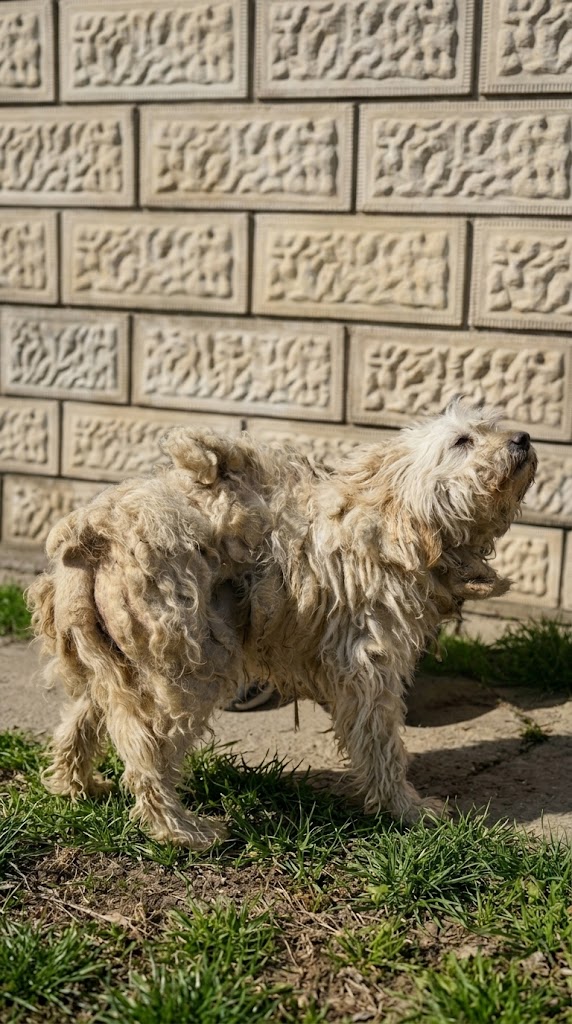
The little dog trembled on the metal grooming table, almost completely hidden beneath a thick shell of tangled fur.
She was small, believed to be a Maltese mix, but the heavy coat surrounding her made it difficult to recognize the delicate animal underneath.
The salon was quiet. The lighting was soft. The people around her were trying to help.
Yet none of those things seemed to reassure her.
Every unfamiliar movement brought uncertainty. Every approaching hand made her tense. Even while standing nearly motionless, her body continued to shake.
The people caring for her could see that this would not be an ordinary grooming appointment.
Her coat had become more than an inconvenience.
It was a physical burden that had been pulling against her skin for a long time.
And removing it would require something just as important as professional grooming equipment.
Patience.
Because although the groomers could cut away the tangled hair, they could not simply cut away the fear that came with it.
The Small Dog Hidden Beneath Months of Neglect
The little dog had reportedly come from a remote rural area.
Much of her earlier life remained unknown, but her physical condition spoke clearly about the discomfort she had endured.
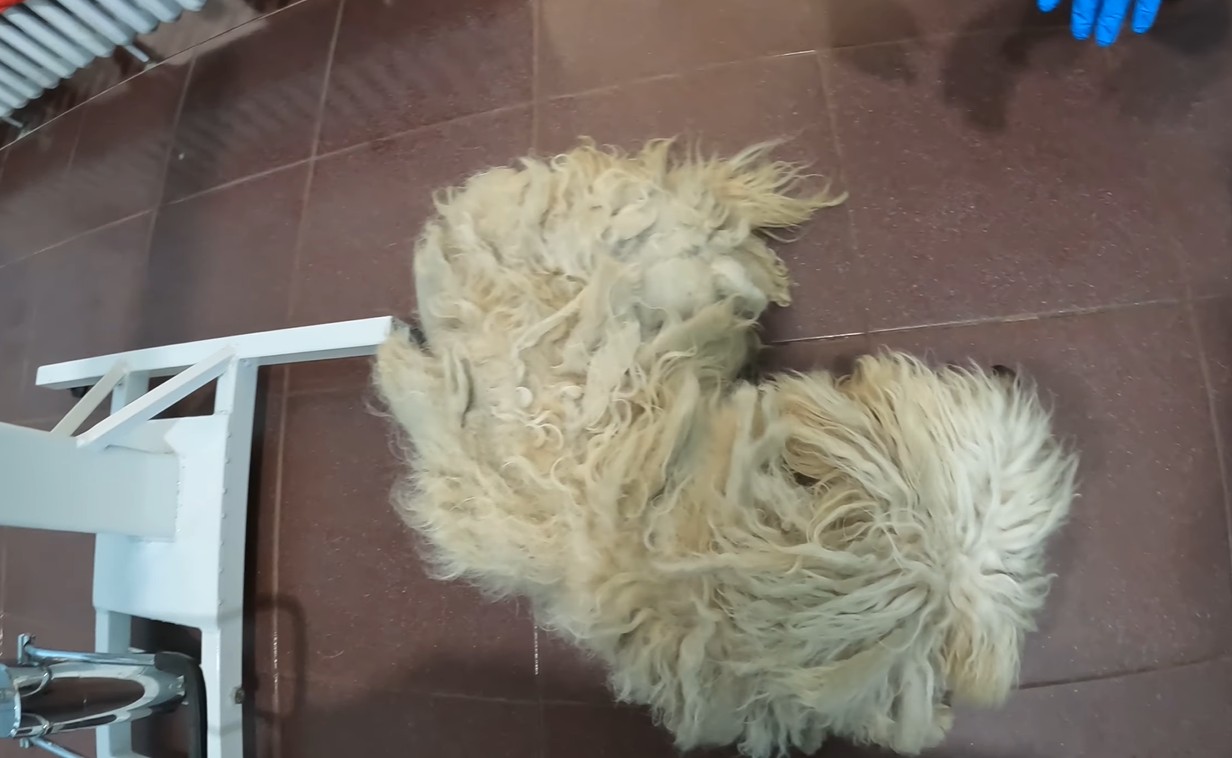
Her once-soft coat had become a dense covering of hardened, tangled hair.
Instead of hanging naturally around her body, the fur had formed thick, rope-like clumps. Dirt and debris were trapped inside the mats, along with insects.
What should have protected her skin had gradually become something that restricted her movements.
The weight was only part of the problem.
Severely matted fur can pull against the skin when an animal moves. In her case, the groomers could already see signs of irritation and bruising beneath the tangled covering.
A simple shift in position could create discomfort.
Even an ordinary movement might tug at sensitive areas.
The little dog had been living beneath this burden for months.
There was no way to know exactly how often she had been touched during that time, or what experiences had taught her to fear unfamiliar hands.
But her reaction inside the salon made one thing clear.
She did not yet feel safe.
The grooming team understood that rushing would only make an already difficult situation more frightening.
Their first challenge was not making her look clean.
It was helping her through the process without adding unnecessary pain.
Every Cut Had to Be Made With Care
Removing badly matted fur requires a different approach from a routine haircut.
The groomers could not simply brush through the hardened clumps. The tangles were too dense and too close to her body.
They needed clippers, steady hands, and constant attention to the condition of the skin beneath the coat.
That skin was already sensitive.
A careless movement could cause further injury.
So the team worked slowly, taking away sections of the heavy fur while watching the little dog's reactions.
Piece by piece, the covering began to separate from her body.
The process revealed just how much hair had been weighing her down.
For the groomers, the change was visible.
For the little dog, however, the experience was still unfamiliar.
She could not understand why strangers were holding her, why the equipment made strange sounds, or why the coat she had lived beneath for so long was being removed.
The people around her knew they were trying to relieve her discomfort.
She had no way of knowing that.
This was one of the most difficult parts of helping her.
The very actions intended to make her comfortable could also trigger the fear that made her resist.
And as the session continued, that fear would become impossible to ignore.
The Frightening Moment When Fear Took Over
The heavy clumps of fur were gradually disappearing.
The grooming team was making progress.
Then the blow dryer started.
Its sudden noise frightened the little dog so intensely that she lunged forward and bit the groomer's hand.
The reaction happened quickly.
It could easily have been misunderstood as deliberate aggression.
But the people working with her recognized the difference between an animal trying to hurt someone and an animal reacting because she feels threatened.
She was frightened.
Her response appeared to be an attempt to protect herself from something she did not understand.
The groomer had been injured, but the team did not respond with anger.
They stopped.
They gave the situation the attention it needed.
The incident was an important reminder that a rescue animal's behavior cannot always be understood by looking at a single moment.
A dog that bites while frightened is not necessarily an aggressive dog.
Fear can make even a small, vulnerable animal react defensively.
And when a dog has experienced prolonged discomfort, unfamiliar handling may be especially difficult.
The little dog had already endured the physical strain of her neglected coat.
Now, the people caring for her were seeing how much caution would be needed to help her feel secure.
The session could continue.
But it could not continue in exactly the same way.
VIDEO: A Terrified Little Dog Struggled Against the Hands Trying to Free Her From Painful Matted Fur
When Helping Meant Changing the Approach
After the frightening incident, the grooming team reassessed how to continue safely.
They did not abandon the work.
The little dog's coat still needed attention, and leaving the remaining mats in place would have meant allowing the discomfort to continue.
But her fear could not be ignored.
The team moved forward more cautiously.
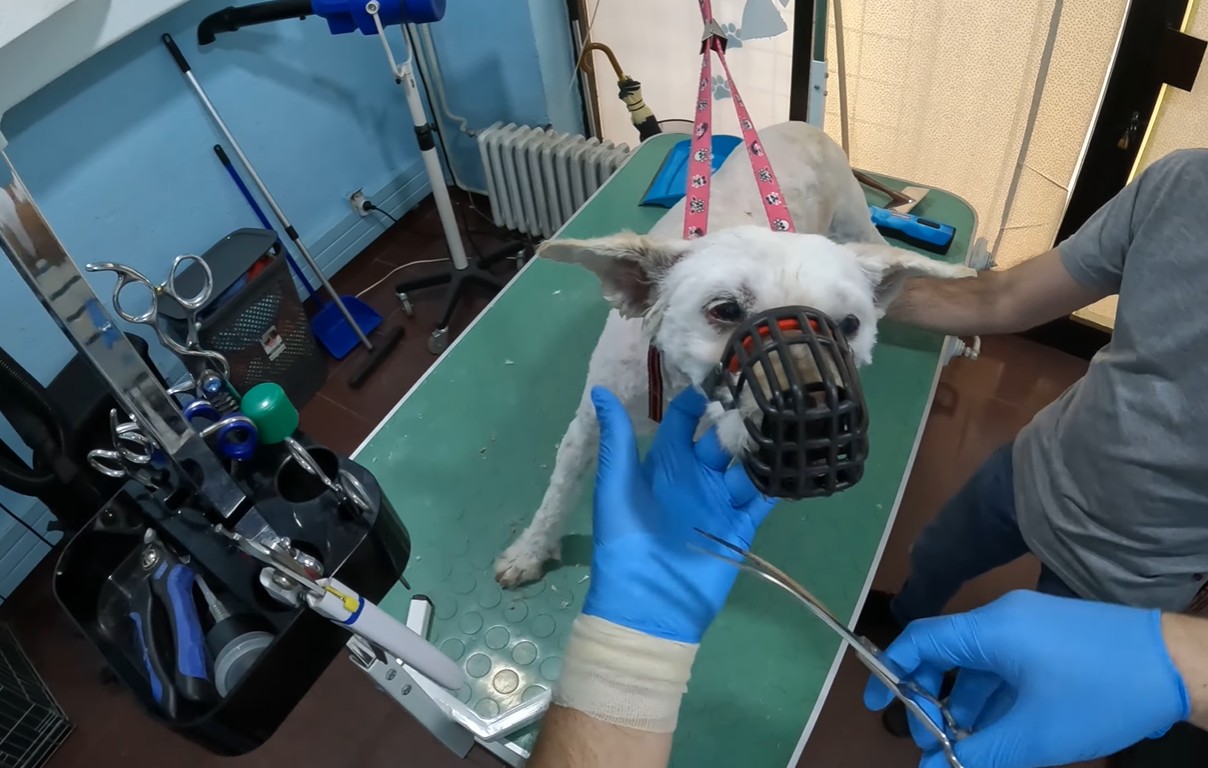
A soft muzzle was introduced to protect both the groomers and the dog during the remaining care.
It was a safety measure, not a punishment.
That distinction matters.
The dog was not being blamed for her reaction. The team was adapting to what her behavior had communicated.
She needed help, but she also needed careful handling.
There was a delicate balance between completing the necessary grooming and avoiding additional distress.
For the people in the salon, this meant paying attention to more than the appearance of her fur.
They needed to consider her movements.
Her breathing.
The tension in her body.
The way she responded to the equipment around her.
These small signs helped guide the remaining session.
And slowly, with the team's continued care, the work moved forward.
Warm Water and the First Signs of Relief
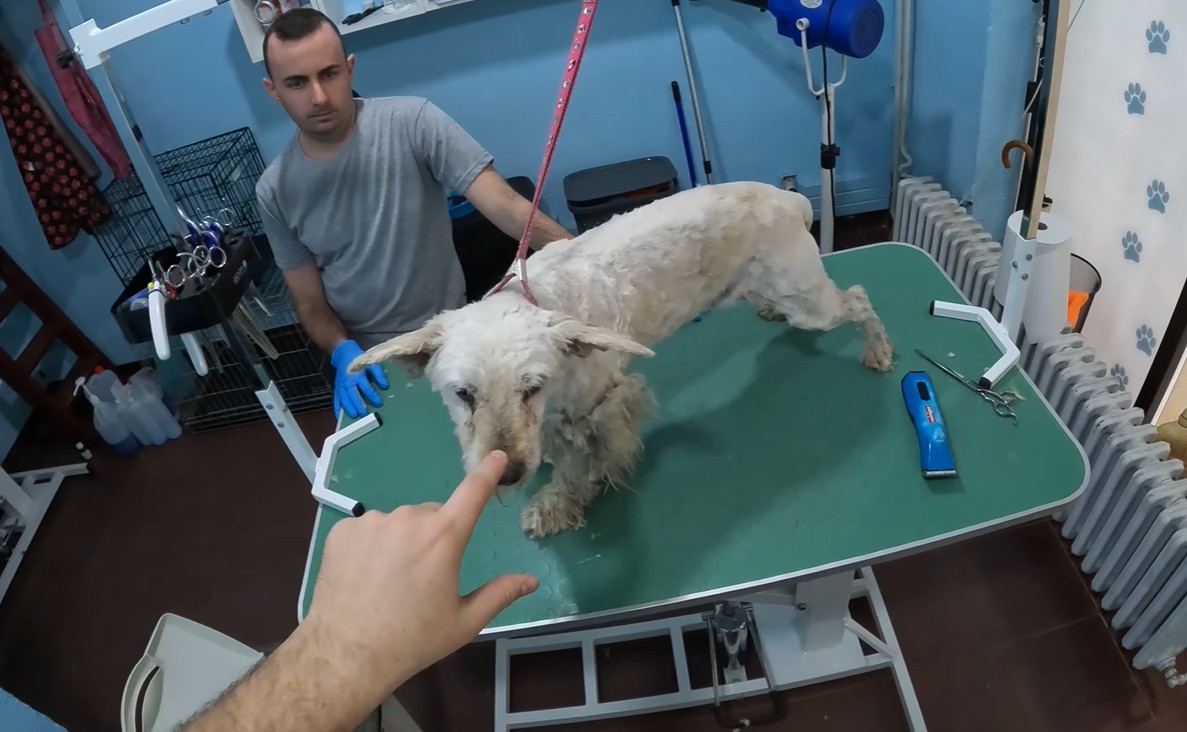
Once the most difficult part of removing the heavy mats was behind her, the little dog received a gentle bath.
Warm water helped wash away the dirt that had accumulated in her coat.
A soothing shampoo and conditioner were used to clean and care for the remaining fur.
After so much tension, this became a quieter part of the experience.
The dog who had trembled on the grooming table began to show signs of physical relief.
Her muscles gradually relaxed.
Her breathing became calmer.
It was a subtle change, but an important one.
For an animal that had been carrying painful tangles for months, the absence of that weight could make a meaningful difference.
The hardened fur had limited her comfort.
Now, the grooming team was giving her the opportunity to move without the same constant pulling against her skin.
Of course, a bath could not undo everything she had experienced.
Clean fur did not mean that every physical problem had been resolved.
And a calmer moment did not mean her fear of people had disappeared.
Still, the change mattered.
The team had helped her through an unfamiliar, challenging process.
Despite the moment of panic, the grooming was continuing with care rather than anger.
The little dog was being given something she had clearly needed.
Relief from the heavy coat that had surrounded her body for so long.
A Tiny Dog Finally Visible Beneath the Fur
By the time the grooming session ended, the difference in her appearance was remarkable.
The hardened clumps that once obscured her body were gone.
Without the bulky covering, her small frame was finally visible.
She looked like a different dog.
But this was not simply a cosmetic transformation.
For months, the tangled coat had been pulling against her skin and making ordinary movement uncomfortable.
Removing it allowed her to stand and move without the same weight dragging at her body.
The change was physical and immediate.
The emotional part of her recovery was much less certain.
The fear that had caused her to tremble and react defensively could not be expected to disappear during a single grooming appointment.
Still, the people caring for her had accomplished something meaningful.
They had recognized her distress.
They had responded to her defensive reaction with understanding.
And they had completed the care she needed while trying to keep her as comfortable as possible.
Alexander gently wrapped the little dog in a warm towel as the session came to an end.
It was a simple act.
But after the tension of the grooming table, the towel offered warmth and comfort as she was prepared for the next part of her journey.
The account does not confirm where she went afterward or whether she eventually became comfortable around unfamiliar people.
Her longer-term recovery remained unknown.
What was visible was the difference between the dog who arrived and the dog who left the grooming table.
She no longer had to carry that suffocating coat.
And she had been handled by people who understood that her fear deserved compassion.
The Part of Rescue That Cannot Be Finished in One Day
There is a temptation to look at a transformation like this and see a complete happy ending.
A frightened dog arrives covered in matted fur.
Careful hands remove the tangles.
A bath washes away the dirt.
And a clean, small dog emerges from beneath what had once seemed like an impossible burden.
It is a powerful change.
But the most important part of her story may be what remained unfinished.
The grooming team could remove the physical weight that had been hurting her.
They could respond to her fear without punishing her.
They could make the experience gentler and give her a more comfortable beginning.
What they could not do was guarantee that she would immediately trust human touch.
Trust develops differently from a clean coat.
It depends on repeated experiences of safety, consistent care, and the freedom to learn that not every unfamiliar moment leads to discomfort.
For this little dog, the grooming session showed both how vulnerable she was and how much patience she needed.
Her frightened bite was not the defining moment of her story.
Neither was the dramatic difference in her appearance.
What mattered was that the people helping her continued to see a small animal in need of care, even when fear made that care difficult.
They did not expect her to understand their intentions.
They adjusted their approach to meet her needs.
And when the last heavy clumps had been removed, she was finally free of the coat that had restricted her for so long.
Her future was still uncertain.
But one important burden had been lifted.
Sometimes, the first act of compassion is not a dramatic rescue or an instant transformation.
Sometimes, it is a person choosing to remain gentle when a frightened animal does not yet know how to accept gentleness.
For this tiny dog, that choice made all the difference during a difficult day.
Her fur could be cleaned in a single session.
Learning that human hands could also bring comfort would take more time.
And she deserved every opportunity to discover that difference.


