
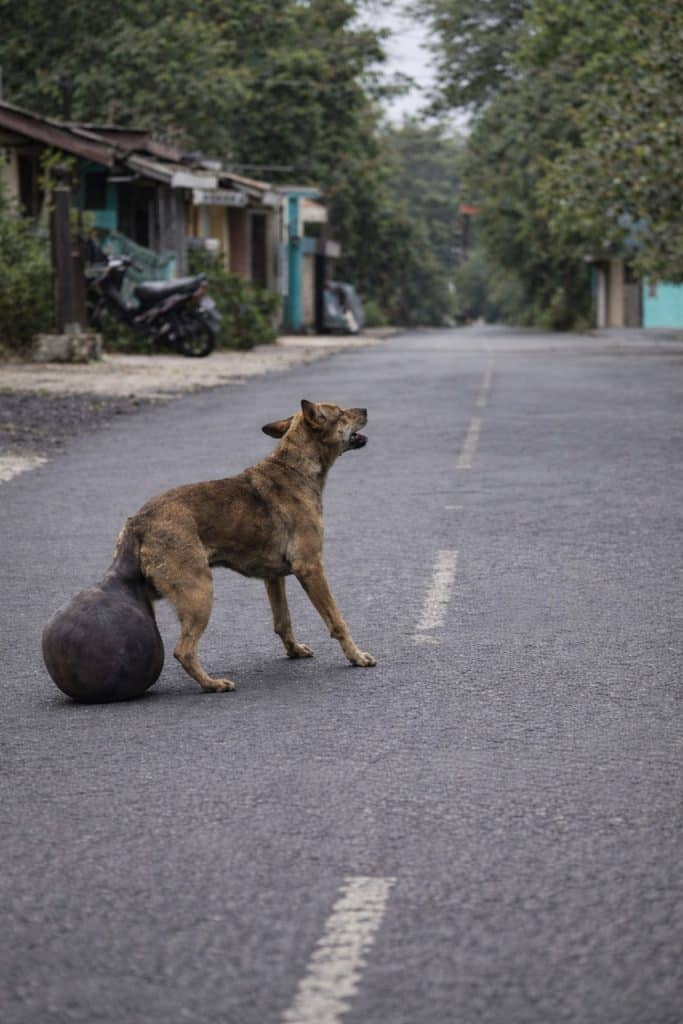
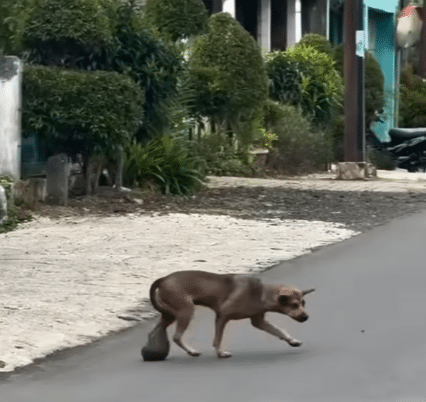
Puspita moved through the industrial district with an enormous swelling hanging from one of her hind legs. Every step appeared to demand effort, yet the frightened stray continued searching for something to eat.
Workers came and went.
Some noticed her following at a distance. Others passed without stopping.
And when anyone tried to get close, Puspita disappeared into the concrete pipes and drainage tunnels scattered around the construction area.
She wasn't looking for attention.
She was trying to survive.
For a dog already struggling beneath the weight of a large, uncomfortable growth, the simple routines of staying alive had become exhausting. Finding food meant walking. Finding safety meant hiding. And trusting a stranger was something she had never learned to do.
Her situation might have continued unnoticed if the swelling on her leg had not become increasingly difficult to ignore.
Eventually, people began to understand that this quiet stray needed help she could never find on her own.
But reaching her would require something more than good intentions.
It would require patience.
The Dog Who Learned to Disappear
In the industrial neighborhood where Puspita wandered, people were familiar with seeing her near the workers.
She kept her distance, apparently hoping someone would leave behind a little food.
There was no indication that she had a secure place to sleep or anyone regularly caring for her. Instead, the construction site and its surrounding drainage structures had become her refuge.
When she felt threatened, she retreated into the tunnels.
The same concrete spaces that offered protection also kept her separated from anyone who might have helped.
It was a difficult contradiction.
To survive, Puspita needed food and human generosity. But when people approached, fear drove her away from the very assistance she needed.
Meanwhile, the large mass attached to her hind leg was becoming an increasingly serious concern.
Its size made ordinary movement appear uncomfortable. Even so, she continued walking through the area, searching for scraps and returning to her hiding places.
Nobody knew exactly how long she had been living this way.
There was no clear history of when the swelling first appeared or how quickly it had developed before people began noticing her.
What was visible was troubling enough.
Puspita was carrying a physical burden that no animal should have to manage without care.
And each day spent avoiding people made the possibility of treatment seem more distant.
When Concern Finally Turned Into Action
As the growth became more noticeable, concerned residents decided that simply watching Puspita struggle was no longer enough.
They contacted a local rescue team.
It was an important first step, but the rescuers quickly discovered that helping her would be complicated.
Puspita had learned to associate approaching people with danger.
When the team attempted to get near her, she ran away.
Her reaction wasn't aggression.
It was fear.
Forcing an immediate capture could have caused additional distress, particularly given the weight already affecting her leg.
The rescuers chose another approach.
Rather than repeatedly pursuing her, they stepped back and began studying her habits.
For several days, they observed her movements from a distance.
They learned where she searched for food, which areas she visited, and where she went whenever she wanted to feel protected.
Most importantly, they identified the tunnel she regularly used as a hiding place.
This slower approach mattered.
Puspita had been making her own decisions about safety for a long time. Sudden movements or unfamiliar attention could send her retreating before anyone could provide help.
By understanding her routine, the team could plan a rescue that respected her fear while still addressing her urgent need for care.
There was no dramatic chase.
No attempt to overpower her in the open.
Just people taking the time to understand one frightened dog.
And eventually, their patience created an opportunity.
The Evening Her Life Began to Change
One evening, Puspita returned to the familiar shelter beneath the construction area.
This time, the rescue team was prepared.
They approached carefully, keeping their movements controlled and avoiding unnecessary commotion.
Puspita was still frightened.
She had no reason to understand why the people she usually avoided were now trying to guide her into a transport crate.
At first, she resisted.
The confined space was unfamiliar, and everything about the situation was different from her ordinary routine.
But the rescuers continued working gently until she was safely secured.
For the first time, Puspita was leaving the industrial district not in search of food, but on her way to receive help.
During the journey, her behavior gradually changed.
The initial struggle gave way to stillness.
It was impossible to know what she understood. Perhaps she was simply exhausted by the experience. Perhaps the absence of further pursuit allowed her to become calmer.
What mattered was that she was finally being transported somewhere safe.
The enormous growth was still attached to her leg.
Her physical discomfort had not disappeared.
But a crucial part of her situation had changed.
She was no longer facing it alone.
VIDEO: Puspita Hid From Everyone While Carrying a Massive Tumor—Watch How Patient Rescuers Finally Brought Her to Safety
A Safe Place, but Trust Would Take Longer
Arriving at a protected resting place brought Puspita into an unfamiliar world.
Instead of the hard surfaces and exposed surroundings of the industrial district, she now had a warm area where she could rest.
Food and fresh water were provided.
There were people nearby who intended to care for her rather than frighten her.
Yet Puspita didn't immediately relax into her new circumstances.
That first evening, she remained curled up quietly inside her crate.
She wasn't ready to eat.
After so much time living cautiously and disappearing whenever people approached, safety was not something she could instantly recognize.
Even a positive change can be overwhelming for an animal accustomed to uncertainty.
The rescuers allowed her the space to settle.
There was no need to demand affection or immediate confidence.
The first priority was simple.
She needed rest.
The swelling continued to cause concern, and medical treatment was still ahead. But Puspita could now spend the night without having to search for another hiding place.
No more retreating into roadside drainage tunnels whenever footsteps came too close.
No more trying to find shelter while struggling with the weight attached to her leg.
Her surroundings had changed in a single evening.
Her ability to trust would understandably take more time.
This was one of the quieter but more meaningful parts of the rescue.
Puspita did not suddenly become a carefree companion.
She remained a frightened dog adjusting to a completely different kind of life.
And the people helping her understood that physical safety was only the beginning.
The Medical Answer Everyone Needed
The following day, Puspita underwent a veterinary examination.
Her long period of struggling on the streets had taken a toll, and her condition required careful evaluation.
But the greatest concern was the enormous mass hanging from her hind leg.
Its appearance and size raised an important medical question.
Could the growth be cancerous?
Until the veterinary team assessed her, the rescuers could not know what treatment would be possible or what the diagnosis might mean for her future.
For a dog who had already endured so much discomfort, the uncertainty was difficult.
Then came encouraging news.
The medical findings indicated that the growth appeared to be benign rather than malignant.
That distinction was significant.
Although the mass was large and uncomfortable, the veterinary team determined that it could be surgically removed.
Puspita finally had a realistic path toward relief from the physical burden she had been carrying.
It didn't mean that everything would be easy.
She still needed an operation, followed by careful recovery.
But for the first time since people began noticing her condition, there was a clear treatment plan.
The swelling that had dominated her daily movement did not have to remain part of her life forever.
What once seemed like an overwhelming problem now had a possible solution.
And that changed the direction of her story.
The Surgery That Lifted an Enormous Burden
Not long after her examination, Puspita underwent surgery.
The veterinary team carefully removed the large growth from her leg.
It was a delicate procedure, but the operation was successful.
The difference was profound.
For so long, Puspita had been forced to walk with the mass hanging from her body.
Every journey through the industrial district had meant carrying its weight.
Now, that burden was gone.
When she awakened from surgery, her leg bore stitches where the growth had been removed.
She still needed time to heal, and the surgical area required protection while her body recovered.
But the most significant obstacle to her physical comfort had finally been addressed.
Puspita rested with a protective collar, which helped prevent her from interfering with the healing area.
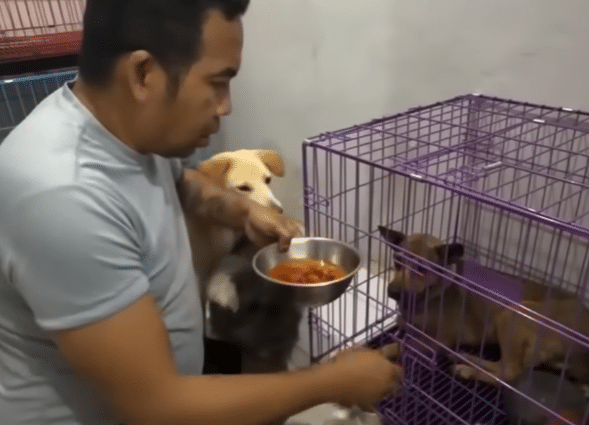
Her rescuer remained nearby, providing food, reassurance, and gentle attention.
These were ordinary acts of caregiving.
For Puspita, they represented an extraordinary change in circumstances.
Previously, she had relied on whatever food could be found near the workers.
Now, meals were provided.
Previously, she had hidden in concrete tunnels to avoid people.
Now, someone stayed close to help her through recovery.
Previously, the mass on her leg had accompanied every painful step.
Now, it had been removed.
There was still healing ahead, and nobody could expect her fear to disappear simply because the surgery was over.
But the practical changes were unmistakable.
Puspita was receiving the treatment and protection she had needed for so long.
Learning That Kindness Doesn't Have to Be Frightening
Surgery addressed Puspita's most visible problem.
The quieter challenge was helping her adjust to life with people.
For an animal that had spent so much time avoiding human contact, trust could not be created by a successful medical procedure alone.
It had to develop gradually.
The rescue team had already shown an understanding of that need when they chose observation over pursuit.
The same patience remained important during her recovery.
Puspita had food, shelter, and someone watching over her while she healed.
She no longer needed to return to the industrial district to search for whatever scraps might be available.
She no longer depended on cold construction pipes for protection.
And she no longer had to carry the enormous growth that had made walking so difficult.
Those changes did not erase the experiences that had shaped her fearful behavior.
But they gave her a different environment in which to recover.
There is something deeply meaningful about providing care without demanding an immediate response.
A frightened animal may not approach willingly.
It may not accept attention right away.
Sometimes, the most compassionate thing a rescuer can offer is the freedom to become comfortable at its own pace.
Puspita's journey illustrates that truth.
The team had not waited for her to become trusting before helping her.
They had adjusted their approach so that a frightened dog could receive the assistance she needed.
And once she was safe, the focus could shift from simply surviving to healing.
A Different Future From the One She Knew
Puspita's story began in a place where she was easy to overlook.
An industrial district.
Workers moving through their daily routines.
A stray dog keeping her distance, following quietly in the hope of finding something to eat.
For a time, those brief sightings were almost all anyone knew of her.
The enormous growth on her leg made her suffering visible, but fear made helping her difficult.
What ultimately changed her circumstances was not one dramatic action.
It was a sequence of thoughtful decisions.
Residents recognized that she needed assistance and contacted rescuers.
The team spent days learning her behavior instead of forcing an immediate confrontation.
They used that knowledge to bring her safely out of the construction area.
Veterinarians examined the growth and identified a surgical treatment option.
The operation successfully removed the mass.
And afterward, Puspita was given the opportunity to rest and recover under compassionate care.
Every step mattered.
The story does not establish that she has completed her entire recovery or found a permanent adoptive family.
Those possibilities belong to the future.
What is already clear is that her immediate circumstances have changed enormously.
The frightened dog who once disappeared into drainage pipes has received medical attention, shelter, food, and the chance to heal without the heavy mass that once slowed her movements.
That is a meaningful outcome in itself.
Sometimes Rescue Means Knowing When Not to Rush
There is an important lesson in the way Puspita was helped.
The rescuers could see that she needed assistance.
They could also see that she was afraid.
Instead of treating that fear as an obstacle to overcome through force, they allowed it to guide their approach.
They observed.
They waited.
They learned.
And when the opportunity came, they acted carefully.
Their patience made it possible for Puspita to reach the medical care she desperately needed.
For many frightened stray animals, rescue isn't simply a matter of opening a door or offering a bowl of food.
It means understanding why an animal may run from kindness.
It means recognizing that fear can remain even when danger has passed.
And it means providing help without expecting immediate trust in return.
Puspita's future is still unfolding.
Her body needs time to recover from surgery, and her confidence around people may take longer to develop.
But she has already been given something that seemed far away during her days in the industrial district.
A chance to live without the enormous burden on her leg.
A safe place to rest.
And people willing to give her the time she needs.
For a dog who once had only concrete tunnels to hide in, that is the beginning of a very different life.
Sometimes the greatest act of compassion isn't reaching an animal first.
It's being patient enough to reach her safely.


