
Some rescue stories begin with urgency.
This one began with a pregnant Dalmatian finally being given a quiet place to rest.
She was already about thirty days into her pregnancy when she entered rescue care. Beneath her spotted coat, the gentle curve of her belly made it clear that she was not arriving alone.
The volunteers soon began calling her Mama Pup.
She had not given birth yet, but everything about the way she settled, rested, and protected her growing belly already reflected the role she was preparing to take on.
Her previous family had reached a point where they could no longer provide the attention she needed during pregnancy. Rather than allowing the situation to become harder for her, they asked for help.
That decision opened the door to a very different chapter.
A Quiet Room for an Expectant Mother
The foster space prepared for Mama Pup was simple and calm.
Soft blankets covered her resting area. Fresh water remained close by. Her meals were adjusted as her pregnancy progressed, and regular veterinary checks helped ensure that everything continued safely.
There was no need for excitement around her.
What she needed most was consistency.
Food.
Rest.
A peaceful place where she could prepare for what was coming.
For the first time in weeks, she was able to settle without having to manage anything beyond the life growing inside her.
Then her breathing began to change.
Her body became more restless.
Labor had started.
Thirteen Tiny Lives Arrive
The birth unfolded gradually.
Volunteers remained nearby without crowding her, ready to help if needed while allowing Mama Pup to follow her instincts.
Then the puppies began arriving.
One after another.
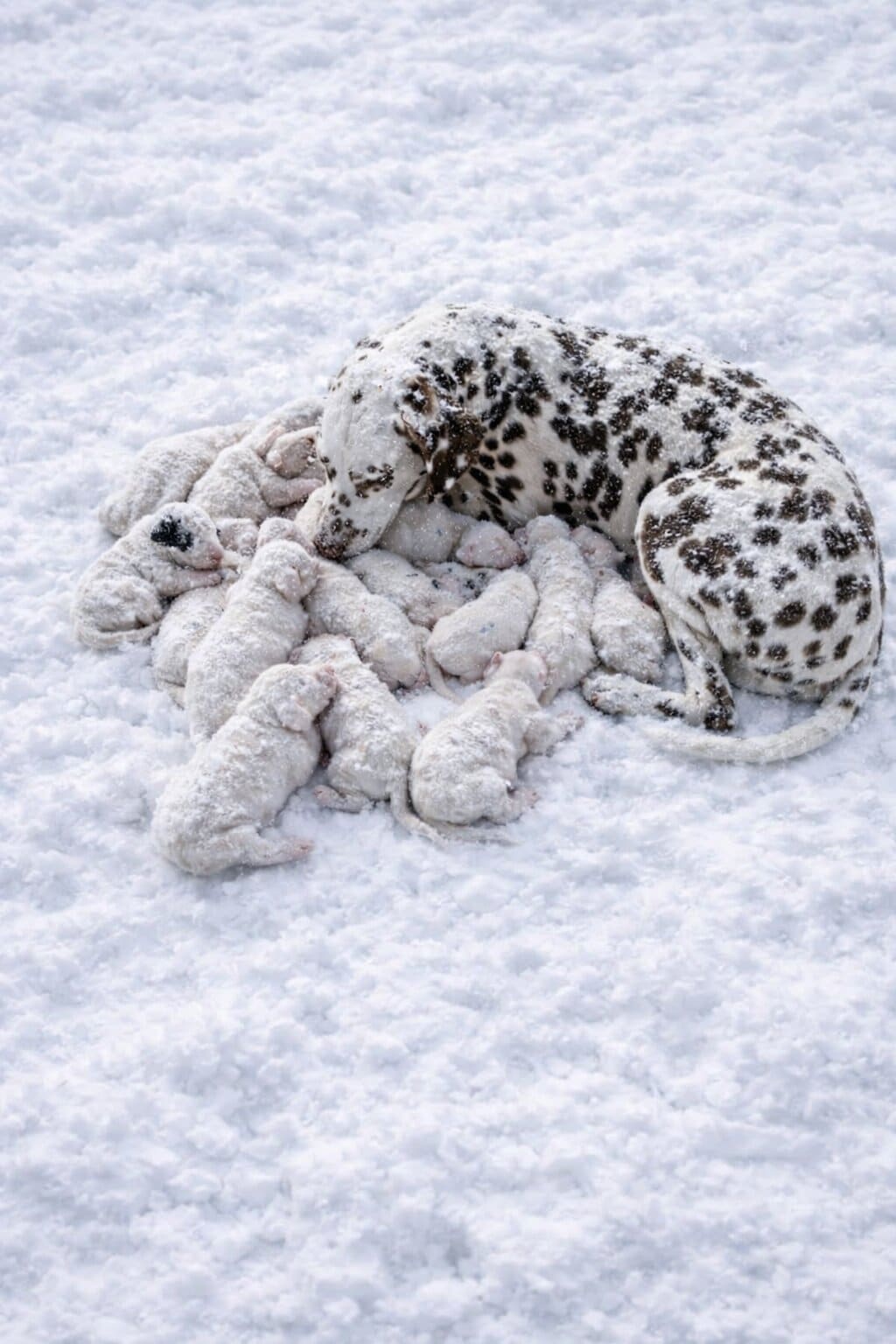
By the time labor was finished, thirteen newborn Dalmatians were gathered against their mother.
At first, they looked almost nothing like the energetic spotted dogs they would eventually become.
Their bodies were tiny and mostly white. Their eyes remained closed. Their world consisted almost entirely of warmth, scent, touch, and the steady presence of their mother.
Mama Pup immediately began caring for them.
She cleaned each puppy and drew them toward her body. As they shifted around the bedding, she repeatedly adjusted her position so the smallest puppies could remain close enough to nurse.
Thirteen vulnerable newborns depended on her at once.
And she stayed remarkably steady.
VIDEO: From One Expectant Dalmatian to Thirteen Puppies — Watch Their First 100 Days Together
The First Two Weeks Were About Growing Strong
During the earliest days, the puppies did little more than nurse and sleep.
They gathered together in a warm cluster, their small bodies constantly shifting as they searched for milk or a comfortable place beside their siblings.
Their voices gradually became stronger.
Soft newborn sounds turned into louder little cries as the days passed.
Mama Pup rarely moved far away.
Even when she stepped toward food or water, her attention quickly returned to the puppies behind her.
The first two weeks were quiet but important.
There were no dramatic milestones yet.
Growth itself was the milestone.
Each day brought a little more strength.
Then, near the end of the second week, another change appeared.
Their eyelids began to move.
The world they had known only through scent and touch was about to become much larger.
Eyes Open, Spots Appear, and the Nest Changes
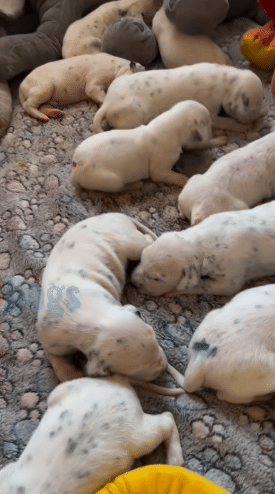
Around the middle of the first month, the puppies began opening their eyes.
Their first looks were uncertain.
Tiny blinks became longer stares as they slowly adjusted to light and movement around them.
At almost the same time, the feature most associated with Dalmatians began becoming more visible.
Spots.
The puppies had arrived with mostly white coats, but their individual black markings gradually emerged.
No two patterns looked exactly alike.
Suddenly, the group of nearly identical newborns was becoming a collection of thirteen distinct little dogs.
Movement changed as well.
Crawling slowly turned into unsteady walking.
Their paws still slipped beneath them, and balance was far from perfect, but curiosity was beginning to pull them beyond the comfort of the nest.
By around Day 20, shallow dishes were introduced.
The puppies approached formula with little understanding of what they were supposed to do.
Some lapped awkwardly.
Others stepped too close and lost their footing.
It was messy, uncertain progress.
Mama Pup watched nearby.
She did not need to control every movement anymore.
Her puppies were beginning to learn for themselves.
Thirteen Personalities Begin to Appear
By the time the puppies reached one month old, the quiet newborn stage was disappearing quickly.
They explored instead of simply sleeping.
They interacted instead of only searching for their mother.
One puppy would tug gently at a sibling's ear.
Another would chase a moving tail.
Small play-fights broke out across the bedding before ending just as quickly as they began.
Their foster space suddenly felt much more active.
Supervised visits outside added another new experience.
For the first time, tiny paws touched grass.
Cool outdoor air moved across their coats.
Sunlight gave them a much larger world to investigate.
Those outings also made their individual personalities easier to notice.
One puppy seemed eager to investigate something new first.
Another preferred to watch before moving closer.
One repeatedly returned toward Mama Pup.
Another seemed happiest beginning games with the rest of the litter.
They had entered the world together, but they were no longer simply "the puppies."
Each was becoming an individual.
Mama Pup remained nearby through those changes.
She was still attentive, but the intensity of the newborn weeks had begun to ease.
Her puppies were stronger now.
They could see.
They could move.
They could explore.
And little by little, they depended less completely on her.
A House Full of Spotted Energy
By the second month, the foster home barely resembled the quiet room where Mama Pup had first arrived.
Toys now covered the floor.
Soft ropes invited games.
Rubber balls rolled between thirteen sets of paws.
Safe climbing structures gave the young Dalmatians even more opportunities to explore.
With thirteen puppies moving at once, calm moments naturally became less common.
But the activity was a sign of how far they had come.
The puppies were alert, curious, and learning quickly.
Their days began developing more structure.
There were periods for play.
Times for settling down.
Gentle interaction with people helped them become increasingly comfortable around human attention.
Every experience gave them something new to understand.
A different sound.
A new texture beneath their feet.
Another person to meet.
Another boundary to learn.
For puppies who had begun life unable to see beyond the warmth of their mother, the world had expanded enormously in only a few weeks.
Mama Pup Changes Alongside Them
The puppies were not the only ones transforming.
When Mama Pup first entered foster care, her life revolved around pregnancy.
Then came labor.
Then nursing.
Then the demanding weeks of caring for thirteen newborns.
As her puppies became more independent, something seemed to change in her as well.
She looked increasingly relaxed.
She no longer needed to respond to every tiny movement in the nest.
She could rest while the puppies played.
She could watch them explore without constantly drawing them back toward her.
The careful expectant mother who had arrived weeks earlier had become the calm center of a remarkably busy family.
There was still plenty happening around her.
Thirteen young Dalmatians ensured that.
But the uncertainty of those early days had been replaced by a sense of stability.
One Hundred Days Later
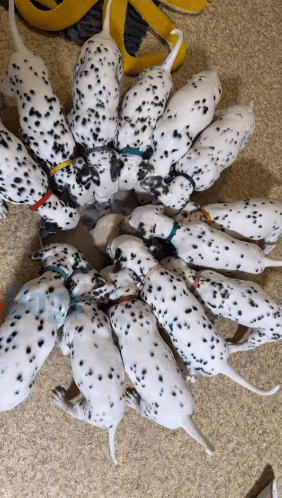
At the end of the first 100 days, the transformation was impossible to miss.
What had begun with one pregnant dog needing additional support had become a thriving family of fourteen.
Thirteen puppies were growing stronger, more active, and more confident.
Their once-white coats now displayed the spotted patterns that made each puppy recognizable.
The small foster room that had once been prepared for a tired expectant mother had become a place filled with movement, toys, learning, and play.
And at the center of it all was Mama Pup.
Her journey had not required a dramatic rescue scene.
There had been no chaotic chase or sudden intervention.
Instead, her story was built around something quieter.
Someone recognized that she needed more support.
Her previous family asked for help.
A foster space was prepared.
Volunteers stayed close.
And day after day, consistent care gave one mother the stability she needed to raise thirteen puppies.
Sometimes rescue is a single urgent moment.
Sometimes it is one hundred days of showing up.
A fresh bowl of water.
A clean blanket.
A safe room.
A patient hand.
A mother finally able to rest while her puppies grow beside her.
Mama Pup arrived carrying thirteen lives that had not yet seen the world.
One hundred days later, those same puppies were running through it.
And sometimes, that is what a second chance looks like.


