
Some rescue stories begin with movement.
Eva Victoria’s began with the painful absence of it.
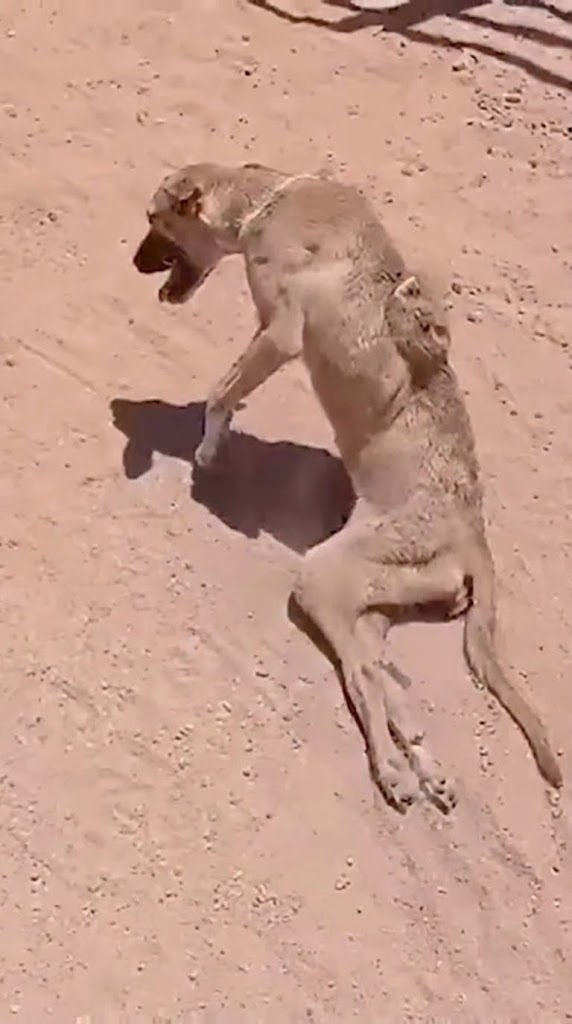
When she was first seen lying on the street, her small body was exhausted. She could lift her head and pull herself forward with her front legs, but her hind legs remained still behind her.
Each attempt to move demanded more strength than she seemed to have.
Yet there was something striking in the way she looked back at the people around her.
Her body was struggling.
Her attention was not.
A Small Dog Still Trying to Move Forward
No one knew exactly how long Eva had been surviving in that condition.
Her fur was dirty and matted, and she appeared worn down by hunger and exhaustion. More troubling was the condition of her back. Something was clearly wrong, and she could not support herself normally.
She had apparently been pulling herself along with only her front legs.
How far she had traveled that way was unknown.
How many people had passed before someone finally stopped was unknown too.
What could be seen was enough.
Eva needed help.
She had little strength left, but when she tried to move, she still made the effort. Her front paws reached forward, her body followed as far as it could, and her back legs dragged behind.
It was not graceful.
It was not easy.
But she kept trying.
That quiet persistence would become one of the defining parts of her story.
The Woman Who Refused to Keep Walking
A woman passing nearby noticed Eva on the pavement.
She slowed down.
Then she stopped.
Instead of watching from a distance and continuing on her way, she approached carefully and lowered herself closer to the dog.
Eva did not try to escape.
The woman spoke gently, giving her time to understand that no one was there to hurt her. Eva managed to raise her head enough to look toward her.
It was a small interaction, but it changed the direction of everything that followed.
The woman wrapped Eva carefully in a blanket.
There was no struggle when she was lifted.
No frantic attempt to get away.
Eva simply allowed herself to be carried.
For a dog who had been surviving alone on the street, that willingness to accept help mattered.
She was placed in the car and taken directly to a veterinary clinic.
The pavement where she had been struggling was behind her.
For the first time in an unknown number of days, Eva was no longer facing her condition alone.
VIDEO: She Could Only Pull Herself Forward With Her Front Legs — Until Someone Finally Stopped
A Name Built Around Life and Victory
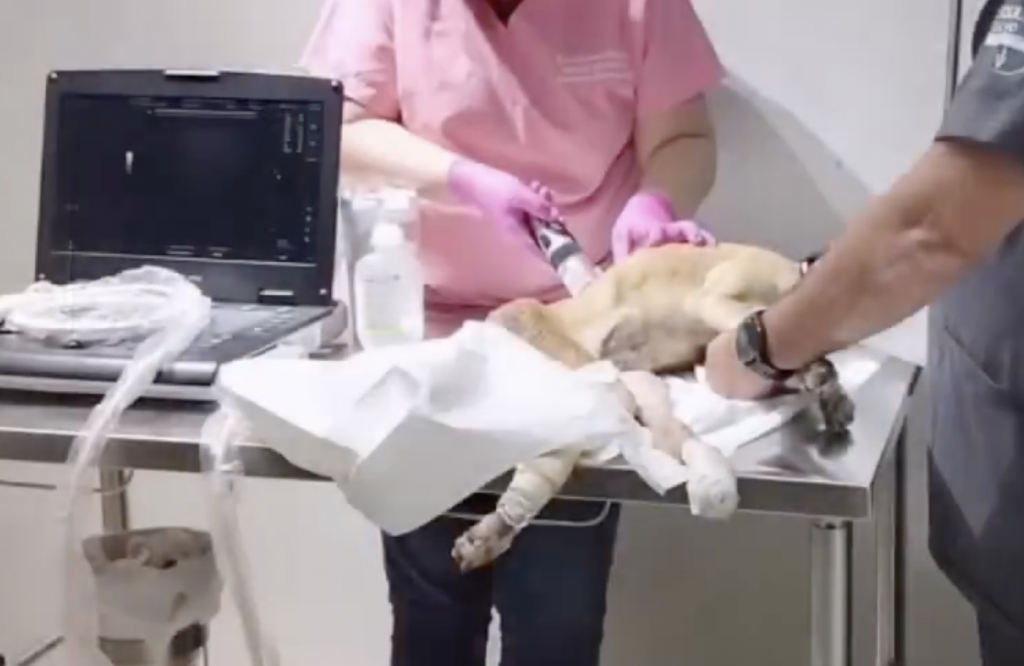
At the clinic, examinations and scans revealed how serious Eva’s condition was.
She had suffered a severe spinal injury. Veterinarians also found an infected wound that required urgent attention.
Her future was uncertain.
There was no simple promise that treatment would restore everything she had lost.
But the veterinary team was willing to give her every reasonable chance.
Around this time, she received the name that would stay with her throughout her recovery: Eva Victoria.
Eva represented life.
Victoria represented victory.
For the people caring for her, those words carried meaning beyond a name. They reflected what everyone hoped she might still have ahead of her.
Eva then underwent a difficult operation.
For nearly six hours, the medical team worked to address the infection and stabilize her spine.
It was delicate work, and there were no guarantees about what would happen afterward.
When the operation finally ended, Eva was still there.
Still breathing.
Still beginning the next part of the fight.
Recovery Began With Almost Invisible Changes
Surgery did not suddenly put Eva back on her feet.
She still could not stand by herself.
Her body remained weak, and recovery required continuous care and patience.
But one important part of her life had already changed.
She was no longer alone.
From that point forward, progress was measured differently.
Not in dramatic transformations.
Not in instant results.
But in movements so small that someone not paying attention might have missed them.
A slight wag of her tail.
A faint twitch from one of her hind legs.
A gentle movement toward a familiar hand.
Each sign offered a reason to continue.
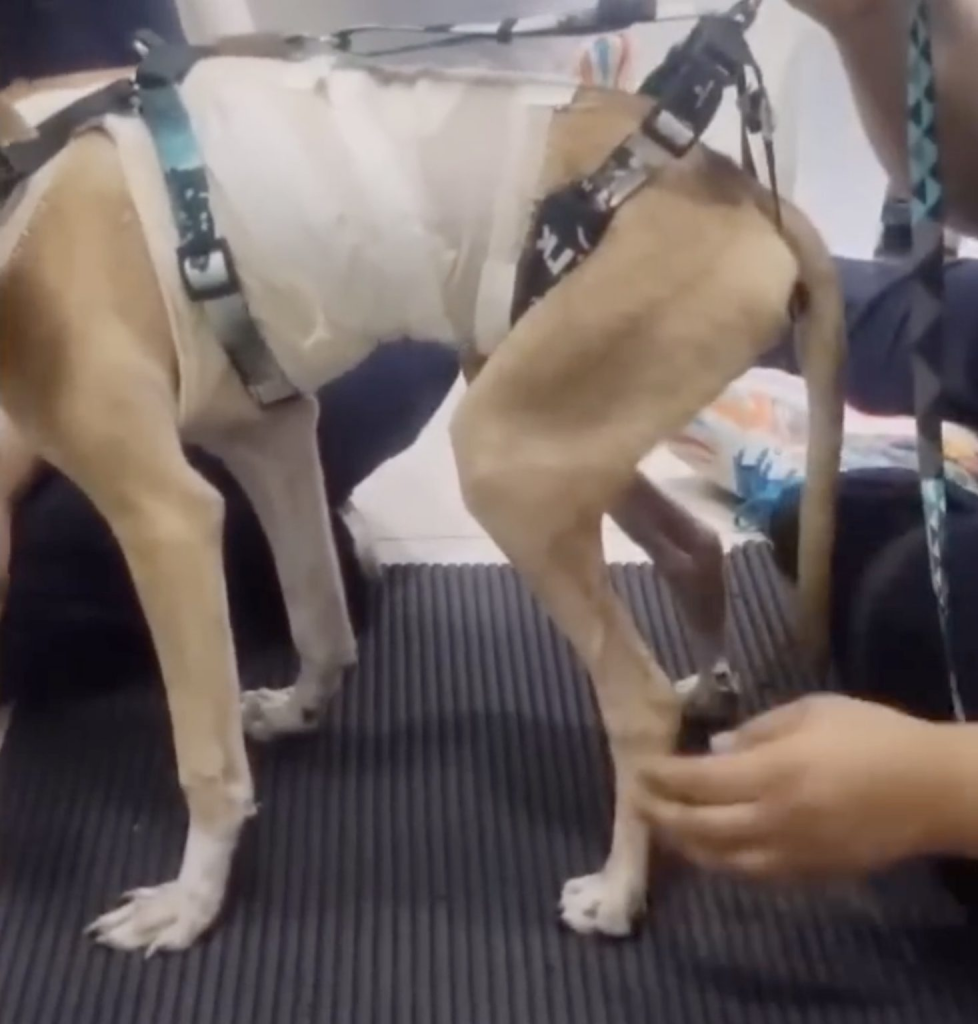
Physical therapy became part of Eva’s routine. Her caregivers used gentle massage, careful stretching, and repeated rehabilitation exercises as they worked with muscles that had gone unused.
Nothing could be rushed.
Her body had been through too much.
Recovery had to happen one small attempt at a time.
Eva kept participating.
Then came a moment that seemed almost insignificant from the outside.
There was movement in her hindquarters.
Tiny.
Brief.
But real.
For the people who had watched her arrive unable to use her back legs, that little response carried enormous meaning.
It did not mean the journey was finished.
It meant there was still something to work toward.
A Wheelchair Changed What Was Possible
Weeks became months.
Eva gradually became stronger, even though her mobility remained limited.
Eventually, she received a custom wheelchair designed to support her hindquarters while allowing her front legs to propel her forward.
The wheelchair was not a sign that Eva had failed to recover.
It was a tool that gave her something she had been missing since the day she was found.
Independence.
At first, she moved cautiously.
Learning to use the wheels required adjustment.
But once Eva understood how the chair responded to her movements, something changed.
She began to move more confidently.
Then faster.
The dog who once had to drag herself inch by inch across cold pavement could now travel under her own power.
Her body had not returned to what it had once been.
Her life had simply found another way forward.
During rehabilitation, another important relationship entered Eva’s world.
Her name was Lila.
Like Eva, Lila had lost the use of her hind legs.
Their circumstances were similar, and the two dogs quickly formed a bond.
They spent time together through a period of life defined by rehabilitation and adaptation.
Neither dog needed to move like every other dog in order to enjoy companionship.
Neither needed to be physically perfect to belong.
They simply had each other.
And soon, that bond would shape their future.
One Family Made Room for Both of Them
Eventually, the time came to consider adoption.
Eva had already traveled an extraordinary distance from the dog found unable to stand on the street.
Now she needed something medical treatment could not provide on its own.
A permanent home.
A family came forward prepared to care for her.
But their decision included something unexpected.
They did not want to adopt Eva alone.
They wanted Lila too.
Keeping the two dogs together meant accepting the responsibility of caring for two animals with special mobility needs. Their new family understood that their daily lives would require patience, attention, and accommodation.
They chose them anyway.
Eva and Lila did not have to lose the friendship they had built during recovery.
They went home together.
It was another turning point in a story already filled with them.
First, someone had stopped beside the street.
Then a veterinary team had treated Eva.
Then caregivers had guided her through rehabilitation.
Now a family was making room for the life she had fought so hard to keep.
And they were making room for her friend as well.
Her Scars Remain, but They Are No Longer the Whole Story
Eva’s life today is far removed from those first moments on the pavement.
She moves around with the help of her wheelchair.
She has comfortable places to rest.
She has people around her who understand what she needs and love her as she is.
Her spinal injury remains part of her history.
So do the months of therapy and adaptation that followed.
But those things no longer tell the entire story.
Eva is also the dog who kept pulling herself forward when her back legs would not cooperate.
She is the dog who accepted help from a stranger.
She is the patient who made it through a long operation.
She is the dog whose smallest movements became milestones.
She is the companion who formed a bond with another disabled dog.
And she is now part of a family that chose both of them.
Eva Victoria’s journey was never about simply returning to the life she had before.
Sometimes recovery does not mean restoring everything exactly as it once was.
Sometimes it means finding a different way to move.
A different way to live.
A different version of freedom.
Her story exists because several people made compassionate choices at moments when those choices mattered most.
A woman stopped instead of continuing past her.
Veterinary professionals treated an injury whose outcome remained uncertain.
Caregivers stayed patient through slow rehabilitation.
And eventually, a family looked at two dogs with special needs and saw not burdens, but lives worth welcoming home.
Eva’s name could hardly be more fitting.
Life.
Victory.
Not because every physical limitation disappeared.
But because the small dog once unable to stand on a cold street was given the opportunity to keep going.
And she did.


