
Some rescue stories begin with a faint sound or a frightened animal hiding from view.
Sunny's began with a color that seemed completely out of place.
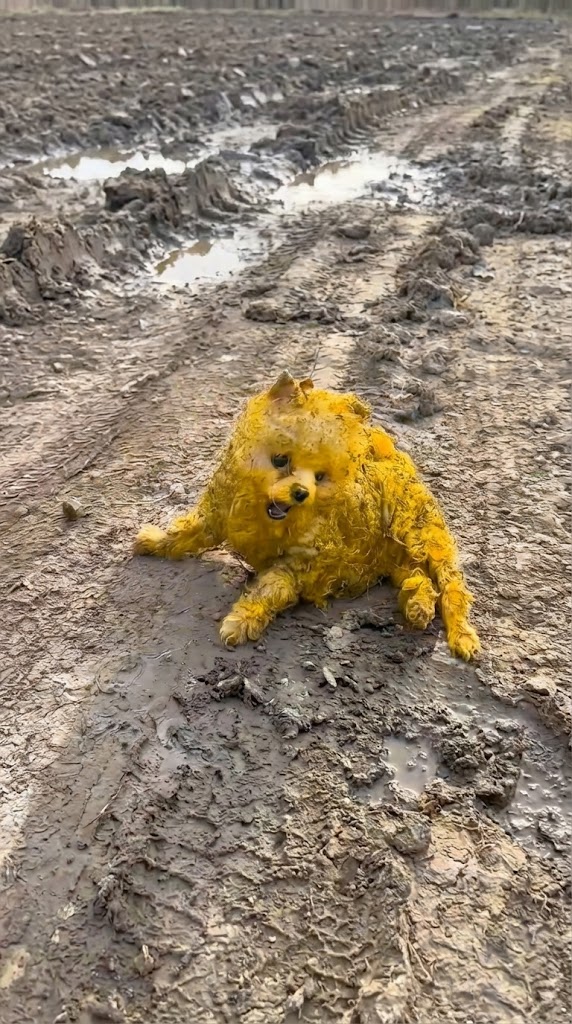
In the middle of a barren landfill, surrounded by discarded plastic, scraps of metal, and piles of waste, rescuers noticed something unusually bright. A patch of yellow rested against the dull colors of the garbage.
From a distance, it could have been another discarded object.
Then it moved.
Curled on top of the waste was a small dog. His coat was coated in dried yellow paint, hardened into stiff clumps around his body. Beneath that strange outer layer was an animal already facing another serious problem: his hind legs were paralyzed.
Yet the detail rescuers could not ignore was his expression.
Sunny was awake.
He was watching them carefully.
And he was still fighting to protect himself.
The Dog Beneath the Yellow
When the rescuers approached, Sunny did not quietly welcome them.
He barked.
The sound was sharp and defensive, coming from a dog who could not simply stand up and escape when strangers came closer. His body was limited, so his voice became one of the few ways he could create distance.
Nothing about his barking meant that he did not need help.
It showed how uncertain he had become around people.
According to the story later shared by neighbors, Sunny had not always lived among piles of garbage. He had once belonged to a family.
Then his circumstances changed dramatically.
An accident left his hind legs paralyzed.
For any dog, losing normal movement would create an enormous need for care. Sunny needed people willing to help him adjust to a body that no longer worked as it once had.
Instead, another accident made his condition even harder.
Unable to move properly, he fell into a container of bright yellow paint.
The paint spread across his coat and eventually dried there, turning soft fur into a stiff covering pressed against his skin.
He could not clean himself.
He could not simply walk away from what had happened.
And the people he depended on did not remove the paint or seek the help he needed.
Left Behind When He Needed Help Most
What happened afterward became the most painful part of Sunny's story.
According to the source, the family who had cared for him brought the paralyzed, paint-covered dog to a landfill and left him there.
For Sunny, the place offered none of the things an injured animal needed.
There was no comfortable surface beneath him.
No familiar home.
No reliable care.
He was surrounded instead by discarded objects, unable to use his back legs and trapped inside a coat hardened by dried paint.
Still, when rescuers finally appeared, he had enough energy to bark at them.
That response mattered.
Behind the fear and the defensive behavior was a dog who had not completely withdrawn from the world around him.
The rescuers chose to look beyond the yellow paint.
They saw the animal underneath it.
And that changed the direction of his life.
VIDEO: Paralyzed and Covered in Yellow Paint, He Was Left in a Landfill Until Rescuers Finally Saw Him
Slowly Removing What Had Covered Him
Getting Sunny away from the landfill was only the beginning.
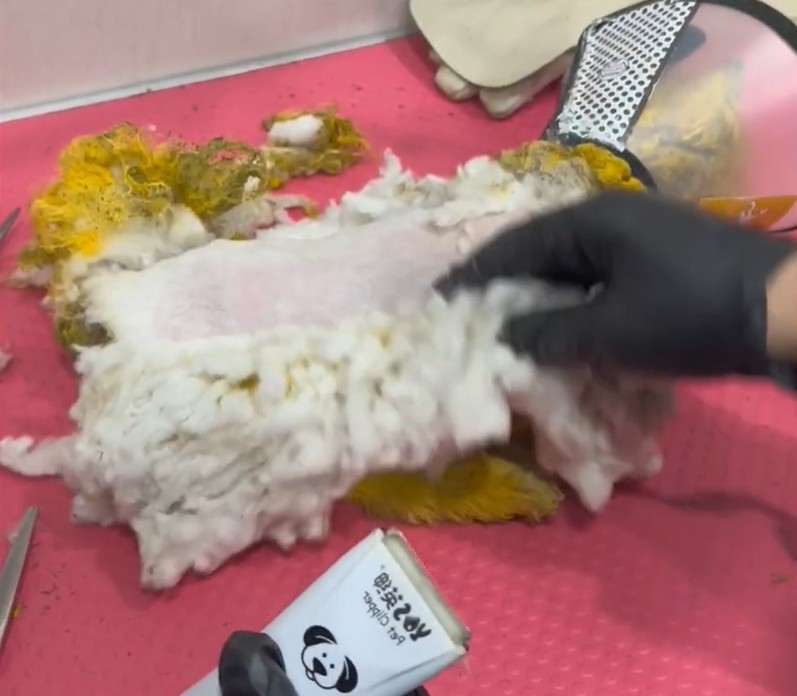
At the clinic, attention turned to the dried paint covering his body.
Removing it required patience.
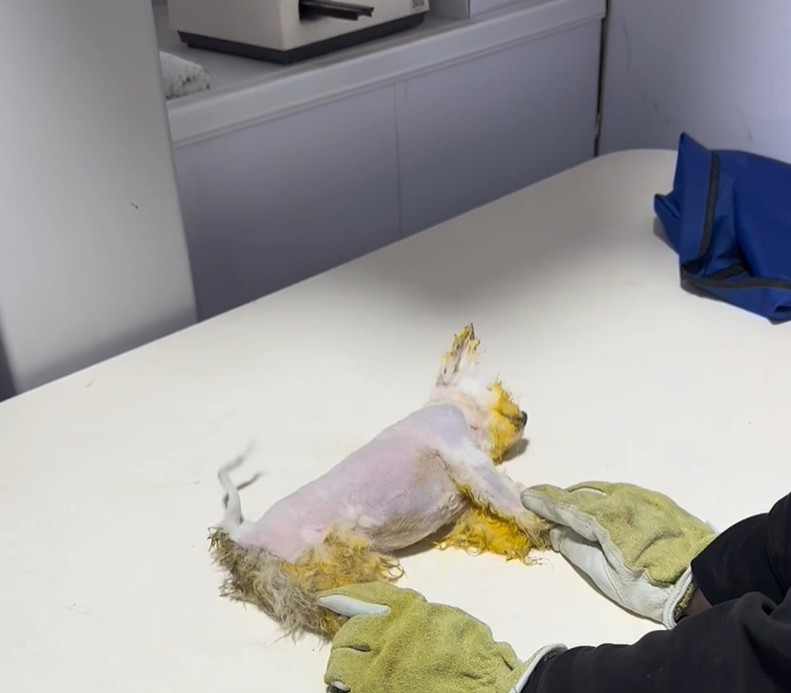
The hardened fur had to be carefully shaved away rather than treated as a simple grooming problem. As more of the yellow layer disappeared, the condition of the skin underneath became visible.
His skin was irritated and had spent an unknown amount of time trapped beneath the paint-covered coat.
Sunny was understandably tense during those early moments of care.
At first, he trembled.
After everything he had experienced, even necessary handling could feel unfamiliar and threatening.
But the people caring for him did not rush the process.
Little by little, the hardened fur came away.
And something else began changing with it.
The dog who had greeted rescuers with defensive barking started allowing people closer.
He was no longer responding to every interaction as though he needed to protect himself.
It was not instant trust.
It was the beginning of it.
Why They Called Him Sunny
During his care, the dog was given a name: Sunny.
The name could easily have been associated with the vivid yellow color that had covered his body.
But for the people helping him, it represented something much gentler.
They wanted warmth to become part of his life again.
Not the artificial yellow that had dried against his fur, but the kind of warmth that comes from being protected, cared for, and treated as though your life matters.
Sunny still faced a major uncertainty.
His hind legs remained affected by paralysis, and doctors needed to examine the extent of the damage.
X-rays were taken to assess his spine.
The source does not confirm whether Sunny will eventually regain full use of his back legs. His long-term mobility remains uncertain.
But during that examination, caregivers noticed something small.
His tail moved.
Then it moved again.
It was only a little wag.
For a dog whose future remained medically uncertain, that tiny movement carried a different kind of meaning. It was not proof that his paralysis had disappeared, and it was not a promise that he would walk again.
It was simply a moment in which Sunny responded to the people around him without the defensive fear that had defined their first meeting.
Sometimes progress begins in moments that would be easy to overlook.
For Sunny, one small wag was enough to show that something inside him was beginning to change.
Learning a Different Kind of Life
Physical recovery and emotional recovery do not always follow the same path.
Sunny's back legs may continue to present challenges.
But his surroundings have already changed completely.
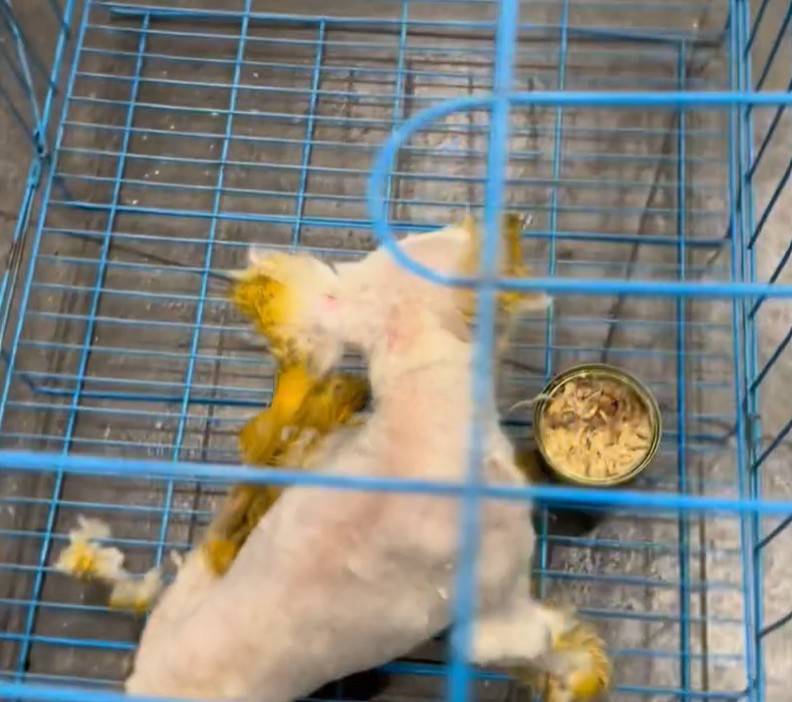
He is now living in foster care, where his daily life no longer resembles the landfill in which rescuers found him.
Soft bedding has replaced the piles of waste.
Food and care are provided rather than uncertain.
Gentle human voices have replaced the need to bark defensively at anyone approaching.
These may sound like ordinary comforts.
For an animal coming from Sunny's circumstances, they are significant.
A safe place gives him the opportunity to experience people differently.
He can rest without needing to remain constantly alert.
He can receive care without being discarded when that care becomes difficult.
He can spend time in sunlight instead of lying among abandoned objects.
The yellow paint that once made him so immediately noticeable has gradually disappeared from his appearance.
What remains is Sunny himself.
Not a strange yellow shape in a landfill.
Not an inconvenience defined by paralysis.
A dog whose life continues despite everything that changed around him.
More Than the Condition He Was Found In
There is still uncertainty in Sunny's story.
No responsible account can promise that his hind legs will recover completely. The damage to his mobility may remain part of his life.
But rescue does not become meaningless simply because an animal cannot return to perfect physical health.
Sometimes the most important change is more basic.
Safety.
Comfort.
Food.
Patient care.
A place where an animal is no longer treated as disposable.
Sunny's circumstances became difficult after paralysis changed his ability to move. The dried paint made those circumstances even worse. But neither condition reduced the value of his life.
His rescue offered something that had been missing when he needed it most: people willing to stay and provide care.
That distinction matters.
Animals can become sick.
They can be injured.
They can develop disabilities that require more time, patience, and responsibility from the humans around them.
Those changes do not turn them into objects that can simply be thrown away.
Sunny's story makes that truth impossible to ignore.
The Light That Was Still There
When rescuers first noticed the bright yellow shape among the garbage, they could have seen only the condition of the dog in front of them.
The dried paint.
The paralyzed legs.
The barking.
The fear.
Instead, they stayed long enough to see more.
They saw eyes that were still watching.
They saw a dog still responding to the world.
They saw a life that needed help rather than judgment.
Today, Sunny is no longer lying in the landfill where he was abandoned. He is living in foster care and receiving the safety and attention his condition requires.
His medical future is not completely known.
But his life is no longer defined only by what happened to him.
The yellow paint is being left in the past.
Fear is slowly making room for trust.
And the dog who once barked at approaching rescuers has already offered a small wag of his tail.
Sunny may never understand why his world changed so painfully.
But now he is learning something far more important through experience:
When he needs help, someone can stay.
When he cannot walk away, someone can carry him toward safety.
And when life becomes difficult, he does not have to be discarded.
Sometimes hope does not arrive as a dramatic transformation.
Sometimes it is a clean coat.
A soft place to rest.
A quiet room.
A tiny movement of a tail.
And for Sunny, those small things are the beginning of a very different life.


