
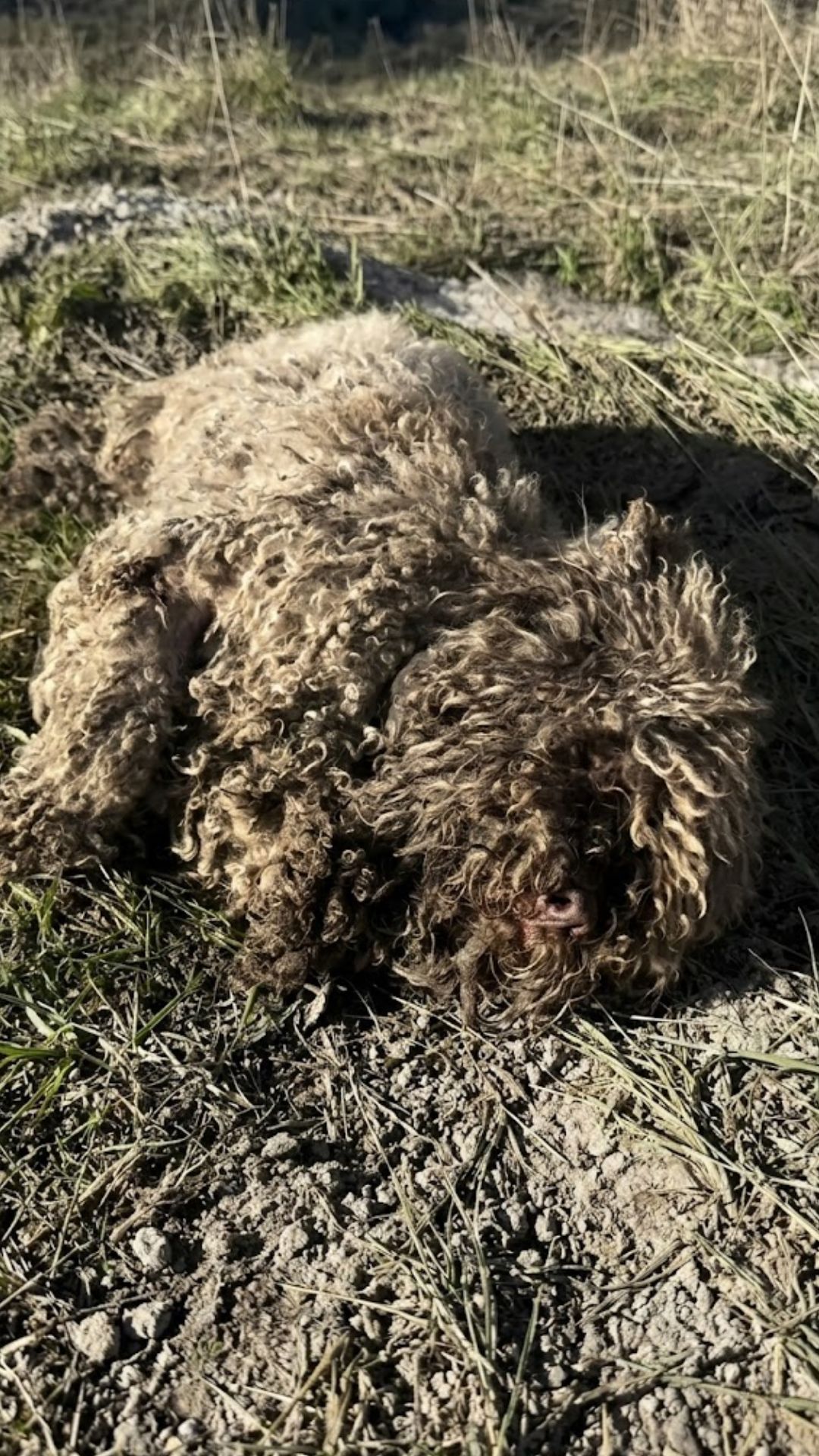
The gray, tangled mass lying against the frozen ground barely looked like an animal.
From a distance, it resembled a small sheep curled into a motionless heap of wool. Its thick covering blended with the dull winter surroundings, making it difficult to recognize anything beneath the layers.
But when animal rescuer Louis Grice approached, something caught his attention.
A slight movement.
Then a pair of eyes looking back at him.
What appeared to be a sheep was actually a dog.
She was alive, but her condition suggested she had been living with serious neglect for a very long time.
And as Louis moved closer, he discovered something else hidden beneath her heavy, tangled coat.
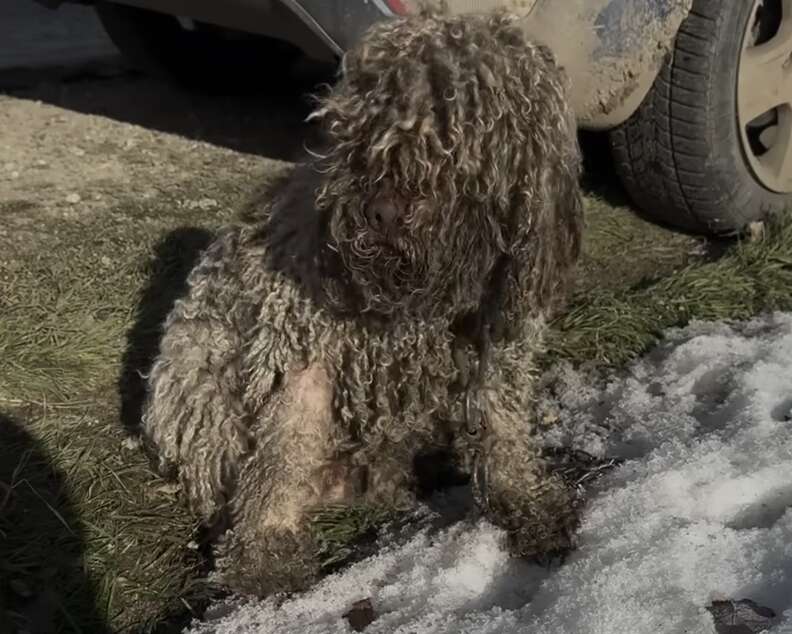
A collar attached to a chain.
The dog could not simply walk away from the place where she had been suffering.
For Louis, the discovery marked the beginning of a rescue that would reveal just how much this quiet animal had endured.
The Eyes Beneath the Tangled Fur
Louis Grice was familiar with the difficult circumstances faced by neglected and abandoned animals in Bulgaria.
Even so, the sight before him was unusual.
The dog was almost completely concealed beneath thick, dirty fur. Her coat had become so severely matted that the individual strands were no longer recognizable.
Instead, they had formed heavy, tangled sections that changed the appearance of her entire body.
From a few steps away, there was little to distinguish her from a bundle of old wool.
It was only when she moved and looked toward Louis that her identity became clear.
There was a living animal beneath that enormous coat.
A dog who needed someone to notice her.
Louis examined her situation and discovered that the collar and chain were buried beneath the matted fur.
The chain made one thing painfully apparent: this was not simply a stray dog wandering through an unfamiliar place.
She had been restrained.
The exact details of her earlier life were not fully known, but the state of her coat suggested that basic grooming and care had been absent for an extended period.
Louis believed the neglect had continued for years.
Her appearance alone was troubling, yet it could not explain everything she had experienced.
There were still injuries hidden beneath the fur.
And those would soon become an important part of her recovery.
A Chain That Had Kept Her in Place
For a dog, freedom of movement is part of ordinary life.
The ability to stand comfortably, walk around, investigate familiar surroundings, and choose a place to rest should never be extraordinary.
For this dog, even those simple activities had become difficult.
The chain attached to her collar restricted her movement, while the enormous weight of her coat added another burden.
Louis understood that removing the chain was an essential first step.
He carefully freed her from the restraint that had kept her in the yard.
The chain fell away.
After so much time spent tethered, she finally had the opportunity to move without it.
But something was wrong.
As she tried to walk, her movements were uneven.
Her difficulty was not simply the result of being covered in heavy fur.
There appeared to be a deeper physical problem affecting one of her front legs.
The discovery changed the urgency of the situation.
Removing the chain had ended one part of her confinement, but it had not relieved the pain she was carrying.
She needed veterinary attention.
Louis arranged for her to receive medical care, recognizing that her condition required more than grooming and a safe place to rest.
For the first time in a long while, the dog's needs were becoming the priority.
And the next stage of her rescue would reveal an injury that had gone untreated.
The Moment Her Rescue Became a Second Chance
There was something particularly moving about the difference between the animal Louis first noticed and the dog he was now trying to help.
At first, she had seemed almost unrecognizable.
Her features were concealed.
Her body was weighed down.
Her movements were limited.
Yet beneath those layers was a gentle animal who had survived long enough for someone to finally intervene.
Louis did not know the full story of how she came to be in that condition.
He could see only the result.
The neglected coat.
The collar.
The chain.
And the obvious difficulty she experienced when attempting to walk.
Each detail pointed to an animal whose basic needs had not been met for an extended period.
Her rescue was not complete when the chain was removed.
It was only beginning.
The next steps would involve understanding her injuries, relieving the burden of her coat, and giving her a chance to recover in a safer environment.
VIDEO: Rescuer Mistakes a Chained Dog for a Sheep in the Snow — Then Discovers the Life Hidden Beneath Her Fur
Beneath the Fur Was an Injury No One Had Treated
At the veterinary clinic, the extent of the dog's condition became clearer.
An X-ray examination revealed an old double fracture in one of her front legs.
The injury had not received proper treatment.
It was an important discovery because it explained why walking had been so difficult even after Louis removed the chain.
She had been carrying an unresolved physical injury alongside the weight and discomfort of her severely matted coat.
The medical findings also raised troubling questions about the care she had received before her rescue.
How long had she been struggling with the injured leg?
How much of her movement had been restricted by pain?
The source does not establish exactly when the fracture occurred, but it confirms that the injury was old and untreated.
For the veterinary team, the priority was no longer discovering the details of her past.
It was giving her the medical attention she needed now.
Before her physical transformation could be fully appreciated, the thick mats covering her body had to be removed.
The team gently sedated her so that the necessary grooming could be performed.
Layer after layer of tangled fur was carefully taken away.
The coat that had made her resemble a sheep gradually disappeared.
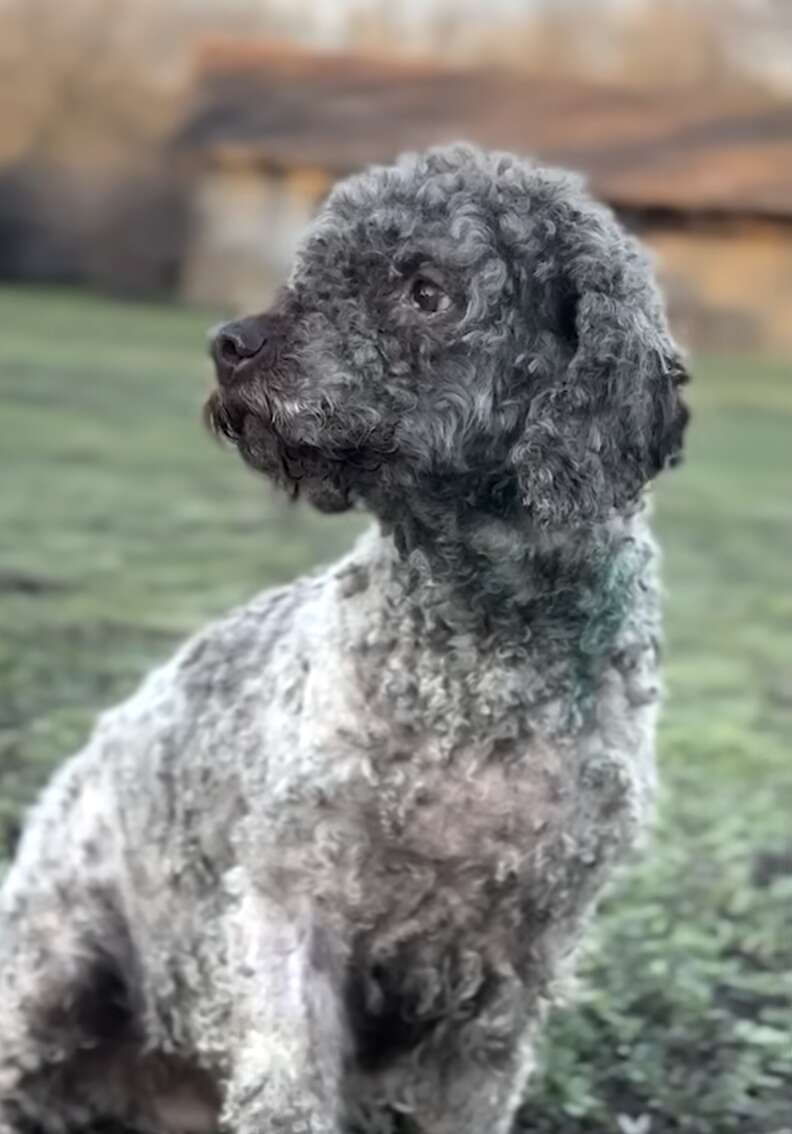
And beneath it was a much smaller dog than her original appearance suggested.
Her gentle features, previously hidden by the mats, became visible.
The difference was remarkable.
The animal Louis had discovered in the cold was no longer concealed beneath an enormous covering of dirty fur.
She could finally be seen as the dog she was.
The rescuers gave her a name.
Tina.
It was a simple name for a dog beginning an entirely different chapter of life.
A Successful Surgery and an Unusually Quiet Patient
Tina's medical needs did not end with the removal of her matted coat.
Her injured front leg required treatment.
The veterinary team performed surgery to repair the fracture, and the operation was successful.
It was a significant step forward.
For a dog who had been struggling to move, receiving treatment for an old injury offered the possibility of a more comfortable future.
But recovery would require patience.
A successful operation did not mean Tina could immediately return to normal activity.
Her leg needed time to heal.
Her body needed an opportunity to regain strength.
And she needed continued care while recovering from the physical effects of her previous living conditions.
During this period, Louis noticed something that stayed with him.
Tina was remarkably quiet.
She did not bark or whine.
According to Louis, she had not made a sound.
There was no confirmed explanation for her silence.
It may have reflected her individual temperament, her experiences, or her adjustment to unfamiliar surroundings.
What mattered most was that her quiet behavior did not prevent her from receiving attention and affection.
She did not need to make noise to communicate that she needed care.
Her condition had already said enough.
And now, with the chain gone, the heavy fur removed, and her injured leg treated, Tina finally had an opportunity to heal.
Small Signs That Tina Was Learning to Trust
Physical recovery was only one part of Tina's journey.
Her response to kindness became another encouraging development.
Despite her difficult past, Tina showed a gentle and affectionate nature.
Rather than avoiding human contact, she appeared to welcome it.
She leaned toward the people who touched her kindly.
She sought warmth and closeness.
Louis described her as an exceptionally sweet dog who wanted affection.
For those following her recovery, this was one of the most meaningful discoveries.
Tina's earlier circumstances had given her many reasons to be cautious.
She had lived with a chain, a neglected coat, and an untreated injury.
Yet she was still willing to accept care from people.
That willingness made the quieter parts of her recovery especially important.
A gentle touch was no longer something she had to endure while restrained.
It could become a moment of comfort.
Human attention no longer meant only the presence of someone nearby.
It could mean care, reassurance, and companionship.
Her behavior suggested that she was becoming increasingly comfortable with the people helping her.
Of course, emotional recovery cannot be measured as precisely as the healing of a bone.
There is no X-ray that can show when an animal begins to feel secure.
Instead, caregivers observe behavior.
Whether a dog approaches willingly.
Whether she accepts gentle contact.
Whether she shows interest in the world around her.
For Tina, those signs were encouraging.
Her affectionate nature was becoming one of the defining parts of her story.
She was no longer known only as the dog who had been found hidden beneath tangled fur.
She was Tina.
A small, gentle companion with a personality of her own.
Six Weeks Into a Journey Toward Healing
Tina's recovery was expected to take approximately twelve weeks.
At the time of the update described in her story, she had completed six weeks of that process.
She was halfway through the planned healing period.
Progress was gradual, but encouraging.
Her injured leg was recovering, and her body was slowly regaining strength.
The difference between her earlier circumstances and her life under Louis's care was already significant.
She was no longer tethered in the cold.
Her heavy, matted coat had been removed.
Her leg had received surgical treatment.
And she was surrounded by people willing to respond to her needs.
These changes gave Tina something that had been missing from her previous circumstances: an opportunity to move forward.
As her condition improved, she began showing more interest in her surroundings.
The yard, once associated with confinement, could now be a place to explore.
Even the snow had taken on a different meaning.
Instead of simply enduring the cold while restrained, Tina was described as playfully hopping through it during her recovery.
It was a small image, but a meaningful one.
A dog once so burdened by fur and injury that she struggled to walk was beginning to experience movement in a different way.
Her recovery still had to proceed carefully.
There were weeks of healing ahead.
But the signs were promising.
She was receiving treatment.
She was responding to affection.
And the dog once mistaken for a sheep was becoming recognizable not only in appearance, but in personality.
The Home Tina Still Hopes to Find
Rescue stories sometimes end with a dog immediately finding a permanent family.
Tina's journey had not reached that stage yet.
At the time of the reported update, she remained under Louis's care while continuing her recovery.
Her surgery had been successful, but she still needed additional healing time before she would be ready for adoption.
That distinction mattered.
She had been rescued.
She had received medical treatment.
She was making progress.
But her permanent home was still part of the future.
Louis hoped that once Tina was fully recovered, she would find someone willing to give her the affection and stability she deserved.
Her needs were not complicated.
She needed a safe home, responsible care, and people who would appreciate her gentle nature.
A family willing to look beyond the circumstances in which she had been found.
A family who would see the affectionate dog beneath the history of neglect.
The physical changes in Tina were already easy to recognize.
Her enormous coat had been removed.
Her injured leg was healing.
Her movements were improving.
But the most important change was larger than her appearance.
Her life was no longer defined by a chain.
The dog who had once been nearly invisible beneath dirty, tangled fur was now known by name and cared for as an individual.
She was no longer simply surviving in the same place.
She was recovering, forming connections, and preparing for the possibility of a different future.
There is still an unfinished part of her story.
The source does not confirm that Tina has been adopted, and her recovery was ongoing at the time described.
For now, her progress offers a hopeful reminder of what timely intervention and consistent care can accomplish.
Louis could have mistaken the strange shape in the snow for something that did not need his attention.
Instead, he approached.
He noticed the eyes beneath the fur.
And he discovered a dog who needed help.
That decision led to freedom from her chain, treatment for an old injury, and a genuine chance to recover.
Tina's life has already changed in ways that once seemed unlikely.
The next chapter remains unwritten.
But when the day comes for her to leave Louis's care, the hope is that she will enter a home where her gentle nature is welcomed and her needs are never overlooked again.
For a dog who spent so long hidden beneath a neglected coat, being seen and cared for has already made an extraordinary difference.
And perhaps the greatest gift still awaiting Tina is something beautifully ordinary.
A family who will love her for the rest of her life.


