
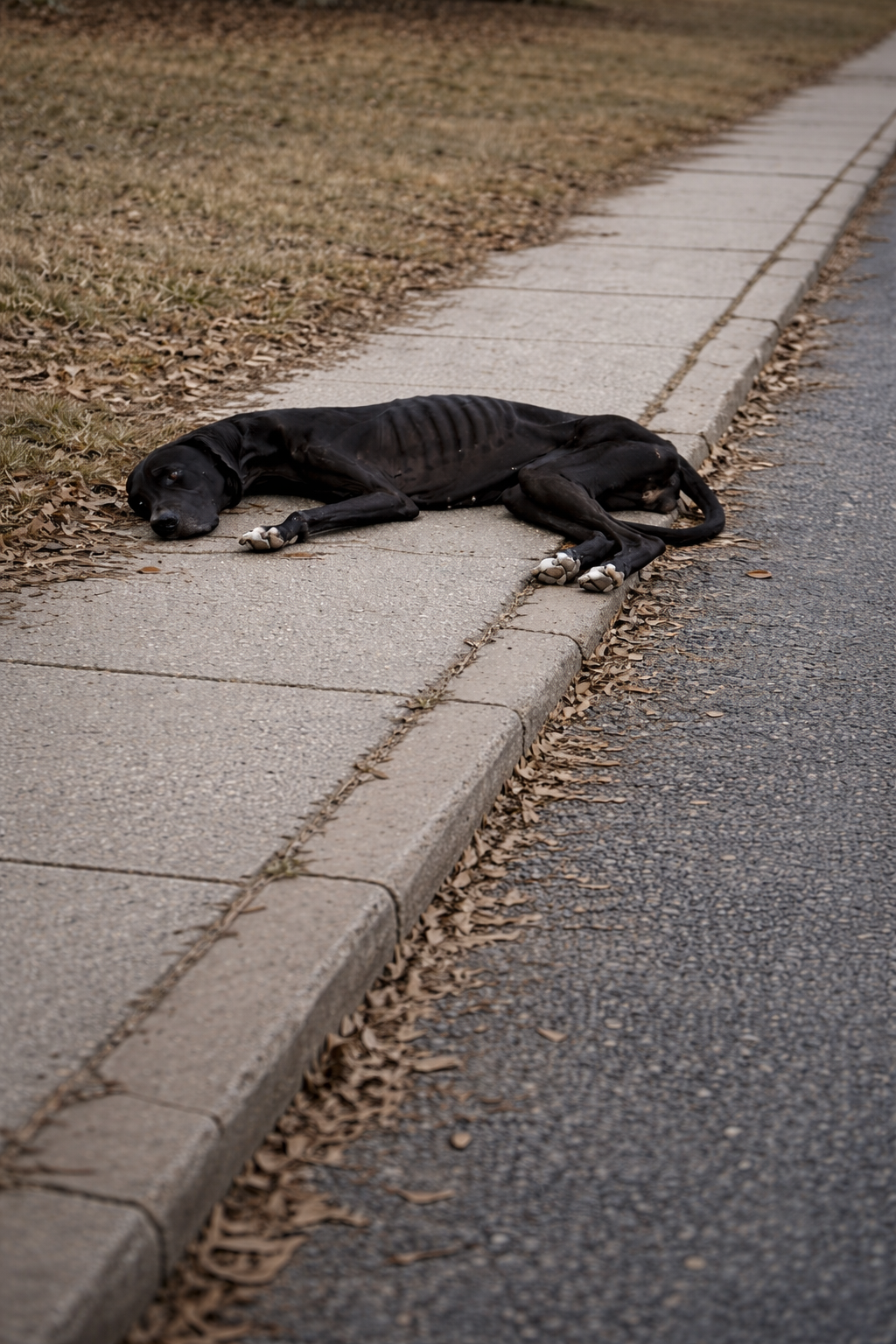
Cars kept moving around her.
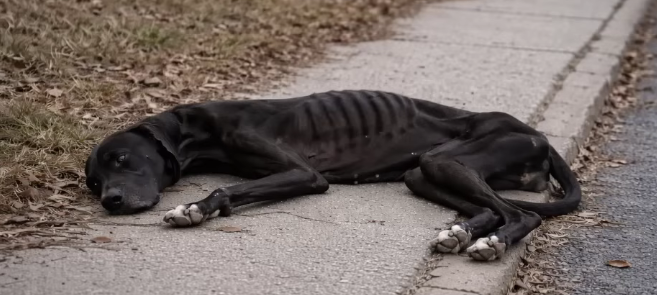
In the middle of the road lay Lola, a black Great Dane whose once-powerful frame had become painfully thin. Her ribs were visible beneath her coat, and even lifting her head seemed to require more strength than she had left.
She was believed to be only five or six years old.
Yet the exhaustion in her face made her seem much older.
For an unknown amount of time, people passed by without stopping. Lola remained there, exposed and almost unable to move, until rescuers finally reached her.
That moment did not mean the danger was over.
It simply meant she would no longer have to face it alone.
The Great Dane the Road Had Almost Forgotten
Great Danes are known for their size and strength, but there was little strength left in Lola when help arrived.
Her body had become extremely thin. Her muscles had wasted away, and she appeared unable to support herself for more than brief moments.
What had happened before she was found was not fully known.
What rescuers could see was enough.
Lola had been without the nourishment and care she needed for far too long.
Still, there was something striking about the way she responded when people approached her.
She did not lash out.
She did not resist the hands trying to help.
She simply watched.
Even in such a fragile condition, she remained calm while rescuers moved her away from the road and toward the medical attention she urgently needed.
For Lola, reaching safety was only the beginning.
Her body still had an enormous fight ahead.
A Medical Fight That Could Not Be Rushed
At the veterinary clinic, the extent of Lola's condition became clearer.
Her breathing was weak and shallow. Severe muscle loss made standing difficult, and nearly every movement seemed to drain what little energy she had.
Tests also revealed severe heartworm disease.
It was a serious diagnosis requiring careful, long-term treatment, and Lola was already starting that process from an extremely weakened state.
Then additional problems appeared.
She developed a fever.
She began vomiting.
A thick nasal discharge suggested that her body was also struggling with infection.
For the people caring for her, those first hours carried no easy reassurance.
Lola needed food, rest, medical supervision, and time.
Most of all, she needed enough strength to make it through one day before anyone could think too far ahead.
Yet whenever someone spoke softly to her, Lola did something the veterinary team had not expected.
She tried to rise.
Her legs trembled beneath her.
Her body seemed barely capable of cooperating.
But she tried anyway.
VIDEO: Too Weak to Stand Alone, Lola Kept Trying Until Gentle Hands Helped Her Rise
The footage from those early days captures the reality of her condition more clearly than any dramatic description could.
Lola is supported by a harness while gentle hands help steady her enormous but fragile body.
There is no sudden transformation.
No effortless recovery.
Just careful movement.
A few uncertain steps.
A dog learning how to trust her own legs again.
For an animal as weak as Lola had become, those steps meant something important.
She was still participating in her own recovery.
A Few Inches Became Something Worth Celebrating
Lola was given a quiet bedroom where she could rest away from unnecessary noise and pressure.
During those first difficult nights, her caregiver stayed close and listened carefully to her breathing.
Her condition could change quickly, and even small differences mattered.
Walking required support.
A sling was placed beneath her abdomen to help carry some of her weight while she practiced moving her legs.
At first, progress could be measured in inches rather than yards.
A few steps forward.
A pause.
Another attempt.
Nothing about it was rushed.
Lola's body had been weakened over time, and rebuilding strength would also take time.
The same patience applied to food.
Her appetite did not return all at once. Instead, caregivers offered small amounts of soft, nourishing food, including turkey and freshly cooked eggs.
She began to eat.
Not large meals.
Not quickly.
But enough to give her body something to work with.
Every bite mattered because recovery required more than medicine. Lola needed calories, rest, hydration, and the gradual rebuilding of a body that had been running on almost nothing.
Then another kind of change appeared.
Her tail moved.
Just a gentle wag at first.
Later, she gave her caregiver a small lick on the hand.
Neither moment was dramatic.
That was what made them meaningful.
Lola was no longer simply lying quietly while care happened around her.
She was beginning to respond.
The physical recovery remained slow, but these small interactions offered another kind of progress.
Her personality was beginning to return alongside her strength.
Sunlight, Slow Steps, and a Different Kind of Strength
As the days passed, Lola became steadier.
Eventually, she was strong enough to spend short periods outdoors.
Sunlight warmed her black coat while she stood carefully in the yard, still uncertain of the legs beneath her.
In the beginning, she did very little.
That was enough.
Recovery did not need to look impressive.
Standing outside was progress.
Taking several steps was progress.
Eating another meal was progress.
Resting comfortably was progress.
Gradually, those tiny achievements began to connect.
Lola started taking short walks around the yard.
They were slow and controlled, but they were real.
The Great Dane who had once been unable to lift herself from the road was moving under her own power again.
As her body stabilized, more of her temperament became visible too.
She was gentle.
Quiet.
Patient.
She did not seem to demand constant attention. Instead, she often stayed calmly beside the people caring for her, leaning close and accepting the affection being offered.
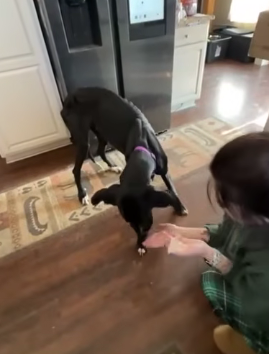
The contrast with her first days was impossible to miss.
Before, nearly every ounce of energy had gone into simply staying upright.
Now there was room for something more.
Comfort.
Connection.
Curiosity about the world around her.
Those changes did not erase what her body had endured.
But they showed that Lola's life was no longer defined only by the condition in which she had been found.
Recovery Was Built From Ordinary Acts of Care
There was no single moment that restored Lola.
Her progress came from many quiet things repeated day after day.
Medical attention.
Small meals.
A support sling beneath her body.
A safe place to sleep.
Short walks.
Someone nearby during difficult nights.
Gentle encouragement whenever she tried to stand.
Rescue often looks dramatic from the outside because the moment an animal is found can happen quickly.
Healing is different.
Healing is usually repetitive.
It means offering another meal even when yesterday's meal was barely touched.
It means helping a weak dog stand again even after she could only manage a few steps the day before.
It means paying attention to subtle changes that might otherwise seem insignificant.
A steadier breath.
A stronger stance.
A wagging tail.
A lick on a familiar hand.
With Lola, those quiet moments slowly added up.
Her body became stronger.
Her eyes appeared brighter.
The dog who had needed a harness simply to remain upright was gradually able to carry herself again.
Nothing about the process suggested that recovery was easy.
It showed something more realistic.
Given safety, consistent care, and enough time, a severely weakened animal can sometimes begin finding strength in places where almost none seemed to remain.
The Difference One Decision Made
Lola's story began in one of the most public places imaginable.
She was lying in a road where people could see her.
And still, cars went around.
That detail is difficult to forget.
Not because every passerby knew what to do, but because Lola's future changed only after someone finally acted.
Once she was removed from the road, an entirely different sequence of events became possible.
Veterinary care could begin.
Her heartworm disease could be identified.
Her fever and other symptoms could be monitored.
She could eat.
She could rest somewhere safe.
She could receive support while learning to walk again.
And eventually, she could stand outside beneath the sunlight instead of collapsing on pavement.
The strongest part of Lola's story may not be that she survived her worst days.
It may be how quietly she kept participating in the effort to save her.
When she barely had strength, she tried to stand.
When food was offered, she slowly began eating.
When her legs became steadier, she walked a little farther.
When she began to feel safer, her tail moved again.
Lola did not recover through one extraordinary moment.
Her second chance was built from dozens of ordinary ones.
A harness.
A meal.
A quiet room.
A patient hand.
Another step.
Then another.
The Great Dane who once lay almost motionless in the middle of the road can now stand again because, eventually, someone chose not to drive around her.
Someone chose to stop.
And for Lola, that decision changed everything.


