
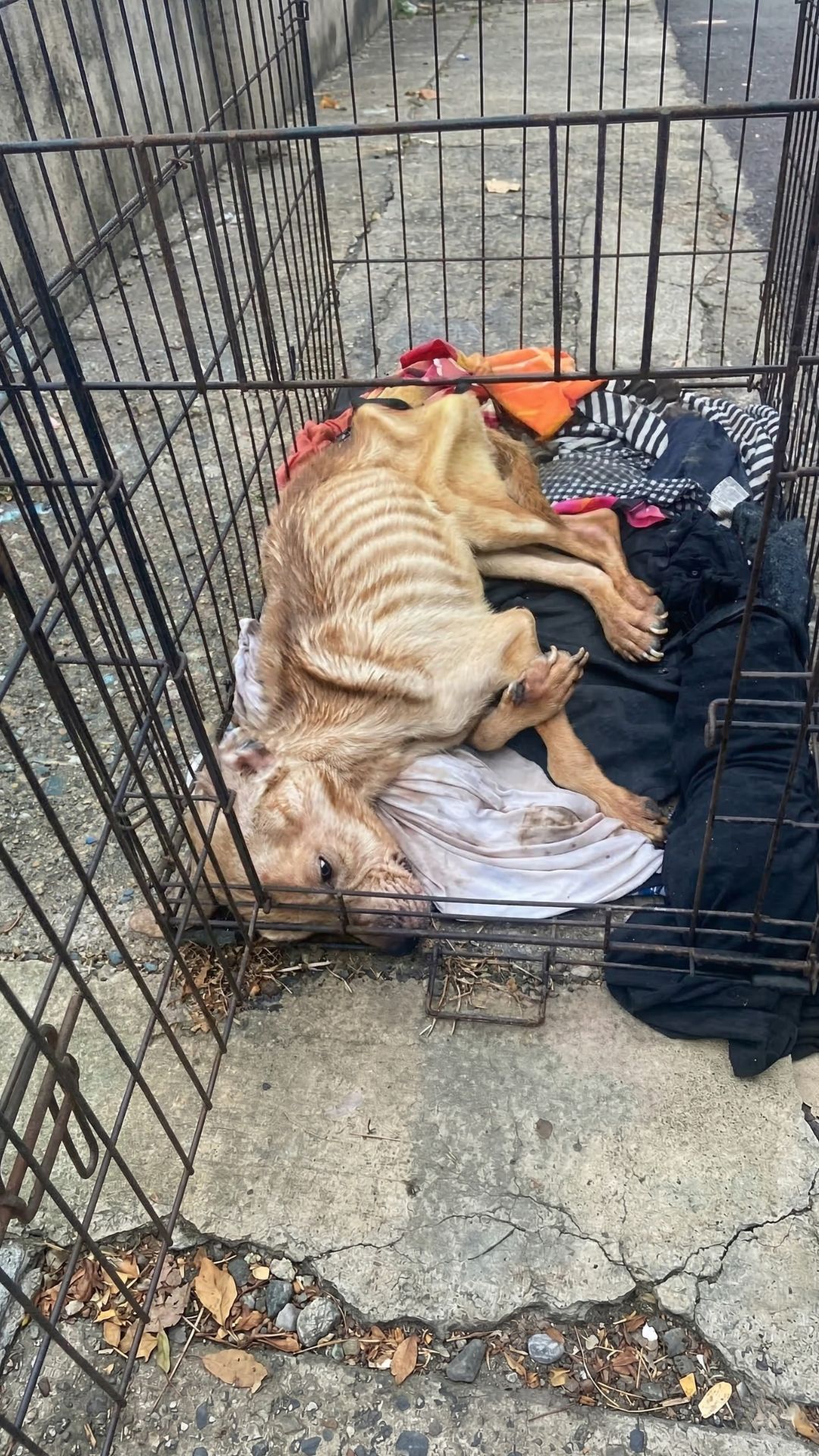
The little tan dog was lying inside a wire crate when officers entered the Philadelphia home. She was so weak that lifting her head seemed beyond her strength.
There was no excited barking.
No curious movement toward the people who had just arrived.
Only a fragile, exhausted animal resting on stained blankets, her thin body showing how urgently she needed help.
The officers had come to the property during an eviction. They had reason to expect an empty home, not a living creature in such a desperate condition.
Yet there she was.
A small dog who would later be named Lexi, weighing just eight pounds and struggling to survive.
What happened after that discovery would gradually turn one of the saddest moments of her life into the beginning of something extraordinary.
But first, she had to make it through the next few days.
The Little Dog Nobody Expected to Find
An eviction can leave a home empty and unfamiliar. Furniture disappears, belongings are removed, and the spaces that once held everyday life become quiet.
In this Philadelphia property, however, something had been left behind.
Inside a small wire crate lay a tan dog whose physical condition immediately revealed the seriousness of her situation.
Her ribs were clearly visible. Her body had lost so much weight that she appeared painfully fragile.
She could not get up to greet the officers.
She could barely move at all.
The circumstances suggested that she had been without adequate food, warmth, and attention for days. The complete details of what happened before the discovery were not known, but her condition left little doubt that she needed immediate assistance.
Her body temperature had fallen dangerously low.
At only eight pounds, she had very little strength remaining.
It is difficult to imagine how overwhelming the situation must have been for such a small animal. The crate offered confinement, not the medical help or nourishment she desperately needed.
For the people who found her, there was no time to lose.
The dog was still alive.
That single fact meant there was an opportunity to help her.
A Rescue That Could Not Wait
The tiny dog was taken to the Pennsylvania SPCA, where veterinary professionals began working to stabilize her.
The journey from the property to medical care marked the first important change in her circumstances.
She was no longer alone inside the crate.
People now knew she was there, understood the seriousness of her condition, and were taking action on her behalf.
Yet arriving at the shelter did not mean the danger had passed.
Lexi, as she would come to be known, was in critical condition.
Her body temperature was too low, her strength was severely depleted, and she needed intensive support.
The veterinary team faced a difficult challenge. They needed to help a profoundly weakened dog recover without placing additional strain on her fragile body.
There was no guarantee that treatment would succeed.
Still, the staff had something important that Lexi had been missing.
The ability to provide consistent, professional care.
For an animal who had been found almost motionless, even the earliest steps toward stability mattered.
The first goal was not to make her walk, play, or behave like a healthy dog.
It was simply to help her survive.
The Delicate Work of Keeping Lexi Alive
At the Pennsylvania SPCA, Lexi's treatment began with the most urgent needs.
Staff surrounded her with heated blankets to help restore her dangerously low body temperature.
Intravenous fluids were administered as part of the effort to stabilize her.
Veterinarians also discovered that her protein levels were critically low. Her condition was serious enough to require an emergency transfusion.
Each intervention was part of a larger effort to support a body that had been pushed far beyond ordinary weakness.
Lexi could not stand.
She could not even reposition herself without assistance.
For a healthy dog, changing position while resting is an effortless movement. For Lexi, that simple action was beyond her physical ability.
Her caregivers had to help.
Every few hours, staff members carefully adjusted her position and gently massaged her muscles. These small acts were important because remaining in one position for too long could create further problems.
Her recovery required attention not only to the major medical concerns but also to the smallest daily needs.
Warmth.
Support.
Careful handling.
And time.
There was something quietly moving about the contrast between Lexi's condition and the attention she now received.
The same dog who had been found lying helplessly inside a crate was now surrounded by people working to give her another chance.
But the early days remained uncertain.
The staff could provide treatment, nutrition, and constant monitoring. They could respond to her needs and adjust her care.
What they could not do was guarantee how quickly her body would respond.
For several days, the question remained open.
Would Lexi become strong enough to recover?
A Small Movement That Meant So Much
Recovery is not always marked by one dramatic event.
Sometimes, progress appears in a movement so ordinary that it would barely attract attention under different circumstances.
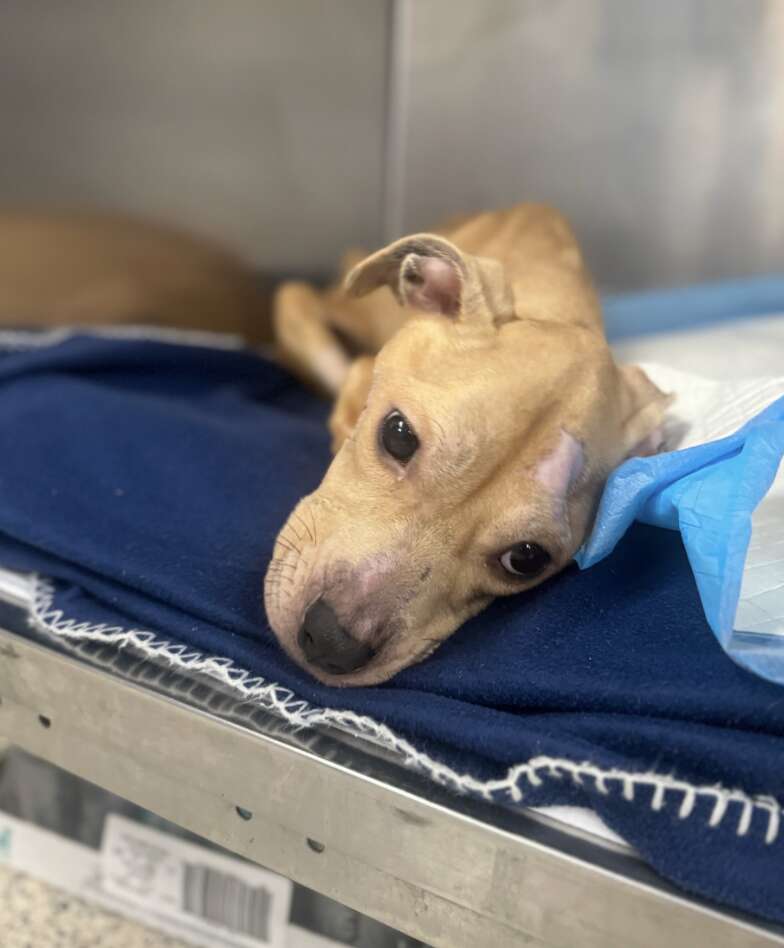
For Lexi, that moment came when her caregivers found her sitting upright without assistance.
She had done it herself.
Only days earlier, this little dog had been unable to lift her head. Now she had enough strength to support her body.
It was not the end of her recovery.
But it was a clear sign that the effort to save her was beginning to make a difference.
VIDEO: Found Too Weak to Lift Her Head, Lexi Slowly Finds the Strength to Stand Again
Her caregivers continued helping her rebuild strength through food, rest, and medical attention.
Soon, she was able to eat while sitting comfortably.
That detail may sound small, but it represented several meaningful changes.
She was becoming stronger.
Her body was responding to care.
And she was beginning to perform ordinary activities that had seemed impossible when she first arrived.
Meal by meal, Lexi gradually gained weight.
The sharp outline of her bones became less prominent as her condition improved.
There was no sudden transformation. The progress came through repeated, consistent care and the slow return of abilities that had been lost.
Then another milestone arrived.
With assistance, Lexi stood on her feet.
Her first steps were unsteady, and she still needed support. But the little dog who had once been unable to move independently was beginning to walk.
It was an important step toward regaining her mobility.
And soon, something even more personal changed.
Lexi began to wag her tail.
For the people who had cared for her through those difficult early days, that timid movement offered a glimpse of the dog emerging as her health returned.
She was doing more than responding to medical treatment.
She was beginning to engage with the world again.
Learning That Life Could Be Gentle Again
Physical recovery was only one part of Lexi's journey.
During the weeks after her rescue, her behavior began changing as well.
The dog who had once lain almost motionless in a crate slowly became more curious about her surroundings.
She started moving with greater confidence.
She discovered toys.
She began playing.
These were ordinary experiences for many family pets, but for Lexi, they represented an enormous change from her condition when she was found.
Less than a month after the rescue, her transformation was already striking.
Her body was stronger, and her growing interest in the world was becoming increasingly visible.
She was still shy in unfamiliar situations.
That hesitation did not disappear all at once.
But the people caring for her began seeing another side of her personality.
Lexi was gentle.
She was affectionate.
And as she became more comfortable, she formed close bonds with the caregivers who had supported her recovery.
The relationship between an animal and a caregiver often develops through familiar routines.
For Lexi, those routines included the daily assistance and attention documented throughout her treatment.
People helped her when she could not move.
They supported her as she regained her ability to eat and stand.
They continued caring for her as she became strong enough to explore and play.
Over time, her responses reflected growing comfort around the people who looked after her.
The change was visible in her movements and behavior.
The hesitant tail wag.
The willingness to play.
The growing confidence in her steps.
Lexi was no longer simply an animal receiving emergency treatment.
She was becoming a dog with the energy and freedom to enjoy ordinary experiences again.
The Family Who Looked Toward Her Future
As Lexi grew healthier, another important chapter approached.
She would need a permanent home.
The Pennsylvania SPCA eventually determined that she had recovered enough to become available for adoption.
By then, her story had attracted considerable interest.
Adoption applications began arriving from people who wanted to give her a home.
For a dog who had once been left behind, the change in circumstances was remarkable.
She was no longer an overlooked animal in an empty property.
People were actively hoping to welcome her into their lives.
Among the applicants, one family was selected to become her new family.
They were prepared to welcome a dog whose earliest known circumstances had been difficult, but whose future could look very different.
Before leaving, Lexi completed her remaining medical treatments.
Then came the moment that the rescue team had been working toward.
She was going home.
Her first car ride with the family was not entirely comfortable. Lexi appeared uncertain, and the unfamiliar experience required patience.
Her new family offered gentle reassurance as she adjusted.
It was a fitting beginning for a dog who had already made such progress through steady, compassionate care.
There would be new routines, new surroundings, and new experiences.
But this time, she would have a family beside her.
Her adopters also made a meaningful decision.
They gave her a new name.
Molly Brown.
The name was chosen to reflect resilience and survival, qualities that had become central to her story.
Lexi would always be part of the history of her rescue.
But Molly Brown was the name she would carry into her new life.
From a Wire Crate to the Freedom of the Beach
The contrast between Molly Brown's rescue and her life after adoption is extraordinary.
When officers first found her, she could barely move.
Today, the dog once known as Lexi runs with energy and enthusiasm.
She plays.
She explores.
She enjoys the freedom to move without the weakness that once made standing nearly impossible.
Her rescuers have watched videos of her running along the beach, her ears moving in the wind and her tail lifted high.
Those images tell an important part of her story.
The same small dog who once needed help simply changing position can now run across an open stretch of sand.
The dog who required intensive care to survive is enjoying the ordinary pleasures of life with a family.
The transformation did not happen through one act alone.
It began when officers discovered her inside the home.
It continued when veterinary professionals responded to her critical condition.
It depended on days of careful monitoring, medical treatment, feeding, and physical support.
And it became a lasting new beginning when a family welcomed her home.
Each stage mattered.
Without the discovery, she might not have received help in time.
Without veterinary care, her severely weakened body might not have recovered.
Without patient caregivers, those first difficult days would have been even harder.
And without adoption, the next chapter of her life would have remained uncertain.
Together, those moments changed what was possible for her.
The Life Molly Brown Was Given a Chance to Enjoy
Molly Brown's story is not only about the distance between two images: a frail dog in a crate and a healthy dog running on a beach.
It is also about everything that happened between them.
The heated blankets used to support her fragile body.
The medical treatment given when her condition was critical.
The careful assistance when she could not turn or stand.
The first time she managed to sit upright.
The gradual return of her appetite and strength.
The uncertain first steps.
And the quiet moment when her tail began moving again.
None of those achievements was insignificant.
Together, they formed the path from emergency rescue to recovery.
Her life also illustrates why helping an animal does not end with removing it from immediate danger.
Sometimes, rescue means days of attentive medical care.
Sometimes, it means allowing an animal to become stronger at its own pace.
And sometimes, the final piece is a family willing to provide the stability and affection that make a permanent home possible.
Molly Brown received all three.
Her beginnings in the Philadelphia home were marked by serious neglect and physical weakness. But those circumstances did not become the final definition of her life.
She recovered.
She was adopted.
And she went on to enjoy the freedom, companionship, and everyday happiness that had once seemed so far away.
For the people who helped save her, watching her run along the beach offers a beautiful reminder of what their work made possible.
A little dog once left behind was given the chance to move forward.
And this time, she had a family to move forward with.


