
The moving trucks were gone. The curtains were closed. And somewhere inside a house that appeared completely empty, a small white dog was still waiting.
Her name was Eyelit.
For seven days, according to rescuers, she had been alone without food or water. The people who once lived there had moved away, leaving behind furniture scraps, unwanted belongings, and a little companion who depended on them.
From the street, nothing seemed unusual.
The driveway was quiet. The house showed no signs of activity. Neighbors had little reason to imagine that a living animal remained behind those walls.
But then came a sound.
A faint cry broke through the stillness.
It was easy to miss at first. Yet someone heard it, paid attention, and eventually discovered that the supposedly vacant house wasn't empty after all.
That small moment of concern would change Eyelit's life.
The Little Dog Hidden Behind the Silence
When concerned neighbors entered the former family home, they found rooms scattered with discarded items and household clutter.
Among everything left behind was something they never expected.
A small white dog.
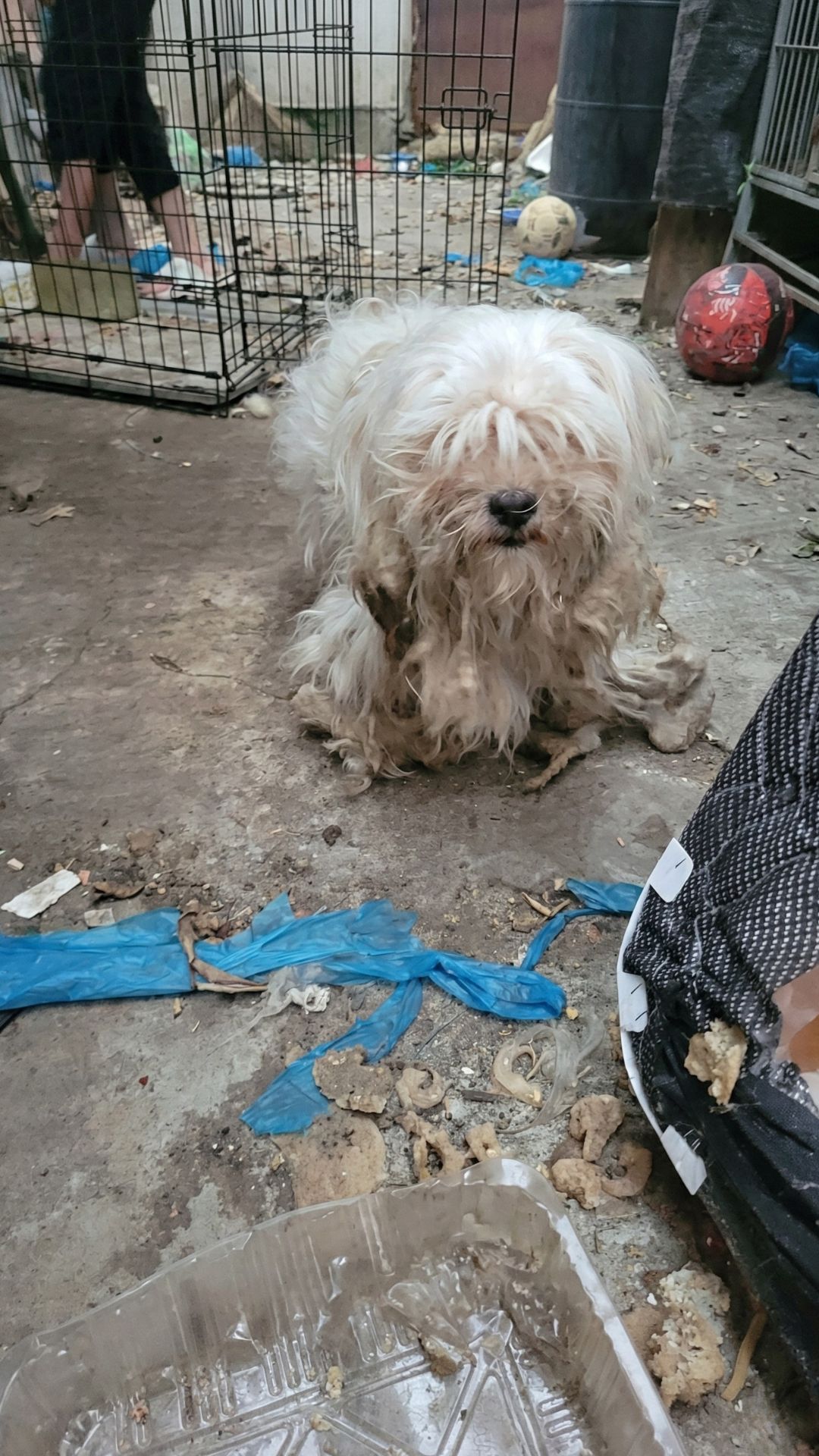
Eyelit was sitting almost motionless, her body covered in such thick, tangled fur that her natural shape was difficult to recognize.
Her condition told a troubling story.
The coat that should have protected her had become a heavy, restrictive layer. Large sections of fur had twisted together into dense mats, pulling against her skin and interfering with ordinary movement.
Even taking a few steps appeared uncomfortable.
The fur around her face had grown so thick that much of her vision was obstructed.
And beneath that neglected coat was a dog who had reportedly spent an entire week with no access to food or water.
It wasn't simply a matter of needing a haircut.
Eyelit needed someone to recognize that she was struggling.
The neighbors had come expecting to find remnants of a move. Instead, they discovered a vulnerable animal who had been overlooked when everyone else left.
Her presence raised an immediate question.
How could a dog be left behind in a house that everyone believed had been vacated?
An Explanation That Could Not Change Her Situation
After finding Eyelit, the neighbors attempted to reach the people who had previously lived in the house.
Perhaps there was an explanation.
Perhaps the dog had been left behind during an emergency, or there had been some misunderstanding about who would care for her.
But according to the account shared by rescuers, the former owners said they had nowhere to take Eyelit.
That explanation left her situation unchanged.
She was still inside the empty house.
Still without the care she needed.
Still carrying a heavy coat that had clearly gone unattended for a long time.
There was no reported arrangement for a new home or alternative caretaker before the family moved away.
For Eyelit, the consequences were immediate and physical. Whatever circumstances led to the decision, she had been left in a place where she could not provide for herself.
Dogs depend on people for basic necessities: food, clean water, protection, grooming, and medical attention when something goes wrong.
Eyelit had been deprived of that support.
Yet one important thing had changed.
Someone now knew she was there.
And the neighbors were no longer willing to leave her unseen.
When Help Finally Reached Eyelit
The rescue volunteers who came for Eyelit could not be certain how she would respond.
After days of isolation, hunger, and discomfort, a dog might become fearful of unfamiliar hands. Some retreat when approached. Others resist because they cannot understand what is happening.
Eyelit responded differently.
When people moved toward her, she leaned into their attention.
She did not growl or try to escape.
Instead, she accepted the gentle contact being offered.
There was something especially moving about that response.
Her body showed clear signs of prolonged neglect, yet she remained receptive to human kindness.
The rescuers could see how much care she needed. But they could also see that beneath the tangled fur was an affectionate little dog.
For the first time since the house had been left behind, Eyelit was no longer alone.
The people standing beside her had come with a purpose.
They intended to bring her somewhere safe.
What began as a faint cry inside a silent building had become the first step toward a different future.
VIDEO: Abandoned for Seven Days in an Empty House, Eyelit Finally Meets the People Who Came to Save Her
Her rescue was important, but getting her out of the house was only the beginning.
The condition of her coat required professional attention, and her overall health needed to be assessed.
There was much more to Eyelit's recovery than simply removing her from the place where she had been found.
She had been discovered.
Now she needed care.
Beneath the Tangled Fur Was a Dog Who Still Trusted People
After her rescue, Eyelit was taken to a veterinary clinic.
There, the extent of her physical discomfort became easier to understand.
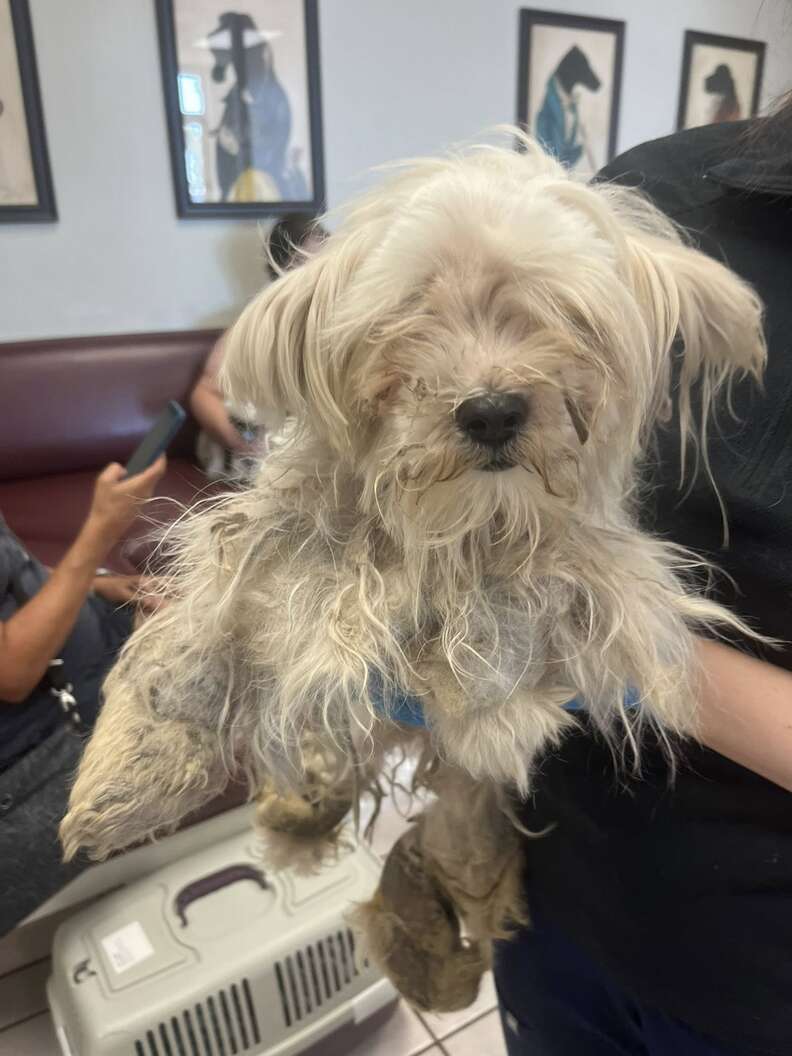
Her fur had formed thick, dense mats that pressed and pulled against her skin. The condition had caused irritation and areas of soreness, making even ordinary movement uncomfortable.
Grooming was no longer only about appearance.
It had become an essential part of restoring her comfort and well-being.
The accumulation of tangled hair also affected her face.
With fur covering much of her eyes, Eyelit had been navigating her surroundings with limited visibility.
The burden was both visible and difficult to ignore.
A dog's coat normally serves an important protective function. But when long fur becomes severely matted, the same coat can interfere with daily life.
Simple movements become harder.
Skin can remain irritated beneath the tightly packed hair.
And activities that should be effortless may become uncomfortable.
For Eyelit, this was not a recent inconvenience. Her appearance suggested that proper coat maintenance had been missing for a considerable time.
Still, her behavior at the clinic offered a striking contrast to her physical condition.
According to the rescue account, Eyelit remained gentle and affectionate while the veterinary staff and volunteers examined and cared for her.
She even gave little kisses to the people helping her.
Those gestures did not erase what she had experienced.
But they revealed something meaningful about the dog beneath the neglected coat.
Despite everything, she was willing to accept kindness.
The veterinary visit also marked an important change in her circumstances.
Inside the abandoned home, Eyelit had no way to relieve the tight mats or address the discomfort they caused.
Now, she was surrounded by people who recognized those problems and could begin helping her.
Nothing about her difficult situation could be undone immediately.
The seven days alone had already happened.
The neglected coat had already taken its toll.
But the next part of her life would not have to look like the last.
The Day Her Real Face Finally Appeared
The following day brought one of the most significant moments in Eyelit's recovery.
It was time to remove the tangled fur.
The grooming process required patience and care. Her coat had become so densely matted that the accumulated hair needed to be removed gradually rather than treated like an ordinary trim.
As the groomers worked, the extent of what had been covering her became increasingly clear.
Layer after layer was taken away.
The heavy mats that had restricted her movement began to disappear.
Slowly, Eyelit's natural shape emerged.
Her face, once almost hidden by overgrown fur, became visible again.
Her eyes were no longer buried behind the tangled coat.
And without so much weight pulling against her skin, she could move with greater ease.
For anyone who had seen her inside the abandoned house, the difference was remarkable.
There was no need for a dramatic medical procedure to understand why the grooming mattered.
It addressed a source of discomfort that had been affecting her daily life.
The transformation was visible in her appearance, but its importance went far beyond how she looked.
Eyelit could see more clearly.
She could move more comfortably.
She no longer had to carry the same dense covering of tangled fur wherever she went.
These were ordinary comforts that every dog deserves, yet they had been missing from her life.
The grooming did not create a new dog.
It allowed the little dog who had always been there to emerge from beneath the neglect.
And perhaps that was the most meaningful part of the entire process.
Under all those mats was still Eyelit.
The same gentle dog who leaned toward her rescuers.
The same affectionate companion who offered kisses to the people examining her.
The same small animal who had waited in a house everyone thought was empty.
Only now, she could begin experiencing life without the physical burden that had followed her for so long.
Learning What Safety Feels Like Again
Removing the matted fur was a major step, but Eyelit's story did not end at the grooming table.
She also needed something far more lasting.
A secure place to live.
Regular meals.
A comfortable place to rest.
People who would pay attention to her needs instead of leaving her behind.
According to the rescue story, Eyelit now has those things.
Her life today is very different from the one rescuers encountered in that vacant house.
She lives in a caring environment where her basic needs are met and where she is surrounded by people who value her well-being.
The contrast is difficult to overlook.
Before, there had been an empty property with no one to provide for her.
Now, she has a home where food arrives regularly and comfortable places to sleep are available.
Before, her tangled coat had made simple movement difficult.
Now, she can move without carrying that same painful weight.
Before, the people responsible for her had gone away.
Now, she is cared for by people who have made room for her in their lives.
For an animal who had spent seven days alone, these ordinary forms of stability represent an enormous change.
Recovery is not always defined by one dramatic moment.
Sometimes it is the accumulation of things that should never have been missing in the first place.
Food.
Rest.
Gentle care.
The reassurance that someone will be there.
Eyelit may never be able to communicate exactly what those days alone felt like. The full details of her earlier life are not known.
What is clear is the difference between the condition in which she was found and the life she has now.
She no longer needs to endure that isolation.
And the people around her now have the opportunity to help her enjoy the companionship and comfort she was missing.
The Small Cry That Someone Chose to Hear
There is one detail in Eyelit's story that remains especially powerful.
The house looked empty.
Anyone passing by could reasonably have believed the family had moved on and nothing important remained inside.
The vehicles were gone.
The curtains were closed.
There was little to suggest that a helpless animal had been left behind.
But a faint sound reached someone who cared enough to investigate.
Without that moment of attention, Eyelit's situation might have continued unnoticed.
Instead, the neighbors recognized that something was wrong and took action.
Rescue volunteers then stepped in, and veterinary professionals and groomers helped address the needs that had been neglected for so long.
No single part of that effort tells the whole story.
The neighbors noticed her.
The rescuers brought her to safety.
The veterinary staff and groomers helped relieve her physical discomfort.
And the people caring for her now provide the stability she deserves.
Together, those acts of compassion created an entirely different future for a dog who had once been left behind.
Eyelit did not need grand gestures.
She needed people who would listen, respond, and follow through.
Her transformation is a reminder that animal rescue extends beyond the moment a dog is discovered.
It includes identifying what has been missing, meeting immediate needs, and providing an environment where the animal can live safely afterward.
For Eyelit, the difference between abandonment and security began with someone taking a quiet cry seriously.
No Longer the Dog Left Behind
It is difficult to look at Eyelit's journey without thinking about the contrast between the beginning and the ending.
At first, she was a small white dog hidden among unwanted belongings inside a deserted home.
Her fur was severely matted.
Her movements were restricted.
She had reportedly gone an entire week without food or water.
And the people she depended upon were no longer there.
Yet when kindness finally reached her, she did not turn away.
She welcomed gentle hands.
She accepted attention.
She allowed others to begin helping her.
Over the days that followed, the thick covering that had weighed down her body was carefully removed. Her face became visible, her movement improved, and her life began to change.
Today, she has what she should have had all along: safety, care, and a place where she belongs.
Her story does not require an extraordinary ending to matter.
There is something deeply meaningful about a neglected dog finally receiving ordinary kindness.
A meal when she needs one.
A safe place to sleep.
A familiar human presence.
A life in which she is no longer forgotten behind a closed door.
The little dog who once waited inside a silent house now has people looking after her.
And perhaps that is the most important transformation of all.
Not simply that Eyelit looks different.
But that she no longer has to wait alone for someone to come back.


