
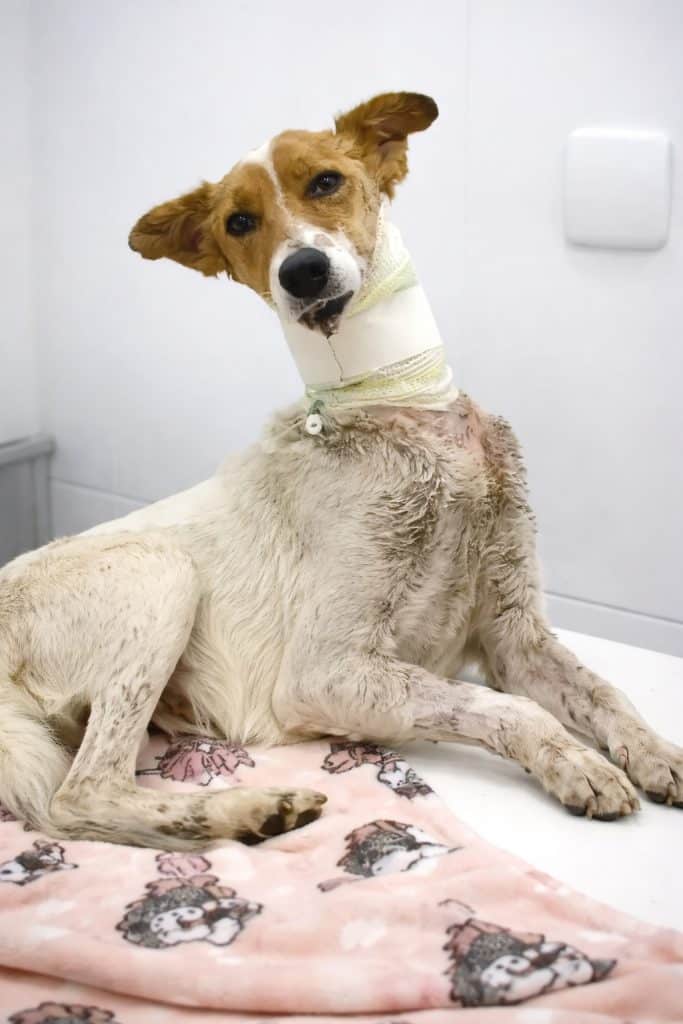
At the edge of a busy road, Lauri lay almost completely still.
Vehicles continued to pass. The sounds of traffic carried on around him, but the small dog could no longer move away from danger or search for help.
The collision had already taken a terrible toll.
His lower jaw had been severely damaged. He could not close his mouth normally, and something as basic as eating had become impossible.
Yet somehow, Lauri was still alive.
He had survived the impact.
Now he had to survive everything that came after it.
When Someone Finally Stopped
By the time Lauri reached rescuers, his condition had become critical.
He was extremely weak. His skin showed signs of parasites, and injuries that had gone untreated were beginning to cause further complications.
But the damage to his face was the greatest concern.
Much of his jaw could no longer function normally, leaving him unable to feed himself. Without another way to receive nutrition, his already fragile body had little chance to recover.
The veterinary team faced an immediate priority.
Before anything else could improve, Lauri needed nourishment.
Because eating normally was not possible, a feeding tube was carefully placed into his esophagus. It would allow food to reach his body while the team worked to stabilize him and plan the next stages of treatment.
For Lauri, even this first step represented a major change.
He was no longer alone beside the road.
There were now people watching his breathing, cleaning his injuries, providing medication, and making sure his body received what it needed.
The care would be complicated.
The outcome was not guaranteed.
But for the first time since the accident, Lauri had support around him.
A Fragile Beginning
The feeding tube did not solve everything.
It simply gave Lauri the chance to keep going.
His body was exhausted, and recovery would require far more than a few days of rest. The damage around his jaw and lower face needed extensive veterinary attention.
His neck also required care because swelling, infection, and fluid buildup had created additional problems.
Every procedure had to be approached carefully.
There was no quick transformation.
Instead, Lauri's days became a quiet routine of treatment, cleaning, medication, nutrition, and observation.
Small things mattered.
A more stable breath.
A little more strength.
A calmer expression.
The team could not rush his body into healing. They could only support it and wait for signs that the effort was working.
VIDEO: With Half His Jaw Gone, Lauri Began the Long Fight to Eat and Live Again
Rebuilding What the Accident Had Taken
Repairing Lauri's face required complex work.
The veterinary team reconstructed areas around his jaw, lips, and chin as carefully as possible. Much of the lower part of his face had been badly damaged, so restoring basic function would take time.
The goal was not to make everything look exactly as it had before.
The goal was to help Lauri live comfortably again.
To eat.
To recover.
To move through daily life without depending forever on emergency support.
That process unfolded slowly.
After one procedure came monitoring.
After monitoring came wound care.
Then more patience.
At times, progress was so gradual that it could have been easy to overlook.
But Lauri kept responding.
His body began using the nutrition delivered through the tube. The infection started to ease. His breathing became steadier.
Most importantly, his strength slowly began returning.
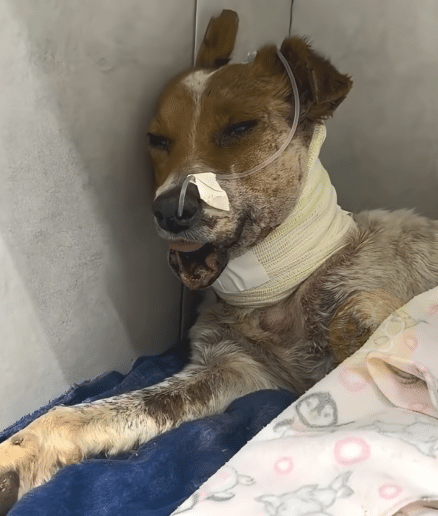
The dog who had arrived barely holding on was beginning to look more present in the world around him.
His eyes followed movement.
He responded when people came near.
He rested while caregivers worked around him.
Nothing about his recovery was dramatic from one hour to the next.
It was built from many quiet moments.
And eventually, those moments began adding up.
The Day He Ate Again
One of the most important milestones came when Lauri no longer needed the feeding tube.
Until then, the tube had been his lifeline.
It had kept his body nourished when his damaged jaw made ordinary eating impossible.
Removing it meant something significant had changed.
Lauri was ready to try eating for himself.
The first food was soft and manageable.
There was no expectation that he would suddenly return to normal. His face had been through too much, and every movement around his mouth required adjustment.
Still, Lauri leaned toward the food.
He tasted it.
And he ate.
It was a simple act, but after everything he had endured, it carried enormous meaning.
He was no longer receiving every meal through a tube.
He was participating in his own recovery.
From there, the progress continued in careful stages.
Soft food became easier.
His bites became stronger.
Eventually, he was able to make gentle chewing movements.
Each improvement gave the caregivers another reason to believe that Lauri was moving farther away from the condition in which he had first been found.
His jaw would never be exactly the same.
But eating independently was becoming part of his life again.
Healing Happened in More Than One Way
Physical recovery was only part of what changed.
Lauri had every reason to be cautious around people.
He had been injured, left without immediate help, and then surrounded by unfamiliar hands, medical equipment, and repeated treatments.
Yet he did not spend his recovery constantly pulling away.
Instead, he gradually accepted the people caring for him.
During wound cleaning, he remained close.
When someone sat beside him, he relaxed.
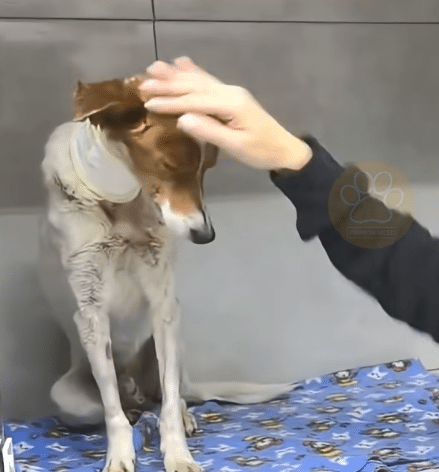
When gentle hands reached toward him, he increasingly allowed the contact.
Trust did not appear all at once.
It grew through repetition.
The same people returned.
Food arrived.
His injuries were cleaned.
Medication was given.
Blankets offered warmth and comfort.
Voices became familiar.
The pattern mattered.
For an animal whose recent experience had been filled with pain and uncertainty, consistency offered something different.
Safety.
Lauri slowly began to seek that comfort rather than simply tolerate it.
He rested beneath blankets.
He responded to the voices around him.
He allowed himself to settle.
Those moments may have seemed small compared with surgery or medical treatment, but they marked another kind of healing.
His body was recovering.
And at the same time, he was learning that human presence could mean care.
A Different Life From the One Beside the Road
The image of Lauri lying helpless beside traffic did not define where his story ended.
With continued treatment and patient care, his condition changed.
He grew stronger.
He learned to eat again.
He could rest without the constant struggle that had marked the period immediately after the accident.
Today, he is no longer surviving one fragile moment at a time.
He can eat without the feeding tube that once kept him alive. He moves with greater strength, and he has a safe place where his needs are noticed.
The accident permanently changed his jaw.
That part of his story cannot be erased.
But permanent change did not mean his life was over.
Lauri adapted.
His caregivers adapted with him.
Together, they found a way forward.
What Lauri's Journey Leaves Behind
Some rescue stories are remembered because everything returns to exactly the way it was before.
Lauri's is different.
His recovery was not about erasing every sign of what happened.
It was about giving him the chance to live well despite it.
When he was found, even eating was beyond his ability. His body was dangerously weak, and the damage to his jaw made survival without help unlikely.
Then came the feeding tube.
The procedures.
The medication.
The cleaning.
The waiting.
And finally, the first careful bites of food taken on his own.
None of those moments alone tell the whole story.
Together, they show what patient care can make possible.
Lauri did not need one dramatic gesture.
He needed people willing to keep showing up.
To feed him when he could not eat.
To care for injuries that could not heal overnight.
To wait through slow progress.
And to continue treating him as a life worth saving even when recovery was difficult.
Once, he lay beside a road while the world moved past him.
Now, he can rest without wondering whether someone will notice.
His jaw may always carry the effects of that accident.
But his life carries something else now.
Safety.
Care.
And the second chance that began when someone finally chose not to pass him by.


