
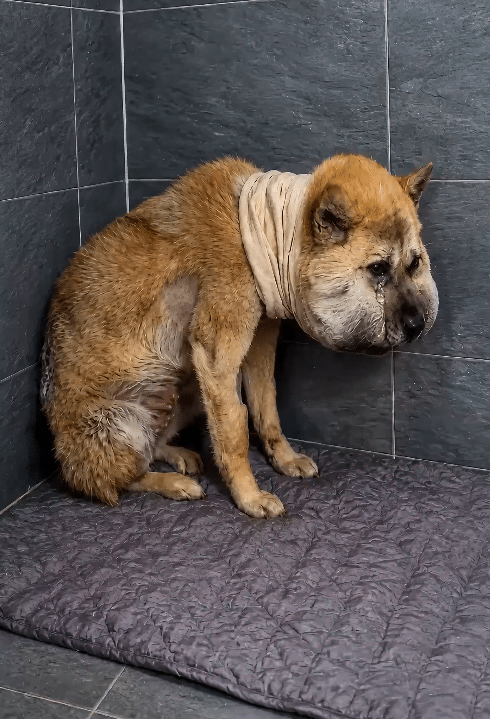
Lucky was only thirty minutes away from a decision that would have ended her life.
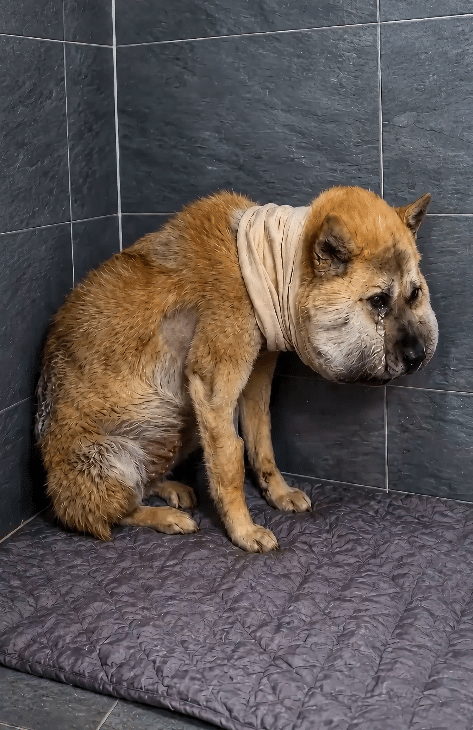
At the shelter, the tiny dog stood little chance of finding a way out on her own. Her face was swollen, her neck had been seriously injured by a tight wire, and even ordinary movement appeared uncomfortable.
She was frightened of people. Her body was weak. There was no way to know how long she had been struggling with the injury.
And yet, she was still holding on.
With the scheduled euthanasia approaching, rescuers reached Lucky in time and gave her something that had almost disappeared from her future.
A chance to survive.
What happened during the months that followed would show just how much one timely rescue, careful veterinary treatment, and patient kindness could change an animal's life.
Thirty Minutes That Changed Everything
When rescuers first encountered Lucky, her condition made the urgency impossible to ignore.
A wire had remained around her neck long enough to cause severe damage. The surrounding area was badly swollen, and her face showed the effects of what she had endured.
She was small, vulnerable, and visibly afraid.
Whenever people came near, Lucky trembled. She had little reason to feel comfortable around unfamiliar hands, even when those hands were reaching toward her to help.
The rescuers could not establish exactly how long she had been living with the injury. What they could see was enough to understand that she needed immediate medical attention.
Her name was Lucky.
At that moment, it was a name filled with possibility rather than certainty.
She had already been placed on the shelter's euthanasia list. Only half an hour remained before the scheduled procedure when the rescue took place.
Thirty minutes.
For a dog in her condition, that brief window separated an ending from the beginning of an entirely different future.
The rescuers acted quickly, taking her directly to a veterinary clinic where professionals could assess her injuries and begin emergency care.
Lucky was not suddenly well.
She was still frightened, still hurting, and still facing a difficult medical journey.
But an essential part of her circumstances had changed.
Someone had decided that her life was worth fighting for.
The Injury That Needed More Than Basic Care
At the clinic, the veterinary team began examining Lucky's neck.
The visible swelling was concerning, but the full seriousness of the injury became clearer as the examination continued.
Initially, the hope was that cleaning the affected area and providing medication might be sufficient.
Unfortunately, the damage was more extensive than first anticipated.
The tissue surrounding the injury had been severely affected, making surgery necessary.
For Lucky, this meant that escaping the immediate danger at the shelter was only the first stage of her fight.
She still needed to get through a delicate medical procedure and the recovery that would follow.
The veterinarians carefully removed damaged tissue, treating the area with the goal of giving her the best possible opportunity to heal.
When Lucky woke after surgery, she was exhausted and physically weak.
But she had survived the procedure.
There was no instant transformation, no sudden return to strength. Her body needed time, and the people caring for her understood that the next steps would require consistency.
Her recovery would be measured in small changes.
A little more rest.
A little more comfort.
And, eventually, the ability to eat again.
VIDEO: Lucky Had Only 30 Minutes Left — Then Rescuers Gave Her a Chance to Live
A Quiet Place to Begin Again
After surgery, Lucky's caregivers focused on the everyday work of helping her recover.
Her injuries required regular cleaning and medication. She needed soft food, sufficient rest, and a warm, peaceful environment where she could regain strength without unnecessary stress.
These were simple forms of care, but their importance was enormous.
Lucky had arrived with a painful injury and an overwhelming fear of human contact. Medical treatment could address her physical condition, but feeling safe around people would take longer.
During the first days, the priorities were straightforward.
Keep her comfortable.
Continue her treatment.
Give her body time to respond.
Then an encouraging change appeared.
Lucky began eating again.
For a healthy dog, approaching a meal might be an ordinary part of the day. For Lucky, whose condition had recently required emergency surgery, the return of her appetite represented meaningful progress.
It suggested that her body was beginning to recover enough to take in the nourishment it needed.
The people caring for her continued to provide the same dependable support.
They did not treat one improvement as proof that her difficulties were over.
There was still healing ahead.
And there was another challenge that could not be solved with surgery alone.
Lucky was deeply afraid.
The Kind of Healing That Cannot Be Rushed
As the injury around Lucky's neck improved, her behavior revealed how cautiously she continued to approach the world.
She often remained curled up in quiet corners.
When someone came close, she lowered her head instinctively.
Even in a place where she was receiving regular care, she seemed uncertain about human attention.
Her caregivers did not demand affection from her.
Instead, they allowed her to adjust gradually.
A comfortable bed gave her somewhere to rest. A peaceful environment reduced unnecessary disturbance. Gentle voices and patient handling helped make daily interactions less intimidating.
Sometimes, Lucky simply watched the people around her without approaching.
On other occasions, she appeared more comfortable with someone sitting nearby.
Those moments might not have looked especially dramatic from the outside.
But for a frightened dog, being willing to remain near a person could be an important step toward trust.
There was no fixed schedule for Lucky to become affectionate or confident.
Her caregivers understood that a physical injury and a fearful response do not necessarily heal at the same speed.
Her medical condition could improve while she continued to hesitate at an unfamiliar movement.
That was not a failure.
It was part of her recovery.
Gradually, Lucky began to experience human presence as something associated with care rather than discomfort.
The change was subtle at first.
She became less withdrawn.
She appeared more willing to observe what was happening around her.
And the little dog who had spent so much time protecting herself from the world began showing signs that she wanted to participate in it again.
New Fur, New Strength, and the First Signs of Curiosity
Lucky's physical recovery continued over the following weeks, although it was not completely straightforward.
Her skin remained sensitive. Some areas required additional treatment, and patches of fur continued to fall out.
These difficulties were reminders that recovering from a serious injury could involve more than the original surgical procedure.
Her caregivers continued attending to the affected areas while monitoring her progress.
Slowly, the visible changes became encouraging.
Lucky began gaining healthy weight.
Her skin looked less irritated.
New fur started growing in places that had previously been bare.
Her appearance was changing, but an equally meaningful development was happening in her behavior.
Lucky was becoming curious.
Instead of remaining in the same sheltered space, she cautiously began exploring her surroundings.
Her movements were still careful.
She would take a few steps, pause, look around, and sometimes glance back toward her caregivers.
It was as though she needed reassurance before going farther.
The people around her continued to respond with patience, allowing her to experience the environment at a pace she could manage.
These ordinary moments showed how far she had come.
The frightened dog who had once recoiled from approaching people was beginning to investigate the world around her.
Her growing confidence did not erase everything she had experienced.
But it created room for something different.
A life no longer centered entirely on fear.
Discovering Friendship and Freedom
As Lucky became stronger, more of her personality began to emerge.
She no longer spent each day hiding.
She became increasingly interested in the other dogs around her.
At first, Lucky watched them from a distance, keeping herself apart while observing their movements and interactions.
Over time, that distance began to shrink.
Eventually, she felt comfortable enough to join them.
This new willingness to socialize marked another stage in her recovery.
Her tail began lifting more frequently.
Her expression grew brighter.
She appeared increasingly at ease in the environment that had once seemed so unfamiliar.
The contrast with her earliest days was striking.
Then Lucky began taking outdoor walks.
For a dog who had previously reacted fearfully to people and unfamiliar surroundings, exploring outside presented a new challenge.
There were different sounds, movements, and sensations to encounter.
Lucky sometimes needed encouragement.
But she continued forward.
She walked during chilly evenings and through winter conditions. She even explored paths covered with snow.
These experiences offered something that had once seemed far beyond her reach.
The ability to move through the world without being overwhelmed by fear.
Her progress was not simply about how far she could walk.
It was about the growing confidence visible in the way she moved.
The same little dog who had once lowered her head whenever someone approached was learning to explore, interact, and enjoy ordinary experiences.
She was no longer merely enduring each day.
She was beginning to enjoy it.
The Little Dog Who Found Her Confidence
By the time several months had passed, Lucky's transformation had become unmistakable.
Her body had regained strength.
Her coat had returned.
She moved with a confidence that had been absent when rescuers first met her.
The changes were particularly evident in updates around day 180 and later around day 260 of her recovery.
By those stages, Lucky had become energetic, playful, and eager to explore.
She could run freely.
She approached her surroundings with much less hesitation.
She seemed comfortable enough to enjoy the simple pleasures that had once been beyond her reach.
None of this happened because of one treatment or one reassuring moment.
Her recovery was the result of many forms of care working together.
Veterinary attention addressed the serious injury to her neck.
Continued treatment helped her skin and coat recover.
Regular nourishment and rest supported her return to physical strength.
And the patience of her caregivers gave her room to become comfortable with people.
The differences were visible not only in her healthier appearance but also in the way she behaved.
Lucky had changed from a frightened, withdrawn little dog into one who could play, socialize, and explore with enthusiasm.
It was a remarkable outcome for an animal whose life had nearly ended before that recovery could even begin.
What Lucky's Second Chance Really Means
It is easy to focus on the thirty minutes that made Lucky's rescue possible.
That final window of time was undeniably important.
Without the rescuers arriving before her scheduled euthanasia, the rest of her story might never have happened.
But what makes Lucky's journey especially meaningful is everything that followed.
Saving her from the immediate danger did not mean that her injuries were healed.
Surgery did not automatically make her comfortable with human contact.
And the first signs of improvement did not mean that she no longer needed treatment, reassurance, or time.
Lucky's transformation came gradually.
It came through daily care, careful observation, and a willingness to let her progress without pressure.
Her story reminds us that meaningful animal rescue involves more than removing a dog from a difficult situation.
It also means recognizing the needs that remain afterward.
For some animals, those needs are medical.
For others, they involve learning to feel comfortable in a new environment.
For Lucky, they involved both.
The dog whose neck had been severely injured needed treatment to regain her health.
The dog who trembled around people needed patience to regain her confidence.
And she received the opportunity to do both.
There is something deeply moving about the contrast between Lucky's first moments in rescue and her later months of recovery.
At the beginning, she was weak, frightened, and approaching the end of the time available to her at the shelter.
Months later, she was running, playing, exploring snowy paths, and enjoying the company of other dogs.
Her future had changed because people intervened when she needed help and continued caring for her long after the immediate emergency had passed.
Lucky's journey offers a simple reminder.
A second chance is not always a single extraordinary moment.
Sometimes, it is the sum of hundreds of ordinary acts of kindness.
A carefully prepared meal.
A quiet place to sleep.
A necessary medical treatment.
A patient person who allows a frightened animal to approach when she feels ready.
Each one can become part of a much larger transformation.
Lucky was rescued with only thirty minutes left before her scheduled euthanasia.
But those thirty minutes did not define the rest of her life.
What came afterward did.
Today, the lasting image of Lucky is not simply that of a frightened little dog with a serious injury.
It is the image of a stronger, happier companion who has rediscovered the freedom to move, play, and trust.
She was given time to heal.
And with that time, Lucky found a life worth looking forward to.


