
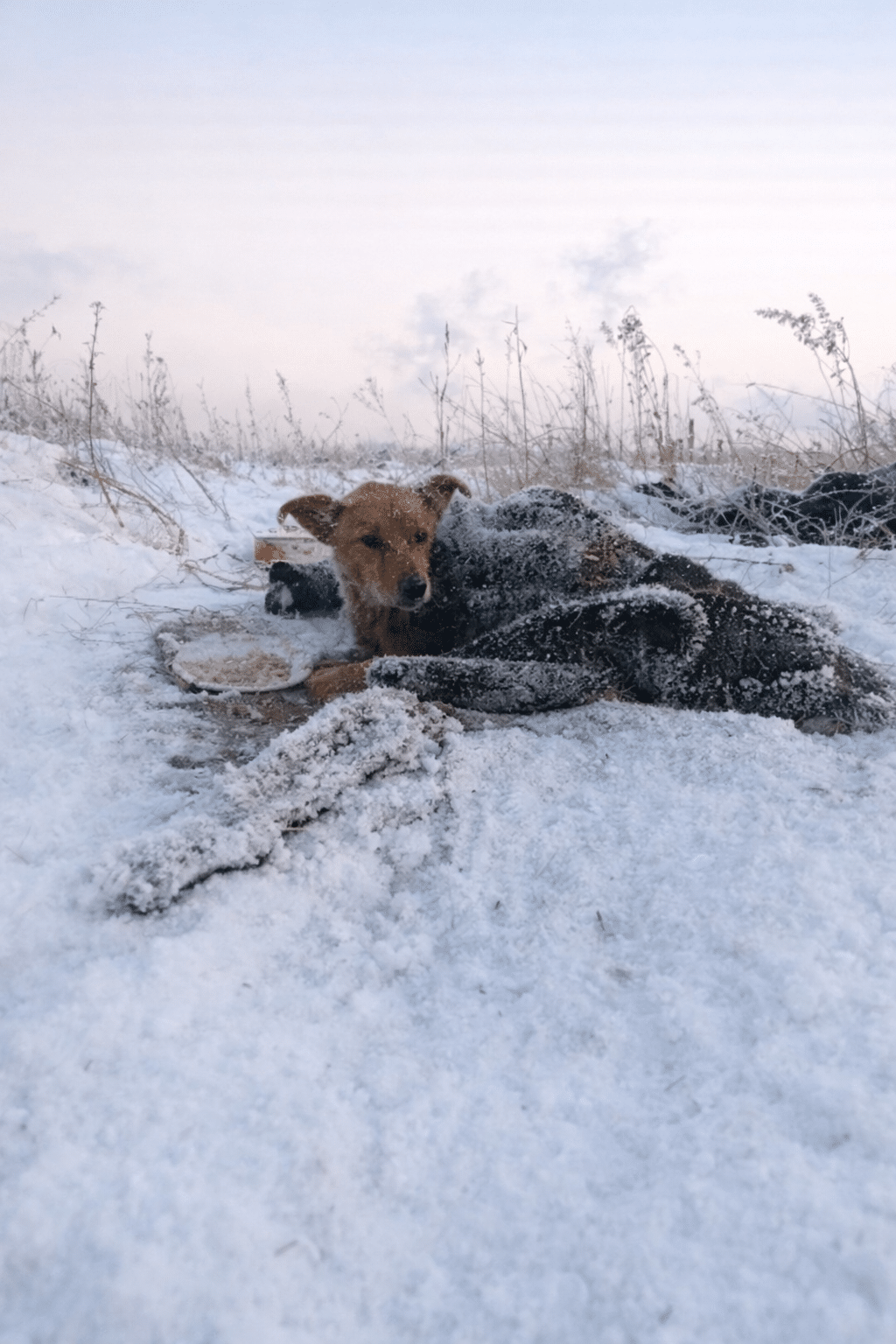
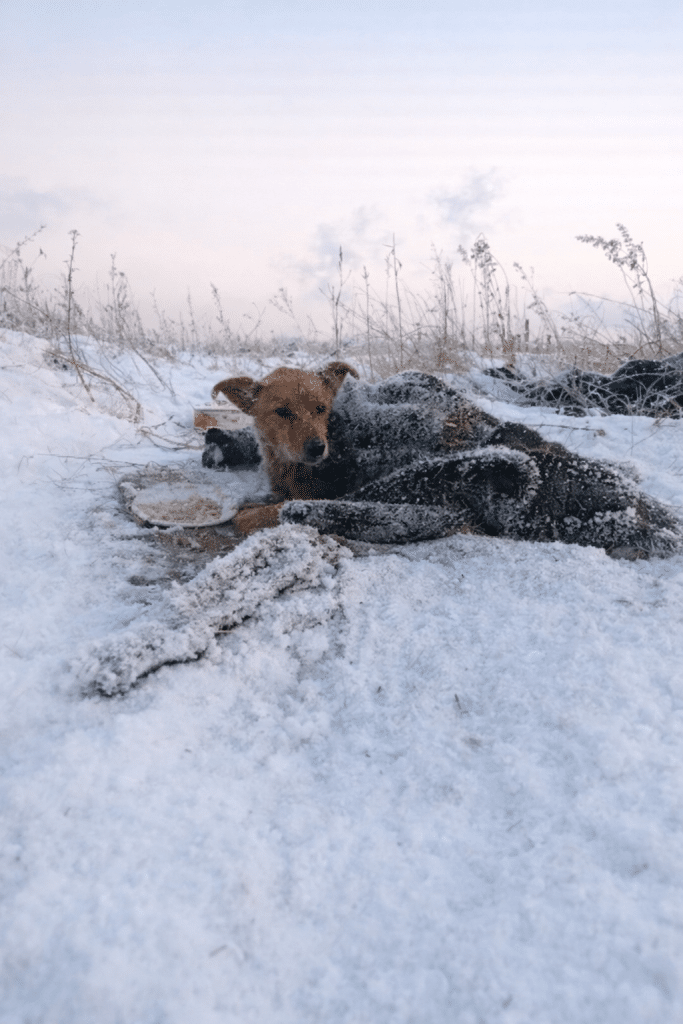
Jason was almost hidden by the frozen ground when someone finally found him.
Snow and frost surrounded his thin body, and the cold had taken away nearly all of his strength. He could not simply get up and leave. Even before anyone understood the full extent of his condition, it was clear that he needed help immediately.
His body was severely underweight. One of his back legs was badly injured, and the freezing conditions had only made an already dangerous situation more urgent.
Yet beneath all that weakness, there was still a dog holding on.
A Rescue That Could Not Wait
The person who found Jason carefully wrapped him to preserve the little warmth he still had and rushed him for veterinary care.
There was no time to know how long he had been outside or exactly what had happened before he was discovered. The priority was simply to stabilize him and understand what his body was facing.
At the clinic, the veterinary team found several serious problems.
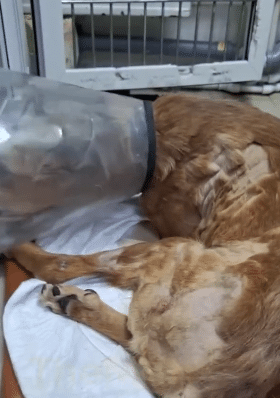
Jason was suffering from severe frostbite and extreme malnutrition. Neurological damage affecting his spine had also left his back legs with very little response. He could not stand or support himself normally.
His condition was fragile enough that every small detail mattered.
Then the caregivers noticed something encouraging.
Jason still wanted food.
In a dog whose body had been pushed so far, that appetite became an important sign. He was weak, but he had not stopped responding to the world around him.
His recovery could begin.
It would simply take much longer than anyone could rush.
When Recovery Became More Complicated
The first days were focused on keeping Jason stable and giving his body the support it desperately needed.
But recovery rarely follows a perfectly straight path.
Roughly ten days into treatment, tests showed new concerns. His liver indicators were worsening, while his albumin level had fallen dangerously low. Jason's weakened body was struggling under the demands of healing.
The veterinary team adjusted his nutrition and added more nutrient-rich foods, including beef, in an effort to strengthen him and improve his condition.
Food was no longer just a meal.
For Jason, every bite was part of rebuilding a body that had arrived with almost nothing left to spare.
VIDEO: Found Helpless in the Snow, Jason Began a Months-Long Fight to Walk Again
Healing the Injuries Was Only the Beginning
By around the twentieth day, Jason was still unable to stand.
When he wanted to move, he relied on his front legs to pull himself forward while his back legs remained largely unresponsive behind him.
It was a difficult stage because progress could not always be seen from one day to the next.
Veterinarians tried several neurological therapies in hopes of encouraging recovery in his spine and hind legs. Meanwhile, his caregivers continued with the quieter work that had to happen every single day.
His injuries were cleaned and treated.
Areas of damaged skin received attention.
His muscles were gently massaged to help keep them active while his mobility remained limited.
There was no single dramatic treatment that suddenly changed everything.
Instead, Jason's recovery was built from repeated acts of care.
A meal.
A treatment.
A massage.
Another attempt to move.
Then the same patience again the following day.
By approximately day forty-eight, most of his visible wounds had healed.
That was significant progress.
But one enormous challenge remained.
Jason still could not walk normally.
For a dog who had already survived the freezing cold and severe physical weakness, the next part of recovery would require time measured not in days, but in months.
The Dog Beneath the Injuries Began to Return
As the weeks passed, Jason's body slowly changed.
The painfully thin figure found in the snow began gaining weight. His strength improved little by little, supported by consistent nutrition and continued care.
And as his physical condition improved, another change became easier to notice.
Jason looked increasingly alert.
His eyes, once exhausted, became brighter and more curious.
By around the one-hundred-and-tenth day of his recovery, Jason had gained nearly five kilograms.
That number represented far more than weight on a scale.
It reflected months of meals, treatment, exercises, and patient attention. The dog who had arrived severely malnourished now had enough strength for the possibility that caregivers had been working toward from the beginning.
Walking.
There were still no guarantees.
But Jason was getting closer.
The Day He Finally Stood
Around day one hundred and twenty, something changed.
Jason stood.
His legs were not immediately strong or steady. His movements were uncertain, and after months without normal use of his back legs, balance had to be rebuilt gradually.
But he was upright.
It was a milestone that would have seemed almost impossible during those early days when he could only drag himself forward with his front legs.
With continued practice and support, standing became movement.
Then movement became steps.
Jason began crossing the grass using all four legs instead of dragging his hindquarters behind him.
The progress was not perfect.
It did not need to be.
Each step showed how far he had already traveled from the frozen place where his story nearly ended before anyone knew his name.
Learning What an Ordinary Life Feels Like
Between roughly days one hundred and fifty and one hundred and eighty, Jason's transformation became increasingly visible.
His body continued to grow stronger.
His coat became thick and healthy again.
Walking was no longer only an exercise performed during rehabilitation. Jason learned to move calmly on a leash and explore open spaces on his own four paws.
These may sound like ordinary moments for a healthy dog.
For Jason, they were anything but ordinary.
Months earlier, simply standing had been beyond his physical ability. His back legs had barely responded, his body was severely underweight, and the freezing conditions had left him in need of urgent care.
Now he could walk through the grass.
He could look around with curiosity.
He could experience movement without having to pull himself forward with only half of his body.
The contrast did not happen because of one extraordinary moment.
It happened through many ordinary ones.
Caregivers continued showing up.
Veterinary treatment continued.
Meals continued.
Exercises continued.
And slowly, Jason's body began answering all that patience.
Some Recoveries Cannot Be Rushed
Jason's journey stretched across many months.
That matters because rescue stories can sometimes make healing appear almost immediate: a dog is found, brought to safety, treated, and suddenly everything is different.
Jason's experience was not like that.
Visible injuries could heal while mobility remained uncertain.
Weight could return while neurological problems still required attention.
One milestone could be followed by another long period of work.
His progress came in stages.
First, he survived the immediate danger.
Then he began eating.
His wounds gradually healed.
His body gained weight.
He became stronger.
Eventually, he stood.
And finally, he walked.
Each stage depended on the one before it.
From Frozen Ground to Four Steady Paws
The dog eventually exploring open spaces bore little resemblance to the fragile figure first discovered lying in the snow.
Jason had not simply gained weight or grown a healthier coat.
He had reclaimed an ability that once seemed painfully far away.
He could stand on all four paws.
He could walk.
He could move through the world again without dragging his back legs behind him.
His recovery is a quiet reminder of what patient care can accomplish when nobody expects healing to happen overnight.
Sometimes progress is almost invisible.
Sometimes it is measured in a little more appetite, a stronger muscle, or one uncertain attempt to stand.
And sometimes, after months of those tiny victories, a dog who once could not rise from the snow is walking across the grass again.
Jason's story did not change in one dramatic instant.
It changed because compassion kept showing up long enough for his body to finally catch up with the determination he had shown from the beginning.


