
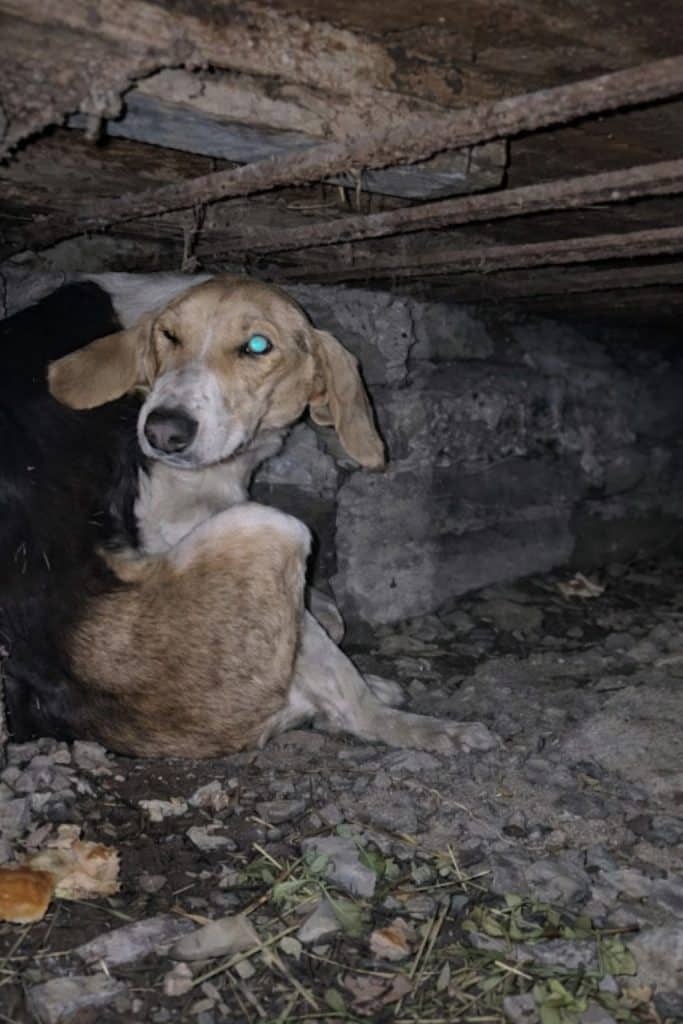
A narrow beam from a flashlight swept beneath the concrete structure late in the evening.
At first, there seemed to be little worth noticing. The space was cramped and dark, scattered with debris and empty cans. It looked like the kind of forgotten gap most people might pass without a second thought.
Then something moved.
Pressed close to the wall was a small dog.
He did not bark.
He did not rush toward the light.
He simply remained where he was, almost hidden by the shadows, as though staying completely still had become his safest option.
Hidden Where Almost No One Could See Him
The closer the rescuer looked, the more troubling the situation became.
The dog's white, brown, and black coat was dulled by dirt and dust. His body trembled inside the narrow space, and one of his hind legs hung awkwardly, unable to support him properly.
Whatever had happened before he was discovered was not explained.
What was clear was that he was hurt.
Like many frightened animals, he appeared to have followed a simple instinct: find somewhere small, dark, and difficult to reach.
For a while, that hiding place may have offered protection from whatever frightened him outside.
But the same shelter had become a prison.
The opening beneath the concrete was extremely tight. The dog had pushed himself far inside, and with his injured leg, getting back out on his own seemed beyond what he could manage.
There was little room to turn.
Little room to move.
And seemingly very little strength left for another attempt.
What made the scene especially quiet was the absence of any dramatic cry for attention.
He was simply there.
Waiting in a place where someone easily could have missed him.
The Rescue Could Not Be Rushed
Finding the dog was only the beginning.
The rescuer faced another challenge: how to bring him out without causing more fear or worsening his condition.
Inside such a confined space, sudden movements could easily have frightened him farther into the gap. Grabbing at him too quickly might also have caused unnecessary discomfort to his injured leg.
So the rescuer slowed everything down.
There was no attempt to drag him out immediately.
Instead, the rescuer crouched close to the opening and extended a hand.
Not to seize him.
Just to make contact.
Fingers gently touched the top of the dog's head.
For a moment, he remained tense.
His surroundings were still unfamiliar, and he had no way of knowing what the person reaching toward him intended to do.
Yet he did not growl or snap.
He did not scramble deeper into the darkness.
He stayed where he was and allowed the touch to continue.
That small decision changed the rescue.
The rescuer softly stroked his head and neck, keeping every movement slow and predictable.
The dog was still frightened and still injured, but the interaction no longer seemed to be between a trapped animal and a stranger trying to pull him away.
A little trust had begun to form.
VIDEO: Injured and Trapped in a Dark Concrete Gap, He Finally Let Someone Reach Him
Trust Had to Come Before Freedom
There was no reason to hurry once the dog had accepted the rescuer's presence.
The calm contact continued.
A gentle hand.
A quiet pause.
Then another reassuring touch.
Gradually, the dog's trembling appeared to lessen. His breathing became calmer as the rescuer remained beside him.
Only then did the effort to move him forward begin.
Even at that point, the rescuer did not simply pull.
The dog was encouraged toward the opening, allowed to move gradually rather than being forced through the confined space.
Inch by inch, he came closer.
For an injured animal, those few movements represented a significant change.
Moments earlier, the darkness behind the concrete had been the only place he seemed willing—or able—to remain.
Now he was moving toward the person waiting outside.
Slowly, more of his body became visible.
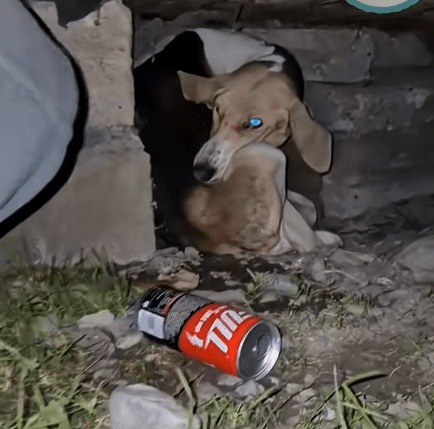
Then, after the careful work of earning his trust and guiding him forward, he finally cleared the narrow opening.
The place that had concealed him was behind him.
For the first time since he was discovered, there was open space around him.
Outside the Gap, His Condition Became Clearer
Freedom did not mean the difficult part of his story was finished.
Once the dog was fully outside, the extent of his visible condition was easier to see.
His injured hind leg remained weak and hung unnaturally. His coat looked dirty and uneven, and exhaustion showed in the way he held himself.
The surroundings were also suddenly very different.
Instead of darkness and concrete walls, there was open space, light, movement, and a person standing close beside him.
It could have been overwhelming for an animal that had just spent an unknown amount of time hidden away.
But one important thing had changed.
He was no longer trapped.
The rescuer carefully lifted him and held him securely, supporting his body as gently as possible.
The dog did not fight the embrace.
He did not struggle to escape.
He simply remained still.
It was impossible to know what he understood in that moment, but his behavior showed that he was willing to let the rescuer carry him away from the place where he had been stuck.
Sometimes rescue looks dramatic.
Other times it is much quieter.
An injured dog resting in someone's arms can be the entire turning point.
From a Dark Hiding Place to the Next Step
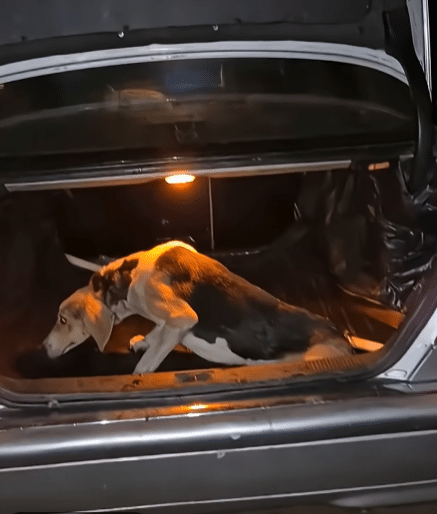
A vehicle was already nearby.
Inside, a protective covering had been prepared so the dog could be placed down without unnecessary discomfort.
The rescuer lowered him carefully, paying particular attention to the injured leg.
There was still no confirmed explanation for the injury.
There was still no immediate answer about how long recovery might take or what treatment would eventually be required.
Those questions belonged to the next stage.
For now, the goal was simpler: get him somewhere his condition could be properly examined.
The plan was to take him to a veterinary clinic.
For a dog who had been unable to free himself from beneath the concrete, even that short journey represented an enormous change in direction.
He was no longer waiting alone for someone to notice him.
Someone had noticed.
Someone had stayed.
And now someone was taking him toward professional care.
Safe Did Not Yet Mean Healed
The available footage does not offer a complete recovery story.
It does not show months of rehabilitation, a final medical outcome, or an adoption into a new home.
The confirmed story ends much earlier.
The dog lies quietly inside the vehicle after being rescued.
He is still injured.
Still uncertain.
Still at the beginning of whatever care will come next.
That distinction matters.
Rescue is often described as a happy ending, but being removed from immediate danger is usually only the first step.
An animal may still need examination, treatment, rest, patience, and time before anyone can know what the future will look like.
For this dog, the important truth at that moment was much smaller and more immediate.
He had made it out.
He was supported.
He was being taken for veterinary attention.
And he no longer had to face the next part alone.
What One Patient Rescue Can Change
There was no dramatic chase in this story.
No instant transformation.
No moment when the dog's injury suddenly disappeared.
Instead, the rescue depended on something much quieter.
Someone looked closely enough to notice movement in a dark space.
Then, after finding the dog, that person understood that getting him out required more than physical strength.
It required patience.
The rescuer waited for the dog to accept a touch before asking him to move.
Trust came before freedom.
That may be the most memorable part of the entire rescue.
When animals are frightened and in pain, help cannot always arrive quickly. Sometimes the safest way forward is measured in inches.
A hand extended into the darkness.
A few gentle strokes.
A frightened body beginning to relax.
Then one careful movement toward the opening.
For the injured dog beneath that concrete structure, those small actions were enough to change the direction of his night.
He had entered the gap looking for somewhere to hide.
He left it in the arms of someone who had chosen not to walk away.
His full recovery was still unknown.
His future had not yet been written.
But the darkness was no longer where he had to remain.
For one small dog, hope began with something simple:
someone saw him, someone reached in, and someone stayed long enough to bring him out.


