
Some rescue stories begin with barking, movement, or a desperate attempt to escape.
This one began almost completely in silence.
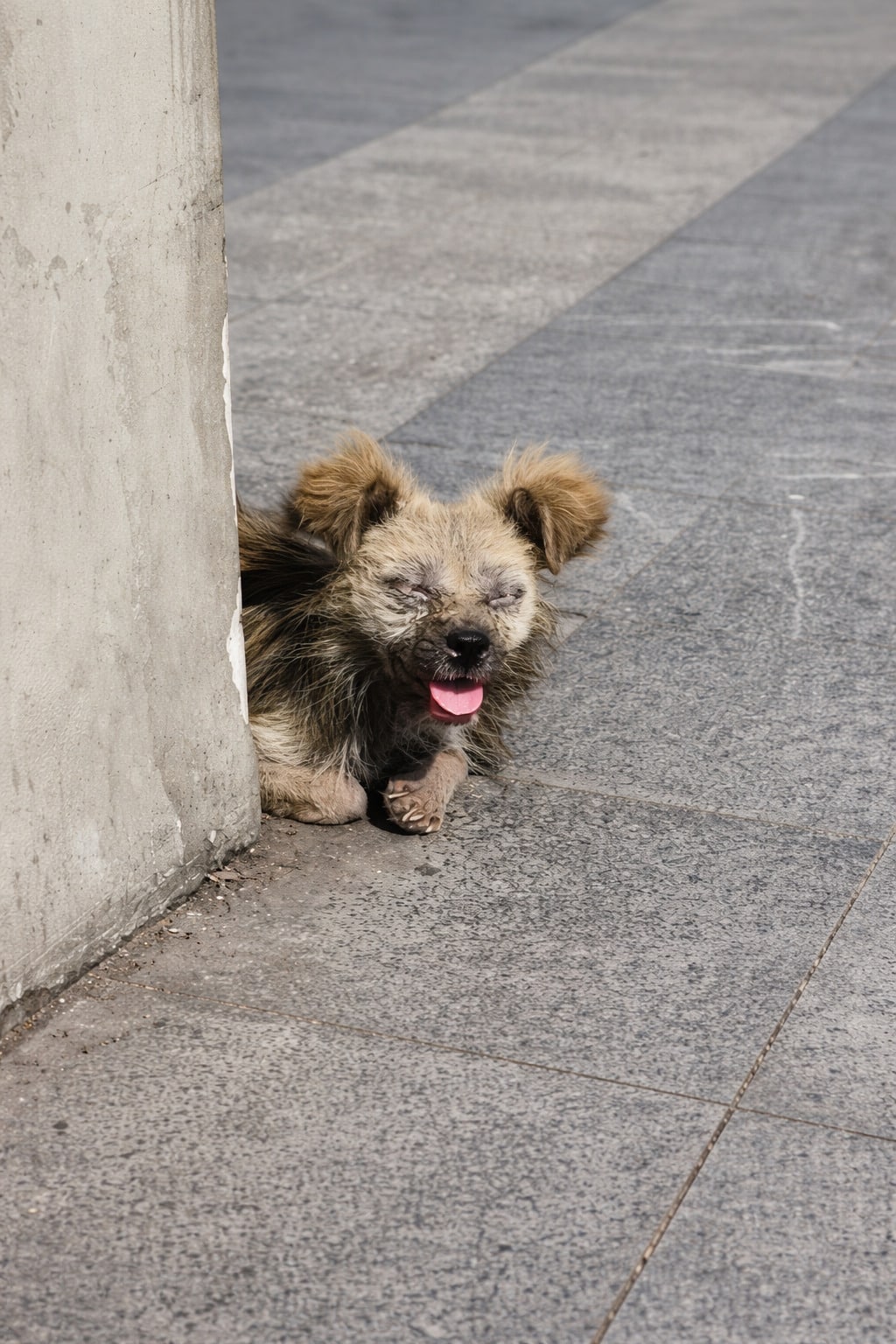
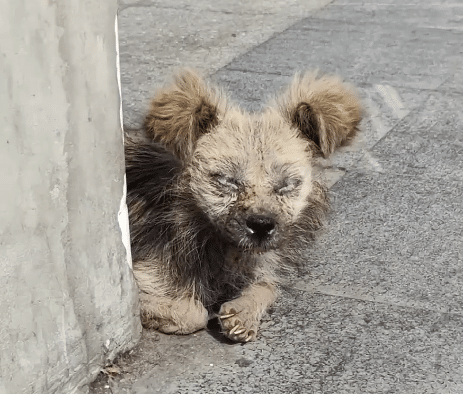
A small dog was pressed tightly into the corner of a rough concrete wall, his body curled inward as though becoming smaller might make the world leave him alone.
He was not resting comfortably.
He was hiding.
A Small Dog Almost Lost in the Corner
His coat was tangled and dirty, with dust clinging to the damp fur around his thin body. His paws were drawn close beneath him, and the outline of his ribs could be seen whenever he breathed.
But the most troubling part was his face.
Both of his eyes were sealed shut.
Hardened discharge had built up around the eyelids until they could no longer open normally. The surrounding skin was swollen and irritated, leaving him unable to clearly see what was happening around him.
He breathed through slightly parted lips, looking exhausted even while lying still.
When footsteps moved closer, he did not suddenly jump up or run away.
He only flinched when a nearby sound reached him.
That small reaction revealed how vulnerable he had become.
He could hear the world approaching.
He simply could not see enough of it to know where to go.
There was little strength left for escape anyway.
The person recording the scene moved closer and slowly lowered themselves toward him. The dog remained tucked against the wall, uncertain but without the energy to defend the small space he had chosen.
The longer the moment lasted, the clearer the situation became.
This was not a dog peacefully sleeping in a quiet corner.
He needed help.
The Moment Someone Chose Not to Walk Away
Sometimes rescue begins with something remarkably simple.
Someone notices.
Someone stops.
Instead of leaving the dog where he was, the person carefully lifted him and took him away from the concrete corner that had become his hiding place.
That decision brought him to a veterinary clinic, where his condition could finally be examined properly.
Under the clinic lights, the extent of the problem was easier to see.
Both eyes were severely infected. According to the source, a bacterial infection had likely been left untreated for an extended period, and without care there was a risk of lasting damage to his sight.
What he needed now was not a dramatic gesture.
He needed patient treatment.
He needed cleanliness.
And he needed time.
VIDEO: His Eyes Were Sealed Shut — Then His Slow Return to the Light Began
Care Began One Gentle Step at a Time
The first stage of treatment focused on his eyes.
Warm saline was used to soften the hardened material that had built up around the eyelids. It could not simply be rushed away. Cleaning had to be done carefully, little by little, while the sensitive skin around his eyes was treated as gently as possible.
Medicated eye drops were applied, and antibiotics were introduced to address the infection.
There was no instant transformation.
For a dog who had been struggling for so long, even basic care had to happen gradually.
During those first days, he slept frequently.
He ate small portions of soft food.
Most importantly, he was no longer lying against cold concrete.
He had a clean place to rest.
He had warmth.
He had people paying attention to changes that might once have gone unnoticed.
Healing did not arrive all at once.
It appeared in small differences.
The swelling around his eyes began to ease.
The skin looked less tight.
The heavy buildup around the eyelids stopped returning with the same intensity.
Each change was modest on its own.
Together, they meant his body was beginning to respond.
Then One Eyelid Began to Move
One morning, something happened that would have been easy to miss if no one had been watching carefully.
An eyelid trembled.
Then it lifted slightly.
Only a narrow opening appeared at first, but after so much time with his eyes sealed shut, even that small gap mattered.
Light could finally reach him again.
The dog paused.
His head shifted toward movement nearby.
For the first time during his recovery, the world around him seemed to be becoming more than sound and touch.
There were shadows again.
There were shapes.
There was movement he could begin to follow.
His sight had not suddenly returned to normal, and his eyes were far from completely healed.
But something important had changed.
The darkness was no longer total.
Small Signs Showed the World Was Returning
As the days continued, the improvement became easier to recognize.
He began turning his head toward movement.
He blinked deliberately, even if the motion still looked unfamiliar.
His expression changed too.
The exhausted emptiness visible when he was first found slowly gave way to greater awareness of the people and objects around him.
These were not dramatic milestones.
There was no single moment when everything became perfect.
Instead, recovery appeared through a collection of tiny victories.
An eye opening a little wider.
A blink.
A head turning toward motion.
A quieter body resting without pressing itself into a corner.
For animals recovering from serious neglect or illness, progress can sometimes look exactly like this.
Quiet.
Gradual.
Easy to overlook unless someone has decided to keep looking.
Rest No Longer Meant Hiding
By the later moments of the story, the dog was lying on a soft blanket.
The contrast with the place where he had been found was striking.
Before, his body had been curled tightly against concrete as he tried to disappear into the corner.
Now, he could rest somewhere clean and comfortable.
His eyes were partially open.
They had not completely healed, and the story did not suggest that every problem had disappeared.
But they were no longer sealed shut.
And he no longer looked like a dog trying to make himself invisible.
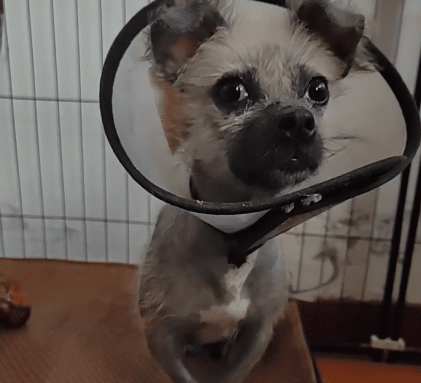
There was a softness in his face that had not been there before.
Not because his journey had suddenly become easy.
But because the conditions around him had finally changed.
He was receiving care.
He was being watched.
And when something changed, someone was there to notice.
Sometimes Rescue Begins With Simply Seeing
There was no complicated beginning to this rescue.
A small dog was sitting quietly in a corner, unable to open his eyes and too exhausted to do much more than endure the world around him.
Someone could have passed by.
Instead, someone stopped.
That single choice led to veterinary care, treatment, a warm place to sleep, and the first small signs that his sight might improve.
His recovery was not immediate.
It unfolded through patient cleaning, medication, rest, food, and time.
And eventually, an eyelid that had been sealed closed began to open.
Stories like his are reminders that animals in need do not always make themselves easy to notice.
Some do not bark.
Some do not run toward people.
Some simply become very still.
That is why compassion often begins before treatment ever does.
It begins with paying attention.
With seeing the animal in the corner.
With recognizing that stillness can mean something more than rest.
And with deciding that the darkness surrounding one small life does not have to be permanent.


