
Some rescue stories begin with barking, movement, or an animal desperately trying to escape.
This one began almost completely still.
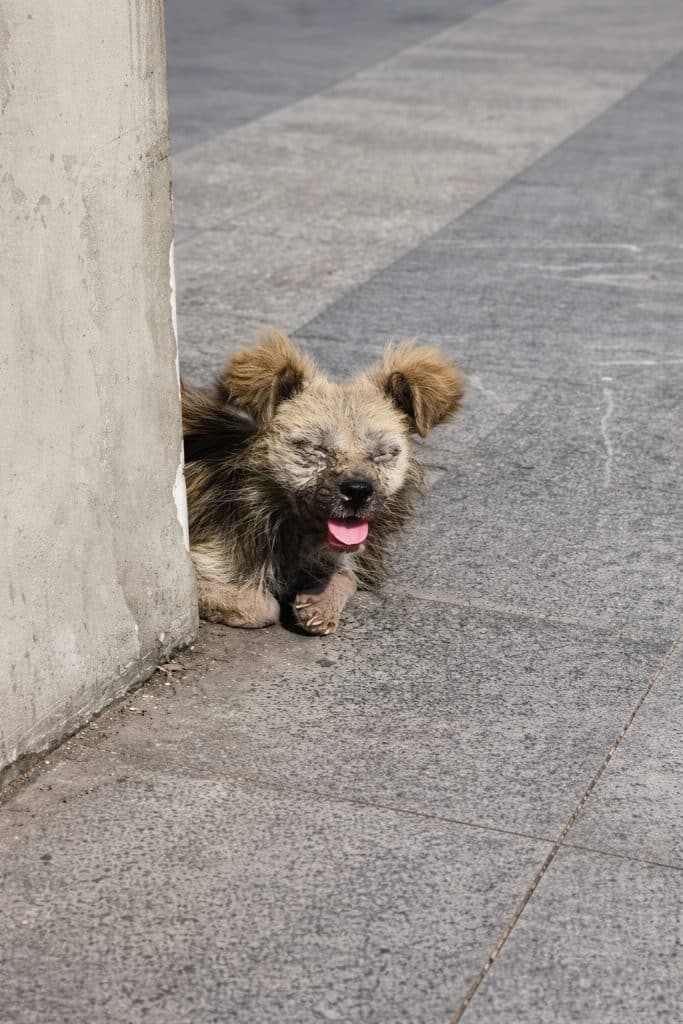
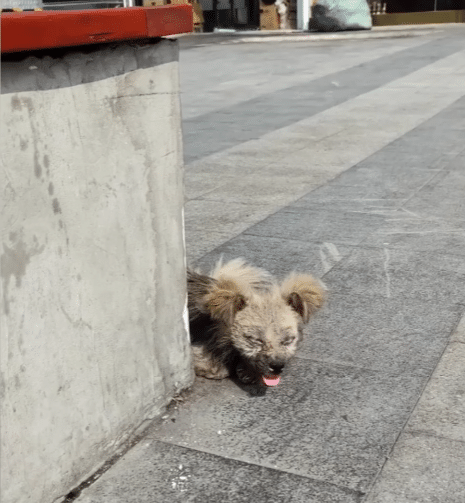
A small dog was curled tightly into the corner of a rough concrete wall, his body pressed inward as though making himself smaller could somehow make the world disappear.
His coat was dirty and tangled. His frame was painfully thin. His breathing came in shallow, uneven rhythms.
But the most troubling detail was his face.
Both eyes were swollen and sealed beneath layers of hardened discharge.
He could barely see—if he could see at all.
And when someone finally came close enough to notice him, he did not run.
He barely moved.
A Dog With Almost No Strength Left
From a distance, it might have been easy to mistake him for a dog simply resting in the shade.
Up close, that illusion disappeared.
His body showed how little strength remained. Hunger had left him extremely thin, while the condition of his eyes had taken away one of the most basic ways an animal understands its surroundings.
Without clear sight, every nearby sound carried uncertainty.
Yet even when a person approached, there was no frantic attempt to escape.
Only a faint reaction.
A small flinch.
Then stillness again.
There was no sign that he trusted the stranger standing near him. He simply appeared too exhausted to protect himself or move away.
That made the moment even harder to ignore.
The dog remained against the cold concrete, breathing quietly, while someone made a choice that would change what happened next.
Instead of walking past, the person moved closer.
One Decision Changed the Direction of His Story
The person behind the camera approached slowly and eventually knelt beside him.
There was no dramatic struggle.
No chase.
No loud rescue scene.
Only a vulnerable dog who needed immediate help and a person willing to recognize it.
Once the dog was seen properly, the seriousness of his condition became impossible to dismiss.
He was gently lifted from the concrete corner and taken for veterinary care.
That transition—from lying unseen against a wall to being carried toward help—became the first real turning point in his story.
Until then, almost everything around him had been uncertainty.
Now, for the first time, something was being done.
VIDEO: His Eyes Were Sealed Shut in a Concrete Corner — Then Someone Reached Down to Help
The Clinic Revealed How Serious His Condition Was
At the veterinary clinic, the problem affecting his eyes was confirmed to be a severe untreated bacterial infection.
Both eyes were badly inflamed.
Over time, thick discharge had accumulated and hardened until his eyelids were effectively sealed closed.
Without treatment, the damage could have become permanent.
The risk to his sight was serious enough that care began immediately.
There was no single dramatic procedure that could erase what had happened.
Helping him would require patience.
The hardened material around his eyes needed to be softened carefully. Warm compresses were used, allowing the buildup to be removed little by little instead of forcing the process.
Antibiotic eye drops were introduced, along with medication intended to address the infection.
Each step was gentle.
Each step mattered.
Recovery Began With Very Small Signs
The first days did not bring an instant transformation.
He was still weak.
His eyes were still swollen.
His body still carried the effects of prolonged hunger and exhaustion.
But his surroundings had changed completely.
He was no longer lying against rough concrete.
He had a clean place to rest.
Food was placed in front of him.
And eventually, he ate.
That ordinary action became one of the first encouraging signs.
Eating meant his body still had something to work with.
Resting safely meant his energy no longer had to be spent simply enduring the environment around him.
Meanwhile, treatment continued.
The swelling began to ease gradually rather than disappearing all at once.
His breathing became calmer.
His body could finally rest without the constant uncertainty of being exposed in the corner where he had been found.
Nothing about the process was fast.
But recovery did not need to be fast to be real.
For this dog, progress arrived in small pieces.
A meal.
A quiet rest.
Less swelling.
A steadier breath.
Each one carried him a little farther from the condition in which he had been discovered.
Then One Eye Began to Open
After days of consistent care, something changed.
One of his eyes opened slightly.
At first, it was only a narrow gap.
Then came a blink.
It was a tiny movement, but after seeing both eyes completely sealed shut, it carried enormous meaning.
The dog began responding more clearly to what was happening around him.
His head followed changes in light.
Movement started to catch his attention.
The world that had been reduced mostly to sound and touch was beginning to take shape again.
His vision was not instantly perfect.
His recovery was not finished.
But the difference was unmistakable.
He was beginning to see.
And as his awareness returned, other changes followed.
His posture became stronger.
His expression softened.
Instead of remaining completely withdrawn, he began showing something closer to curiosity about the people and movement around him.
His eyes had once been the clearest sign of how much help he needed.
Now they were becoming evidence of how far careful treatment had already carried him.
More Than His Eyes Were Changing
The most visible part of this rescue involved his sight, but the transformation was not limited to his eyes.
When he was first found, the small dog barely reacted to the world around him.
He stayed pressed into the concrete corner.
He had little energy to move.
His blindness left him surrounded by uncertainty.
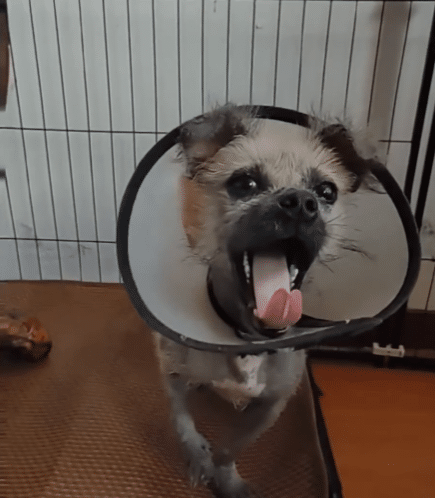
By the time his eyes began opening again, his presence had changed.
He was eating.
Resting.
Responding.
Watching movement.
Those may sound like ordinary things for a healthy dog.
For him, they represented pieces of normal life returning one at a time.
Rescue is sometimes imagined as one dramatic moment when an animal is carried away from danger.
But the quiet days afterward can matter just as much.
Recovery often depends on repeated acts of care that look almost insignificant by themselves.
Another warm compress.
Another dose of medication.
Another meal.
Another safe place to sleep.
Another day in which nobody walks away.
Together, those small acts gave this dog something he had been missing when he lay against that wall: a real opportunity to recover.
From a Forgotten Corner Back Into the World
There was no sudden burst of energy that marked the end of his struggle.
No single moment erased everything that had come before.
Instead, the change appeared gradually.
The dog who once lay nearly motionless in a concrete corner was now reacting to light and movement.
The eyes that had been completely sealed were beginning to open.
The body that seemed to have almost no strength left was becoming steadier.
And the most important difference was simple.
He was no longer alone in that corner.
Someone had seen him.
Someone had come closer.
Someone had decided that his condition was worth stopping for.
That decision led to veterinary care, medication, food, rest, and the gradual return of his sight.
His full past remained unknown.
There was no explanation for how long he had been there or exactly what circumstances had brought him to that concrete wall.
But what happened after he was discovered was clear.
Help arrived before the damage became irreversible.
Sometimes Rescue Begins With Simply Not Looking Away
There is something especially powerful about a rescue that begins without noise.
This dog did not chase anyone for help.
He did not have the strength to run toward safety.
He could barely respond when someone came near.
His condition could easily have remained hidden in an ordinary concrete corner.
Instead, one person noticed.
That was enough to begin changing everything.
The medical care mattered.
The medication mattered.
The food and safe resting place mattered.
But before any of those things were possible, someone had to make the first decision.
To stop.
To look closer.
To recognize that the small figure against the wall was not simply resting.
He needed help.
Days later, when one eye finally began to open and he started following light again, that quiet decision could be seen in the result.
A dog who had been shut away from the visible world was beginning to reconnect with it.
Not through a dramatic miracle.
Through attention.
Patience.
Treatment.
And compassion repeated day after day.
Sometimes darkness does not disappear in a single moment.
Sometimes it fades slowly, beginning with one person who chooses not to walk past.
For this small dog, that choice gave him the chance to open his eyes again—and begin seeing the world from somewhere safer than a forgotten concrete corner.


