
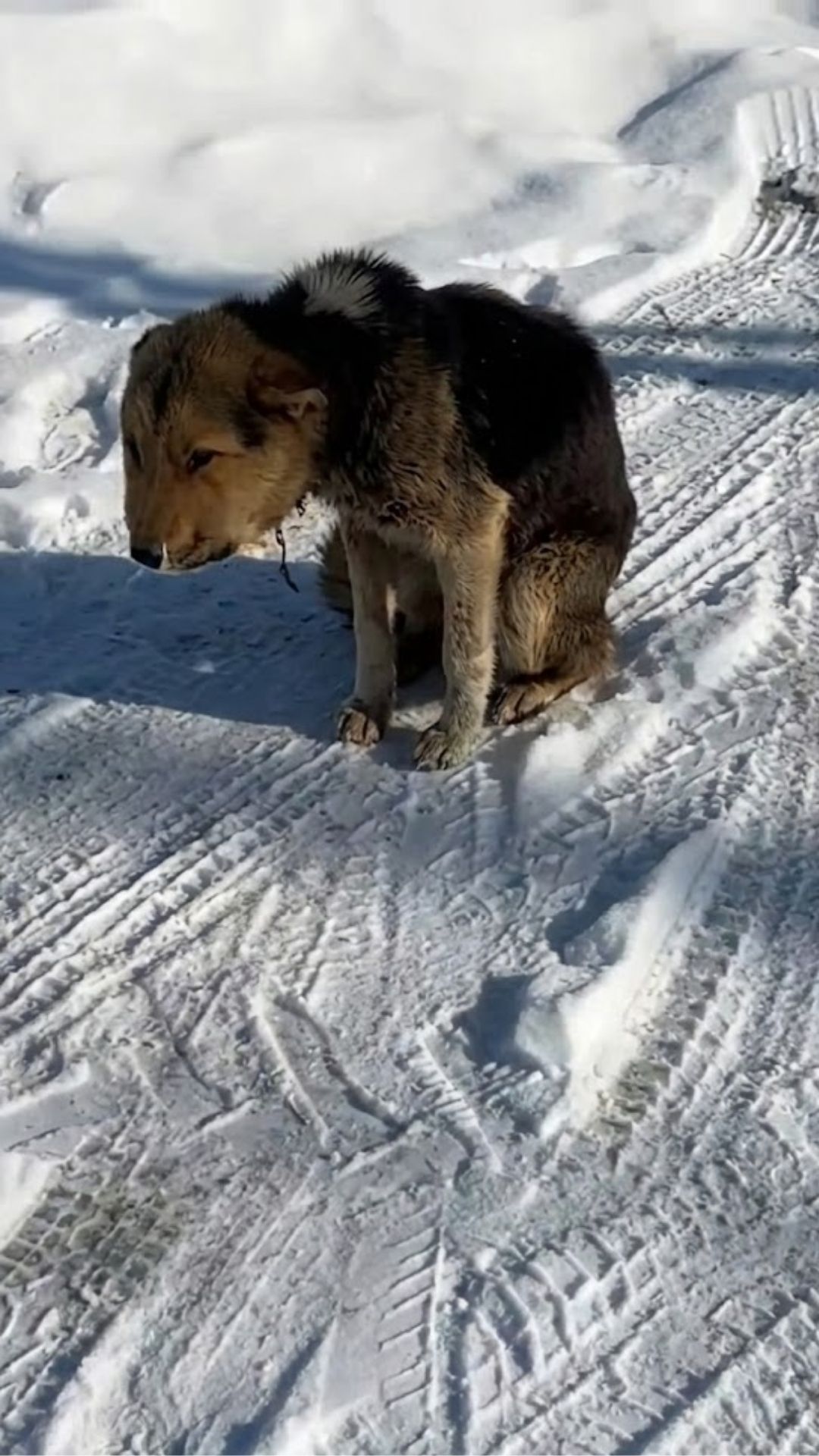
Some rescue stories begin with a dog quietly waiting for someone to notice.
This one began outside a busy supermarket, where a frightened dog had been tied to a pole with a collar around her neck.
The collar may once have fit when she was much smaller.
But she had grown.
The collar had not.
Over time, it tightened until it pressed deeply into her neck, leaving her in serious discomfort and making an already difficult life even harder.
By the time people truly understood how much she was suffering, the change in her appearance was impossible to miss.
Her entire head had become severely swollen.
Yet somehow, beneath the fear and pain, there was still a dog who had not completely given up.
The Dog Everyone Could See, But Few Could Reach
Her swollen face immediately drew attention.
Breathing appeared difficult. Eating was uncomfortable. Even ordinary movement seemed to require effort.
But approaching her was another challenge entirely.
At some point, she managed to move away from the pole, with the rope trailing behind her as she ran through the surrounding streets.
People tried to get close.
She fled.
Again and again.
Her reaction was understandable. Whatever had happened before rescuers arrived, she had learned to be cautious around people.
A hand reaching toward her did not automatically mean safety.
So when rescuers came, they faced two problems at once.
They needed to help her quickly.
But they also had to convince a terrified dog that they were not another threat.
There would be no simple chase.
No sudden grab.
If they wanted to save her, they first had to earn a little trust.
Two Hours of Patience Instead of Force
The rescuers could see that she was struggling.
Her breathing was shallow, her body temperature was high, and exhaustion showed clearly in her eyes.
Still, one tiny moment gave them hope.
When she noticed the people trying to help her, her tail moved.
Just a small wag.
It lasted only a moment, but it revealed something important.
Fear had not erased her ability to respond to kindness.
Rather than rush toward her, the rescuers changed their approach.
They placed food down.
Then they stepped back.
Hunger slowly drew her closer.
She took a bite and immediately moved away again.
So they waited.
They followed from a respectful distance, spoke gently, and allowed her to decide how close she could tolerate them being.
Minutes passed.
Then more.
For nearly two hours, the pattern continued.
A little food.
A little distance.
A frightened retreat.
Then another cautious step forward.
There was no dramatic instant in which all her fear suddenly disappeared.
Trust rarely works that way.
It came one small decision at a time.
Finally, she stopped running.
And for the first time, she allowed the rescuers to approach.
VIDEO: Her Face Was Severely Swollen — Then Patient Rescuers Finally Earned Her Trust
The Collar Had Become Far More Than an Accessory
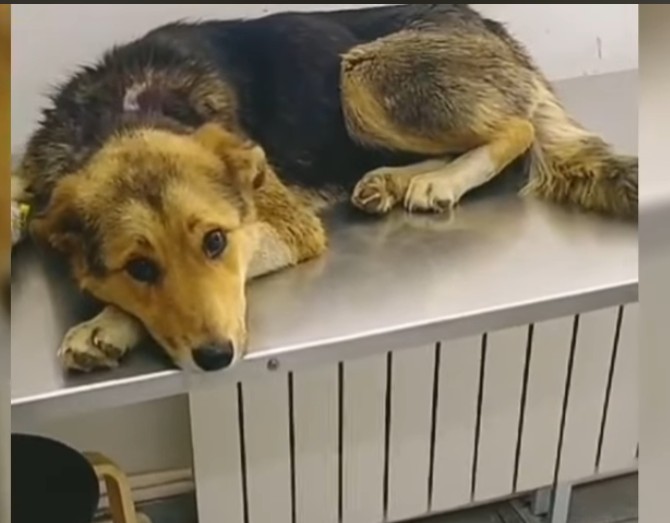
Once they could examine her closely, the seriousness of her condition became clear.
The collar had tightened so much that it had become embedded deeply around her neck.
What had once been an ordinary object had turned into a painful restraint that her growing body could no longer escape.
No one could know exactly how long she had lived with it that way.
But the swelling in her head and the condition of her neck showed that she needed immediate care.
The collar could not simply be pulled away.
Removing it required careful medical attention because the surrounding tissue had already been badly affected.
For a dog who had spent so long running from human hands, she now had to depend on those hands completely.
The same species she feared was now trying to help her breathe comfortably again.
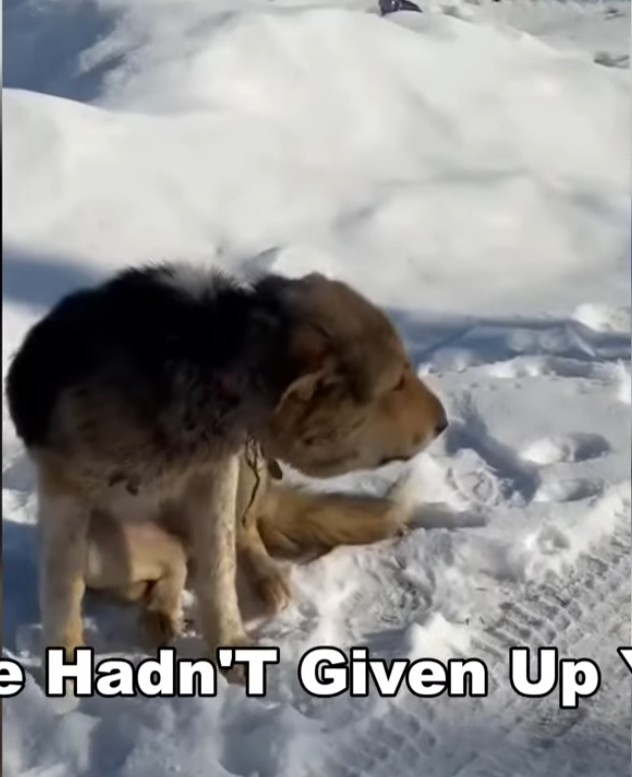
The procedure was delicate, but the collar was finally removed.
And then came one of the simplest moments in her entire recovery.
She took a deep breath.
For everyone who had watched her struggle, that breath carried enormous meaning.
Nothing about her life was instantly fixed.
She still needed time.
Her body still had healing to do.
Her fear would not disappear overnight.
But the object that had been tightening around her neck was finally gone.
For the first time in a long while, recovery could begin without that constant pressure.
Healing Revealed the Dog Beneath the Swelling
The changes did not happen all at once.
During the first week, the swelling gradually began to decrease.
Day by day, more of her natural features became visible.
Her face slowly looked less strained.
Her eyes appeared brighter.
Her tail began moving with greater confidence.
Then, around the tenth day, her caregivers noticed another change.
She seemed to smile.
It was not an exaggerated expression.
Just a small softening around her mouth, the kind of subtle change that might mean little to someone who had not watched her arrive frightened and severely swollen.
To the people caring for her, it meant everything.
One caretaker described her simply as a sweet girl who still wanted to trust despite what she had experienced.
That trust became one of the most meaningful parts of her recovery.
Physical healing could be seen in the shrinking swelling.
Emotional healing appeared differently.
It showed in the way she stayed near people a little longer.
In the way her body relaxed.
In the increasingly frequent movement of her tail.
And in the quiet realization that she no longer needed to run whenever someone came close.
By the twelfth day, her face had nearly returned to its natural shape.
The dog who had once looked almost unrecognizable was beginning to look like herself again.
A New Collar Carried a Very Different Meaning
There was one object that could easily have become a permanent symbol of fear for her.
A collar.
The first one had tightened as she grew, becoming part of the suffering that brought her to rescue.
But on Day 21, she received another.
This time, it was soft.
Adjustable.
Brightly colored.
Most importantly, it fit properly.
The contrast was difficult to miss.
A collar had once represented neglect.
Now another collar represented care.
It could be adjusted as needed.
It was something people would notice, check, and make sure remained comfortable.
The difference was not really in the object itself.
It was in the people responsible for it.
By Day 31, another scene showed just how far she had come.
She was running through open fields.
No rope dragging behind her.
No desperate attempt to escape people.
Just a dog moving freely, tongue out, eyes bright, experiencing a kind of ordinary happiness that once seemed very far away.
The Quiet Life She Had Been Missing
Her story did not end when the collar came off.
Rescue gave her something much larger than a medical procedure.
It gave her a home.
Today, her life is filled with simple routines that many dogs take for granted.
She wakes to gentle affection.
She has her own food bowl.
She sleeps in a comfortable bed.
She even has a favorite toy — a squeaky duck.
But perhaps the clearest sign of how much she has changed is where she chooses to rest.
Beside her human.
Her head can settle peacefully in a lap, and she can fall asleep without needing to stay alert for danger.
For a dog who once ran whenever people approached, that kind of sleep says more than words ever could.
Her new family does not see her as a reminder of suffering.
They see the affectionate dog who survived it.
The playful companion who discovered what safety feels like.
The gentle animal who, even during one of the hardest moments of her life, still managed to offer rescuers a tiny wag of her tail.
What One Small Tail Wag Came to Mean
It would be easy to remember this story only because of the dramatic swelling in her face.
But that was never the most important part.
The most remarkable thing was what remained beneath it.
Her willingness to keep responding.
Her ability to trust again.
And the patience of people who understood that rescue sometimes means waiting for a frightened animal to make the first move.
They could not explain to her why they were following her.
They could not promise her that the hands reaching toward her would be gentle.
They could only show her.
Food placed on the ground.
Space when she needed it.
Soft voices.
No rushing.
Then medical care when she was finally ready to be reached.
Healing followed slowly, as real healing often does.
The swelling decreased.
Her face returned.
Her tail moved more freely.
Her personality emerged.
Eventually, the dog who had once been tied outside a supermarket was running through open space and sleeping peacefully beside someone who loved her.
Her scars remain part of her history.
But they no longer define her days.
What defines them now is something much quieter.
A safe bed.
A favorite toy.
A properly fitted collar.
A human lap where she can close her eyes.
And a tail that no longer gives one uncertain wag from a distance.
It wags because she finally knows she is home.


