
Some rescue stories begin with barking, running, or a frightened animal trying desperately to escape.
This one began with almost no movement at all.
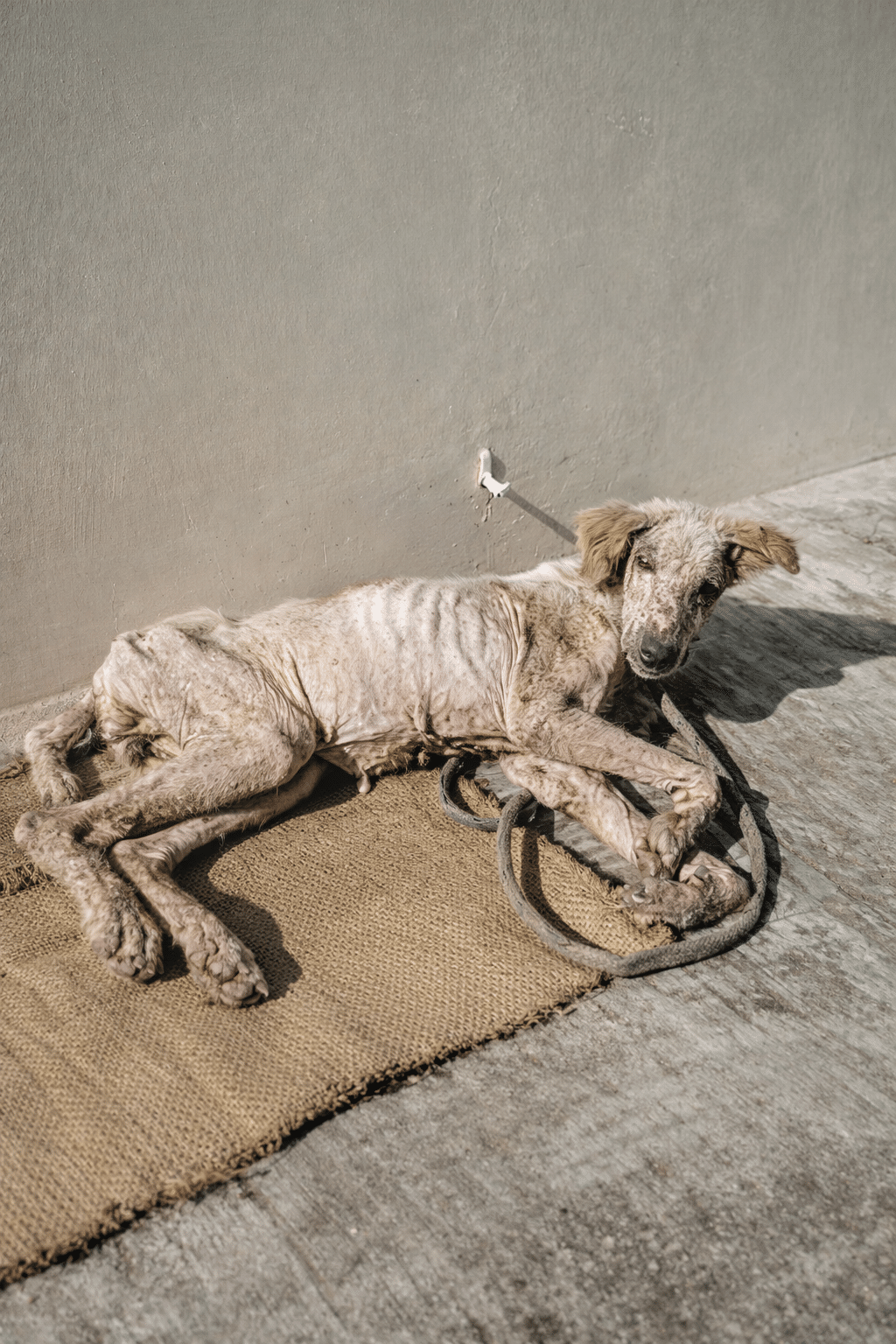
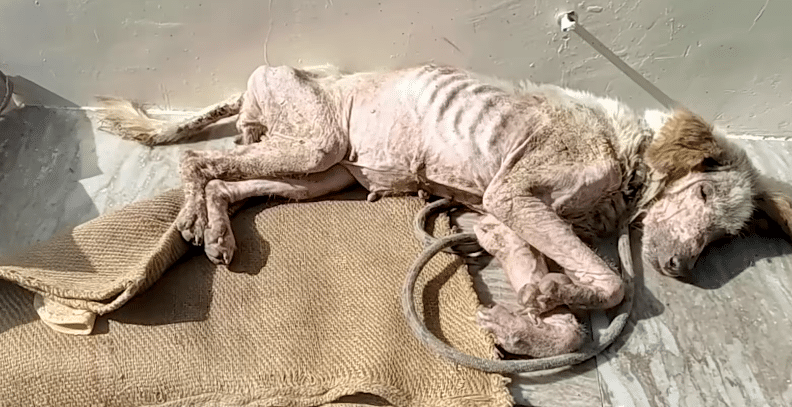
Near the edge of a dusty roadside, a small dog lay curled against the ground. His body had become frighteningly thin, with his ribs clearly visible beneath skin already damaged by severe mange. Large areas of fur were gone, leaving irritated skin exposed.
He did not call for attention.
He did not try to run.
He simply remained where he was, exhausted enough that even standing appeared beyond him.
A Dog With Almost Nothing Left to Give
The physical signs told only part of the story.
Mange had taken a heavy toll on his skin, while parasites had further weakened a body already struggling for nourishment. His tiny frame seemed drained of nearly every reserve it had once possessed.
Even the most basic movements required energy he barely seemed to have.
For an animal living outside, that level of weakness left little margin for survival.
He could not search easily for food.
He could not move quickly away from danger.
And he had no obvious safe place where his body could begin to recover.
Yet he remained quiet.
There was no dramatic struggle or desperate display. His condition spoke for him.
Sometimes the animals in greatest need are not the ones making the most noise.
They are the ones who have become too tired to ask.
The Moment Someone Finally Stopped
That was when rescuers from Animal Aid Unlimited came across him.
They understood immediately that this was not a situation that could simply be watched from a distance. His condition was already severe, and leaving him where he was could have meant losing the narrow opportunity still available to help him.
So they chose to act.
They approached carefully and lifted his fragile body from the roadside.
He did not resist.
Not because he suddenly understood that everything was going to change, but because he appeared to have very little strength remaining.
Still, that moment mattered.
For the first time in the story, he was no longer facing his condition alone.
The ground beneath him was replaced by human hands.
The roadside was behind him.
And although nothing about his recovery was guaranteed, he had been given something he did not have only moments earlier:
A chance.
VIDEO: Found Too Weak to Stand Beside the Road — Watch the Moment His Second Chance Began
Healing Began With the Smallest Steps
Once he reached the shelter, care started immediately.
His irritated skin was gently cleaned with medicated baths, and treatment was provided for the severe mange that had caused so much fur loss and discomfort. The parasites weakening him were also addressed.
For the first time in what may have been a long while, he could rest on soft bedding rather than exposed ground.
Food also had to be introduced gradually.
His body had been deprived for so long that recovery could not be rushed. Strength would have to return slowly, through nourishment, rest, treatment, and time.
At first, there was no sudden transformation.
No dramatic burst of energy.
No instant recovery.
The early signs were much quieter.
One day, he raised his head by himself.
It lasted only a short time, but caregivers noticed.
Before, even that simple movement had seemed difficult.
Now his body was beginning to respond.
Then his eyes started following people around the room.
That was another small change.
He was becoming more aware of the people caring for him.
And eventually, when gentle hands came close, he no longer seemed to pull away in the same way.
Instead, he began leaning toward touch.
Trust Returned Before His Fur Did
Physical recovery can be measured in visible ways.
Weight returns.
Skin improves.
Fur begins to grow.
But another kind of recovery was also taking place.
The dog who had once lain almost motionless beside the road was beginning to engage with the world around him again.
He watched his caregivers.
He accepted their presence.
He allowed himself to rest near them.
Those changes were easy to overlook, yet they carried enormous meaning.
A dog can receive medicine and food while still remaining frightened and emotionally withdrawn. Learning that a human hand may bring comfort rather than danger can take longer.
For him, that process seemed to unfold gradually.
There was no single moment when everything suddenly became easy.
There were only small signs.
A lifted head.
Eyes that followed movement.
A body that relaxed a little more.
A willingness to stay close.
Taken separately, each seemed modest.
Together, they showed that something important was returning.
His strength was not the only thing recovering.
So was his trust.
The First Flick of a Tail
As the weeks passed, the changes became easier to see.
Thin fur began appearing again where large bald patches had once covered his body. The inflammation in his skin eased. His frame gradually filled out as nourishment helped restore the weight he had lost.
His posture changed too.
The dog who once seemed folded inward began carrying himself differently.
He looked stronger.
More alert.
More present.
Then came one of the smallest movements of all.
His tail moved.
At first, it was only a tentative flick.
Then it happened again.
Before long, that small motion became part of the way he greeted the people who had been caring for him.
For rescuers, moments like that can mean more than dramatic milestones.
A wagging tail cannot erase everything an animal has endured.
But it can show that comfort has begun to replace fear.
That safety is becoming familiar.
That the world no longer feels quite as threatening as it once did.
He was no longer simply resting because he had no strength to move.
He was beginning to respond because he wanted to.
The Dog by the Road Was Almost Unrecognizable
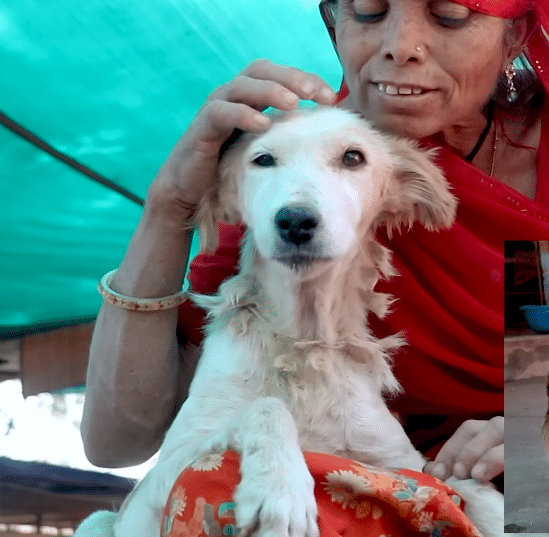
By the time his recovery was complete, the transformation was striking.
The skeletal figure found beside the dusty roadside had become an alert, healthy-looking dog.
His coat had returned.
His skin had improved.
His body carried strength again.
The physical difference alone was remarkable.
But the greatest change could be seen in the way he interacted with the people around him.
His eyes were brighter.
His posture was more confident.
His tail could express excitement.
He had gone from lying quietly on the ground with almost no energy to engaging with the world around him.
That journey had required treatment and nourishment.
But it had also required patience.
Recovery was built through repeated acts of care that may have looked ordinary on their own.
A safe place to sleep.
Food introduced carefully.
Skin cleaned and treated.
Time to rest.
Gentle contact.
Consistency.
None of those things created an instant transformation.
Together, they gave his body and spirit room to return.
One Decision Changed the Direction of His Life
There is a simple moment at the center of this story.
Someone saw a severely weakened dog beside a road and decided not to keep going.
Everything that followed depended on that choice.
The medicated baths.
The parasite treatment.
The soft bedding.
The gradual return of nourishment.
The first time he lifted his head.
The first time he leaned into a gentle touch.
The first flick of his tail.
None of those moments could have happened if he had remained where he was.
Street animals often suffer quietly, and their condition may worsen long before anyone realizes how serious it has become. Some still run from help. Others hide.
And some, like this dog, simply become too weak to do much of anything at all.
That is why noticing matters.
Compassion does not always begin with something dramatic.
Sometimes it begins when someone looks twice.
When someone stops.
When someone decides that a life struggling quietly at the edge of the road is still worth fighting for.
For this dog, that decision became the beginning of everything that came next.
He had been found when his body seemed close to giving up.
He left that chapter with strength, a healthy coat, and the ability to experience comfort again.
What looked like the end of his story became the place where another one began.


