
Rico was hungry enough to search desperately for food, yet eating could not give his weakened body the nourishment it needed.
That was the terrible contradiction at the center of his struggle.
Food was not entirely out of reach. The real problem was what happened after he swallowed it.
His body could not move meals into his stomach properly.
And with every unsuccessful attempt to eat, the distance between hunger and survival seemed to grow.
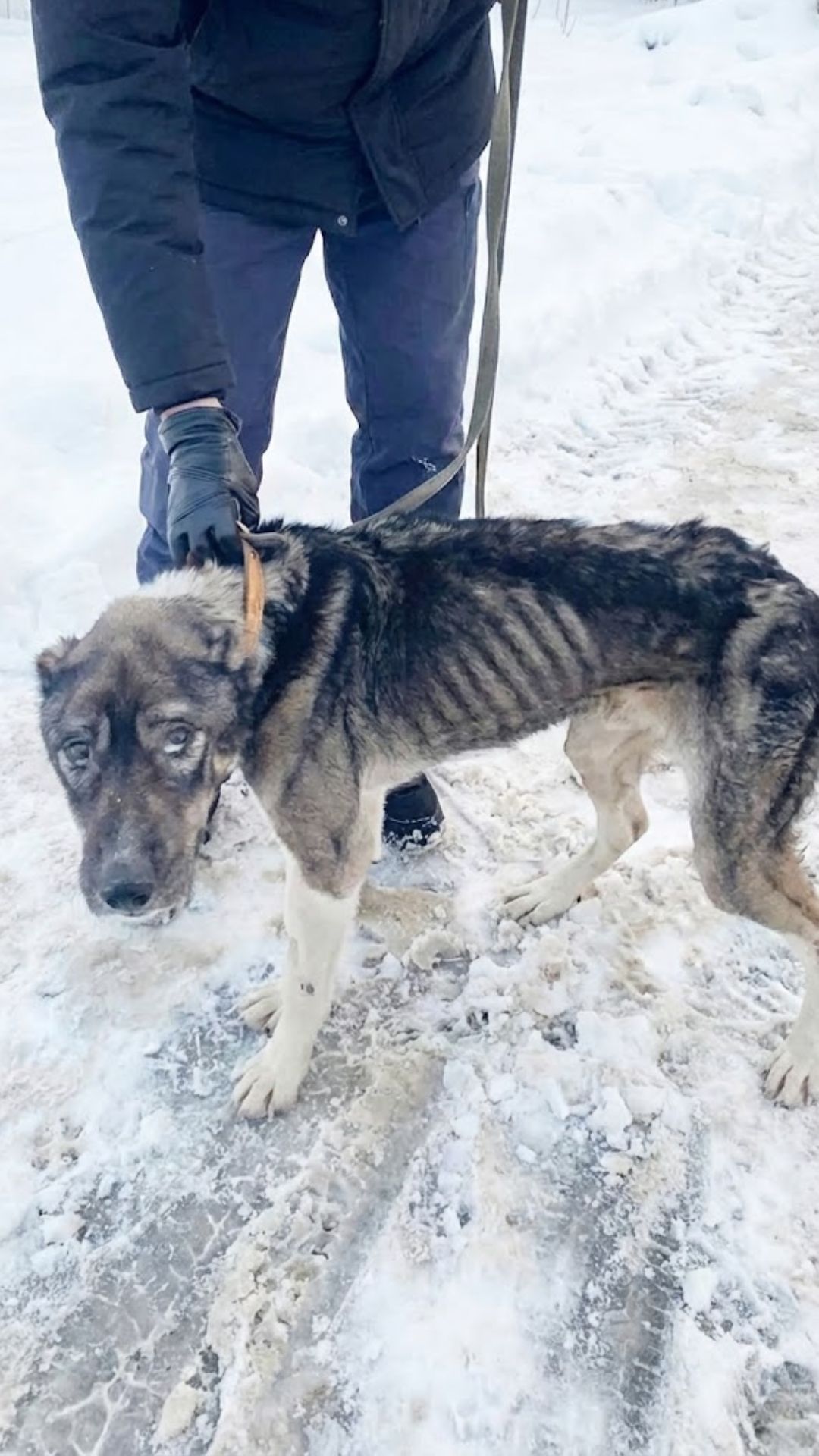
When rescuers encountered Rico near a shelter on Pozharsky Street, his appearance made the seriousness of his condition impossible to ignore.
He was dangerously thin.
His ribs stood out beneath his skin. His backbone was clearly visible, and his hips showed how much weight he had lost.
Even walking seemed to demand more strength than he could comfortably spare.
Yet he was still moving.
Still searching.
Still trying to find the food his body so desperately needed.
What the rescuers did not yet know was that simply offering him a meal would never be enough.
A Fragile Dog Who Needed More Than Food
The rescue team brought Rico to a veterinary clinic without delay.
By then, he was severely underweight, cold, and struggling with weakness. His condition required more than an ordinary feeding schedule.
At first, his extreme thinness suggested a dog who had gone without adequate nourishment for far too long.
It was reasonable to hope that food, warmth, and medical attention might begin to restore his strength.
But an early attempt to feed him revealed a much more complicated problem.
Rico ate.
Then, within minutes, the food came back up.
The same difficulty affected water.
For an animal already so depleted, this was an especially worrying development. Eating should have been the first step toward recovery, yet Rico was unable to benefit from the nourishment being offered.
The rescue team faced a difficult reality.
They could place food in front of him, but they could not assume that the food would reach his stomach.
And until the reason became clear, every feeding attempt carried uncertainty.
Rico's appearance told one part of his story.
What happened after each meal told the rest.
When the Veterinary Team Found the Hidden Problem
Veterinary examinations eventually identified the source of Rico's feeding difficulties.
His esophagus was not working as it should.
Normally, coordinated muscular movements carry swallowed food down the esophagus and into the stomach. It is a process most healthy animals complete without any visible effort.
For Rico, that essential movement was no longer functioning properly.
Food could remain in his esophagus instead of reaching his stomach, eventually coming back up.
The problem was therefore not simply how much he wanted to eat.
It was whether his body could deliver that food to the place where digestion could begin.
Rico had already lost more than 10 kilograms, approximately 22 pounds.
That was a frightening amount of weight for a dog of his size, especially one who was already showing such obvious physical weakness.
His condition also helped explain why ordinary feeding could not solve the crisis.
More food would not necessarily mean more nutrition.
Even water presented a challenge.
The veterinary team now had to find a way to help Rico receive nourishment while working around an esophagus that could no longer perform its normal job.
This was no longer a straightforward case of helping an underfed animal regain weight.
It had become a careful struggle to keep him supported while his medical options were evaluated.
And the people caring for him knew that time mattered.
VIDEO: Rico Kept Losing Every Meal — See How Rescuers Tried to Help Him Eat Again
The Unusual Feeding Routine That Offered Him a Chance
One of the most important changes in Rico's care involved something that healthy dogs rarely need to think about.
Gravity.
Because the muscles in his esophagus were not moving food downward effectively, his caregivers began helping him remain upright after eating.
The method was simple in appearance, but demanding in practice.
Following meals, volunteers carefully supported Rico in a vertical position.
They held him upright for approximately 20 to 30 minutes, giving gravity an opportunity to help move food toward his stomach.
It was a remarkably different approach from ordinary feeding.
For most dogs, finishing a meal is followed by the freedom to walk away, lie down, or rest.
Rico needed something else.
He needed assistance after swallowing.
He needed someone willing to support his weakened body and remain with him long enough for the feeding process to have a better chance of working.
And he needed this attention repeatedly, not just once.
The effort required patience because there was no assurance that every attempt would succeed.
Some days remained particularly difficult.
Even water could come back up.
That meant the challenges extended beyond nutrition. Keeping Rico adequately hydrated was also essential.
To help support him, the veterinary team provided intravenous fluids when his condition required them.
This care could address part of his immediate physical needs, but it did not make the underlying esophageal problem disappear.
Every part of his routine still needed attention.
How he was fed.
How he was positioned.
Whether he could retain what he received.
And whether his weakened body could begin recovering enough strength to face the next stage of treatment.
For the volunteers, helping Rico eat became an act of sustained care rather than a brief moment of kindness.
Holding him upright for half an hour might sound like a small task.
But when that assistance is necessary after meal after meal, it becomes a significant commitment.
Rico could not manage the process alone.
Fortunately, he no longer had to.
Warmth Became Another Essential Part of His Care
Food was not the only concern during Rico's treatment.
He also struggled to stay warm.
His body had lost so much weight that very little fat remained to help protect him from the cold.
He shivered frequently.
For an animal already dealing with severe physical weakness, that discomfort added another difficulty to an exhausting situation.
Caregivers responded by wrapping him in blankets and closely monitoring his condition.
The blankets offered a practical form of comfort while the veterinary team continued addressing his medical needs.
For Rico, recovery was not about overcoming one problem in isolation.
He needed nutritional support.
He needed fluids.
He needed warmth.
And he needed careful observation because his condition remained fragile.
These were not dramatic acts of rescue in the traditional sense.
There was no single gesture that could immediately restore his lost weight or make his esophagus function normally again.
Instead, his care depended on a series of necessary actions repeated with consistency.
A feeding attempt.
Time spent upright.
Monitoring afterward.
Medical support when he could not retain enough food or water.
Keeping him comfortable when his body struggled with the cold.
Each step addressed a different part of the same urgent challenge.
Rico was still in danger, but he was now receiving the kind of continuous attention that his condition demanded.
A Difficult Medical Decision Still Lay Ahead
As the team continued caring for Rico, veterinarians had to consider what might happen if his current feeding routine proved insufficient.
His condition was serious enough that a more invasive approach could become necessary.
One possibility was a gastrostomy.
This procedure would allow a feeding tube to be placed directly into his stomach, making it possible to deliver nutrition without relying on the damaged esophagus.
For a dog struggling to move swallowed food into his stomach, that option could provide an important alternative.
But it was not a minor decision.
It would involve a medical procedure followed by substantial care and recovery.
The veterinary team therefore faced a difficult balance.
They needed to give Rico the best possible opportunity to receive nutrition, while also considering the demands and risks of further treatment.
At the stage described in his story, surgery remained a possibility rather than a confirmed event.
There was no guarantee that the upright feeding routine alone would be enough.
There was also no confirmed final outcome.
What was clear was that Rico's caregivers were continuing to explore ways to keep him alive and support his recovery.
His future depended on how his condition responded to ongoing treatment and what medical decisions might become necessary.
For now, the work continued.
The Gentle Patience Behind His Determination
Despite his weakened condition, Rico showed a calm side throughout his care.
The volunteers supporting him after meals were working with a dog who allowed them to help.
He remained patient while they held him upright.
He also tolerated the treatments and intravenous therapy that had become part of his medical routine.
These details may seem small beside the seriousness of his illness.
But they matter.
Caregiving becomes especially demanding when an animal needs repeated assistance with the most basic physical functions.
Rico's willingness to accept that assistance allowed the team to continue providing the support he required.
His body remained fragile.
His feeding difficulties had not simply vanished.
Yet there was something quietly encouraging about seeing him receive care and continue through another treatment.
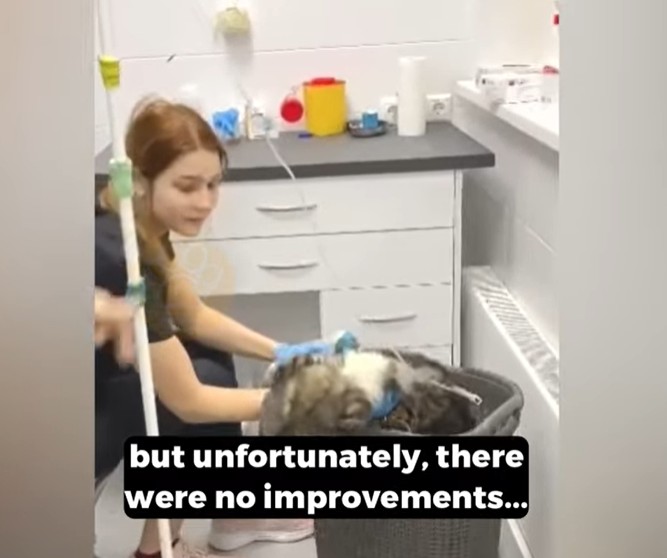
He was no longer wandering near the shelter, searching for food without the specialized assistance he needed.
He was in a veterinary setting, surrounded by people who understood that his hunger could not be solved by filling a bowl.
That distinction changed everything about his immediate circumstances.
The rescuers could not promise him a quick recovery.
They could not remove the uncertainty surrounding his condition.
But they could make sure his needs were being recognized and addressed.
Sometimes compassion is not expressed through a single extraordinary moment.
Sometimes it looks like someone carefully holding a weak dog upright after a meal because that is what his body needs.
Sometimes it means preparing for another feeding attempt even when the previous one was unsuccessful.
And sometimes it means continuing to care for an animal whose recovery is far from certain.
For Rico, those ordinary-looking acts of dedication had become essential.
The Long Road Toward Regaining His Strength
Rico still had a great deal to overcome.
Losing more than 10 kilograms had left him in a severely weakened state, and rebuilding his strength would require more than simply increasing the amount of food offered.
His medical team needed to continue managing the difficulties caused by his esophagus.
That meant careful feeding procedures, ongoing veterinary oversight, and close attention to whether his body was receiving enough nourishment.
Further examinations might also be necessary.
The possibility of surgery remained part of the discussion.
Nothing in the available account established that Rico had fully recovered, regained his lost weight, or moved on to a permanent home.
His story had not yet reached that kind of conclusion.
And it would be unfair to his struggle to pretend otherwise.
What had changed was the support available to him.
Before his rescue, Rico was seen wandering near the shelter in an alarming physical state.
Afterward, his condition was investigated, his feeding problem was identified, and a team began helping him through the daily challenges of staying nourished and hydrated.
That progress does not erase the seriousness of his situation.
But it gives his circumstances a different direction.
Instead of continuing to struggle without specialized care, he now has people working to understand and respond to his needs.
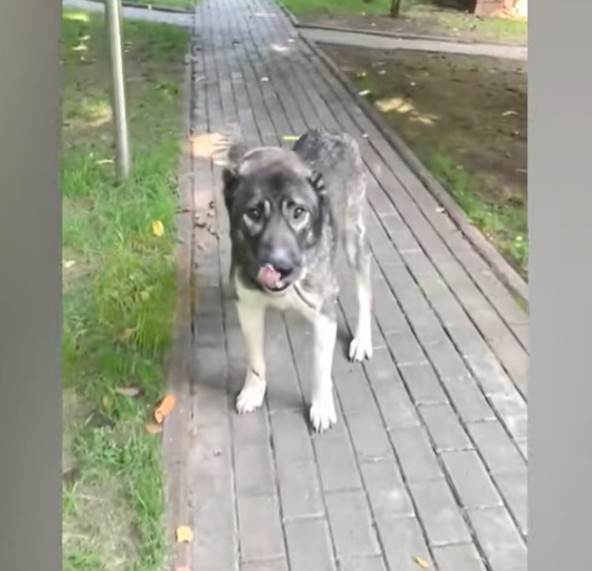
The road ahead may still involve difficult days and challenging medical decisions.
His caregivers will need patience, and his condition will need continued attention.
Yet Rico has already reached an important turning point.
His suffering was noticed.
His unusual medical problem was recognized.
And people stepped in to give him a chance that ordinary feeding could not provide.
A Second Chance Built on Everyday Compassion
Rico's experience offers a reminder that the needs of a rescued animal are not always obvious from appearances alone.
His thin body revealed how much he was struggling.
But the true obstacle was hidden inside a process most animals depend on every day.
He wanted food.
He tried to eat.
Yet his body could not reliably carry that food into his stomach.
Understanding that difference was essential to helping him.
It also changed what kindness needed to look like.
For Rico, rescue did not end when he reached the veterinary clinic.
It continued through the feeding routine, the fluids, the blankets, the monitoring, and the difficult discussions about possible future treatment.
His story remains unfinished.
There is still uncertainty about how much strength he will regain and whether additional medical intervention will be needed.
But he no longer faces those questions without support.
The dog who once wandered in search of nourishment now has people willing to do the patient, demanding work of helping him receive it.
No one can promise exactly what happens next.
For now, the most meaningful part of Rico's journey is not a perfect ending.
It is the chance to keep going.
And for a dog whose own body had made every meal a struggle, that chance means more than a full bowl ever could.


