
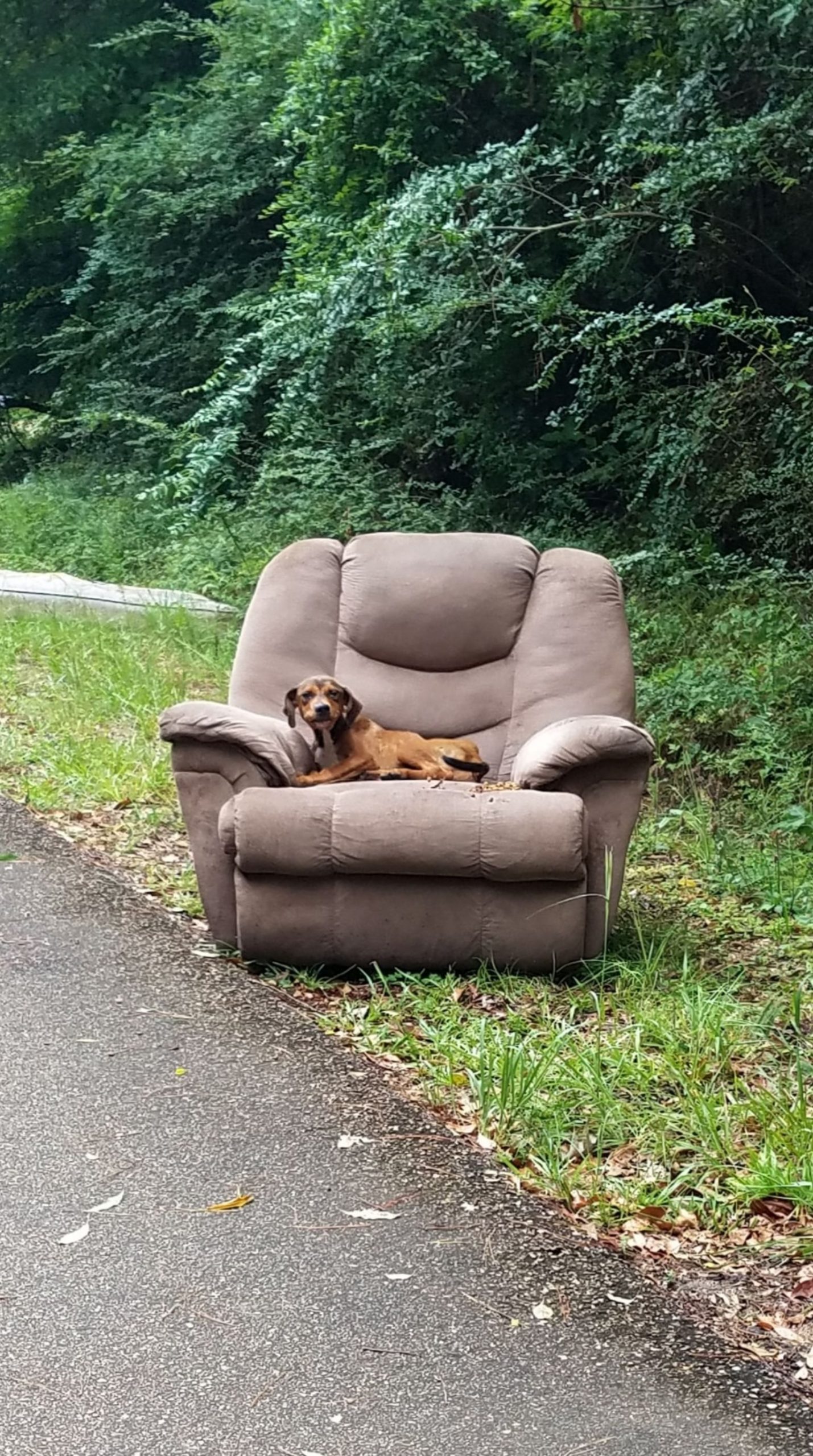
The little puppy had an entire roadside to explore, but he chose to remain curled up in one broken chair.
The cushions were torn. The furniture had been discarded among unwanted household items. And beneath the Mississippi summer sun, the small dog waited in a place where no animal should have been left alone.
He was painfully thin.
He was frightened.
Yet he stayed.
Perhaps the worn recliner still carried familiar scents. Perhaps it was the only object left that reminded him of the life he had known.
Whatever kept him there, one thing was clear: the puppy was not ready to leave that chair behind.
Along a roadside in Brookhaven, Mississippi, an ordinary piece of discarded furniture had become the center of a rescue story that would eventually reach people across the country.
And the little dog at the center of it all would come to be known as Gatson.
The Puppy Who Would Not Leave His Chair
A broken television. An unwanted recliner. A small, bewildered puppy.
According to reports about the incident, a witness noticed a truck stopping along a roadside in Brookhaven. Its occupants unloaded several items, including the old chair and the young dog, before driving away.
The furniture remained where it had been dumped.
So did the puppy.
There was something especially painful about the contrast.
To the people passing through the area, the chair was simply an object that had outlived its usefulness. Its damaged cushions and worn covering offered little reason for anyone to look twice.
But for the little dog curled inside it, the chair appeared to provide a sense of familiarity in a place where everything else had changed.
He did not wander far in search of somewhere better.
Instead, he pressed himself into the old cushions.
As the summer heat surrounded the discarded furniture, the puppy remained exposed and vulnerable. His small frame already showed signs of serious hunger and exhaustion.
He needed food.
He needed shelter.
Most of all, he needed someone to recognize that he was still there.
The sight was difficult to forget: a helpless animal staying close to the very belongings that had been left behind with him.
Dogs cannot explain why they hold on to familiar places. They cannot tell us what they remember or whether they expect someone to return.
But their behavior can reveal how important familiar surroundings have become.
For this puppy, the recliner seemed to be the one place where he still felt connected to something he knew.
And leaving it would require more than simply finding a different place to sit.
It would require learning that another person could be trusted.
The Call That Brought Someone Back for Him
Fortunately, someone had noticed what happened.
After witnessing the roadside abandonment, a concerned person contacted Brookhaven Animal Control.
Officer Sharon Norton responded to the report.
When she arrived, she found the puppy still occupying the discarded recliner, surrounded by the unwanted items that had been left nearby.
His physical condition immediately raised concern.
He was severely underweight, visibly tired, and clearly frightened by his circumstances.
But getting close to him was not as simple as reaching into the chair.
As Sharon approached, the puppy withdrew farther into the cushions.
He had no way of knowing why another unfamiliar person was coming toward him.
Was this person going to take away the only familiar place he had left?
Or had help finally arrived?
Sharon did not try to force the encounter.
Instead, she lowered herself near the chair and offered treats, allowing the puppy to decide whether he felt safe enough to approach.
It was a small gesture.
But for a frightened animal, even the simplest gesture of kindness can become an important first step.
At first, Gatson remained hesitant.
His hunger was evident, yet his fear made him cautious.
The food was close.
So was the stranger offering it.
For a puppy who had already experienced abandonment, accepting that invitation was no small thing.
Sharon stayed patient.
Gradually, the little dog moved toward the treats.
Then came the moment she had been hoping for.
He accepted food from her hand.
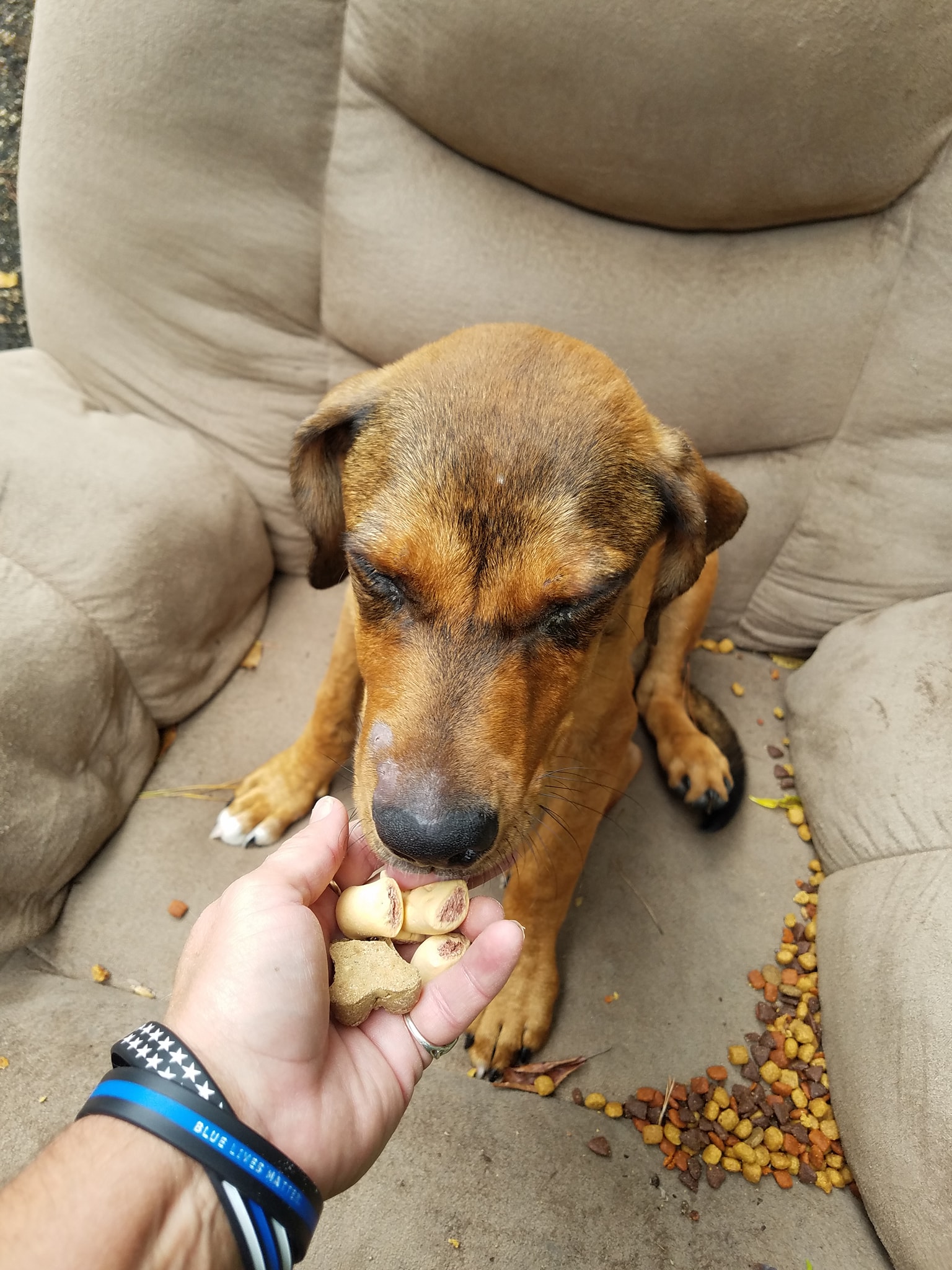
That small act of trust changed the direction of his story.
The puppy who had been keeping his distance was beginning to allow someone closer.
Sharon had not erased his fear.
She had simply given him a reason to believe that this particular human being might be safe.
And that was enough to begin his journey away from the roadside.
A Rescue That Began With a Handful of Treats
For anyone looking at the abandoned recliner, the greatest concern was the puppy's condition.
He had clearly gone without the care and nourishment he needed.
His thin body showed how vulnerable he had become. His reluctance to leave the chair suggested that the experience had also affected his sense of security.
Yet his response to Sharon's gentle approach offered something encouraging.
He was still willing to connect.
He could still respond to patience.
And when kindness was offered without pressure, he began to accept it.
The rescue was not defined by a dramatic struggle or a sudden display of bravery.
Its most meaningful moment was quiet.
A frightened puppy moved toward an unfamiliar hand because that hand held food instead of danger.
The chair that had kept him in one place no longer had to be his only source of comfort.
There was now a person prepared to help him.
With Sharon's intervention, Gatson was finally brought into safety.
The roadside, the dumped furniture, and the exhausting uncertainty of being left alone were no longer the whole of his world.
But rescue was only the beginning.
The next challenge would be helping his weakened body recover and allowing him to feel secure around people again.
VIDEO: He Refused to Leave the Broken Chair — Until a Gentle Rescuer Earned His Trust
A New Name and the Care He Desperately Needed
After his rescue, the puppy was taken to the Brookhaven Animal Rescue League, commonly known as BARL.
There, the focus shifted from getting him off the roadside to helping him recover.
Veterinary staff began addressing his immediate needs.
His thin condition required careful attention to nutrition, and he was given fluids to help restore hydration. His progress was monitored as the shelter began supporting his recovery.
These were not glamorous moments.
There was no instant transformation.
A puppy who had arrived weak and frightened needed consistent care, appropriate nourishment, and time.
His caregivers understood that his recovery could not be measured only by how much he ate.
There was also the question of whether he could become comfortable in his new surroundings.
The animal who had withdrawn into the corner of an old chair now had to adjust to a shelter filled with unfamiliar people and experiences.
For some rescued dogs, physical improvement happens before emotional confidence returns.
For others, those changes develop alongside each other.
Gatson would need patience with both.
The shelter workers gave him a name: Gatson.
It was a simple but meaningful change.
He was no longer just the nameless puppy discovered among discarded household belongings.
He was an individual receiving attention and care.
As his gentle personality became more apparent, the staff also gave him an affectionate nickname.
They called him the "Armchair Bandit."
It was a playful reference to the unusual place where he had been found.
The nickname captured something important about his rescue: even though the circumstances had been painful, the people caring for him were beginning to see more than his hardship.
They were seeing the dog he could become.
And while Gatson continued his recovery, his story was beginning to travel far beyond the shelter walls.
The Photograph That Reached Beyond Mississippi
The image of a small puppy curled inside an abandoned recliner was difficult for people to ignore.
When photographs from Gatson's rescue began circulating online, animal lovers responded with sympathy and concern.
Many were moved by the idea of a dog remaining beside an object associated with the home he had lost.
There was no need for an elaborate explanation.
The photograph already communicated something powerful.
A small animal had been left behind.
He had stayed close to the only familiar object available to him.
And someone had finally come to help.
People from different places shared messages of support as Gatson's story reached a wider audience.
But the attention brought more than expressions of compassion.
It eventually reached the furniture company La-Z-Boy.
The connection was particularly meaningful.
Gatson had been discovered on a discarded recliner, a piece of furniture that had become inseparable from the story of his abandonment.
Now, a company known for comfortable furniture had an opportunity to help the shelter responsible for his care.
La-Z-Boy responded by donating fifty pet beds to BARL.
The company also provided financial assistance to support the organization's rescue and medical programs.
The contribution extended the impact of Gatson's story beyond one puppy.
Other animals staying at the shelter would also benefit from more comfortable places to rest while awaiting their own second chances.
For a dog whose rescue had begun on damaged furniture beside a road, the symbolism was unmistakable.
Comfort had once been something Gatson could find only in an old, discarded chair.
Now, his story was helping provide comfort to animals still waiting for safety and care.
The generosity did not change what he had experienced.
But it helped create something positive from a difficult beginning.
And back at BARL, the puppy himself was gradually changing.
When Fear Began Giving Way to Trust
Recovery did not happen all at once.
Over the following weeks, Gatson received the nourishment and consistent attention he had been missing.
His weight began to improve.
His energy returned.
And the frightened behavior that had defined his first encounter with Sharon gradually became less prominent.
Shelter workers spent time reassuring him through gentle interactions and patient companionship.
They allowed him to become familiar with the people around him.
The changes were not always dramatic.
Sometimes they appeared in the smallest gestures.
A tail that wagged more often.
Eyes that seemed brighter and more curious.
A willingness to engage instead of retreating.
Each sign suggested that Gatson was beginning to feel more comfortable in his surroundings.
The puppy who had once pushed himself into the corner of a recliner was slowly discovering that human attention did not always mean uncertainty.
It could mean food.
It could mean reassurance.
It could mean someone choosing to stay nearby and care for him.
For the shelter staff, watching that confidence return was deeply rewarding.
They had seen the condition in which he arrived.
They knew how frightened he had been.
Now they were getting to know a different side of him.
His personality became increasingly visible as his physical health improved.
Before long, Gatson was able to enjoy the shelter's play areas.
He began running and playing, displaying the liveliness that had been difficult to imagine when he was first found beside the road.
The contrast was remarkable.
A puppy once too frightened to leave an old chair was now moving freely through a place where he was cared for.
His surroundings had changed.
But more importantly, his relationship with those surroundings was changing.
He was no longer limited to staying close to one familiar object.
He was beginning to explore.
The Puppy Who Finally Found a Place to Belong
There was still one important chapter waiting to be written.
Although Gatson had found safety and care at BARL, the shelter was not intended to be his permanent home.
He needed a family who would offer the long-term stability every companion animal deserves.
After everything he had experienced, the prospect of a lasting home carried particular significance.
The puppy who had been left beside unwanted furniture had already learned to accept help from strangers.
He had recovered from the hunger and weakness that marked his arrival.
He had begun showing the playful, affectionate personality that had been hidden beneath his fear.
Now he was ready for a different kind of beginning.
And eventually, that opportunity came.
Gatson was adopted into a loving home.
For the people who had followed his rescue, the news brought the resolution they had been hoping for.
The small dog who once waited beside the road would no longer have to rely on an abandoned chair for a sense of familiarity.
He had a family.
He had a comfortable place to live.
And he had the opportunity to enjoy an ordinary life filled with attention, affection, and security.
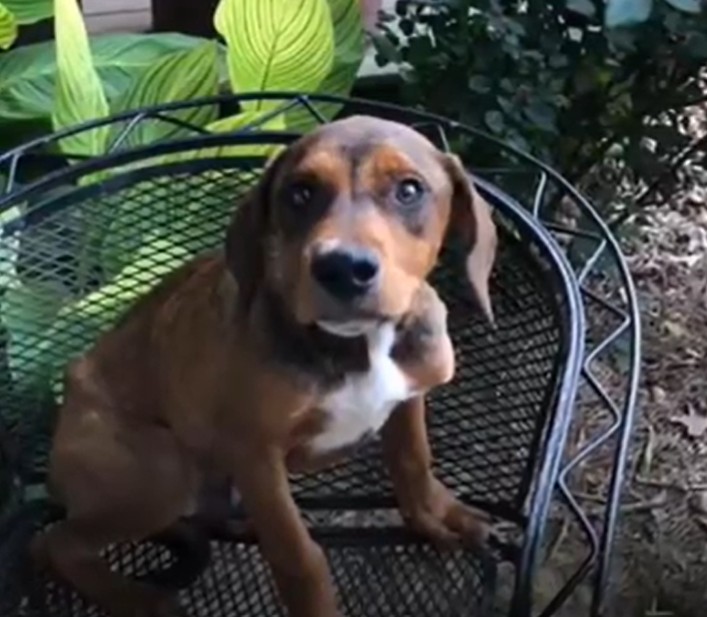
Photographs from his new home revealed how much he had changed.
The timid puppy from the roadside had grown into a more confident companion.
He could spend his days exploring his surroundings, relaxing with his family, and enjoying the simple comforts that had once been missing from his life.
There was no need for a broken recliner to serve as his refuge anymore.
Home was no longer something represented by an object left behind.
It was the place where he was wanted.
The Lasting Meaning of One Small Rescue
Gatson's journey began with a scene that many people might have overlooked.
An old chair.
A broken television.
A pile of discarded belongings beside a Mississippi road.
Among those unwanted items was a living creature who needed help.
The difference between continued hardship and a new beginning came when someone recognized his situation and took action.
A witness reported what had happened.
Officer Sharon Norton responded with patience rather than force.
The Brookhaven Animal Rescue League provided the care he needed to recover.
People who saw his story offered their support.
And a furniture company transformed its sympathy into practical assistance for other shelter animals.
Each contribution played a different role.
Together, they helped change what Gatson's future could look like.
His story also reminds us that rescue is rarely just a single moment.
Removing an animal from danger matters enormously.
But so does everything that follows.
Appropriate food.
Medical attention when needed.
Gentle handling.
A safe place to rest.
The patient work of helping a frightened animal feel secure again.
Gatson's progress showed how those ordinary forms of care can make a meaningful difference over time.
He did not go from fear to confidence in a single afternoon.
His transformation unfolded through repeated experiences of being treated kindly.
For Officer Sharon Norton, the response to his rescue was an encouraging reminder of what can happen when people work together for an animal in need.
And for everyone who remembers the photograph of that puppy curled inside a discarded recliner, there is now a very different image to hold on to.
Gatson is no longer waiting beside the road.
He is no longer relying on an old piece of furniture for comfort.
He has been given the opportunity to live as a cherished member of a family.
The chair was the last familiar thing he had when he was abandoned.
But it was not the last place he would call home.
Sometimes, changing an animal's life begins with something as simple as noticing, stopping, and offering a frightened puppy a handful of food.
For Gatson, that moment became the beginning of everything that followed.
And the little dog who once waited for someone to come back finally found people who wanted him to stay.


