
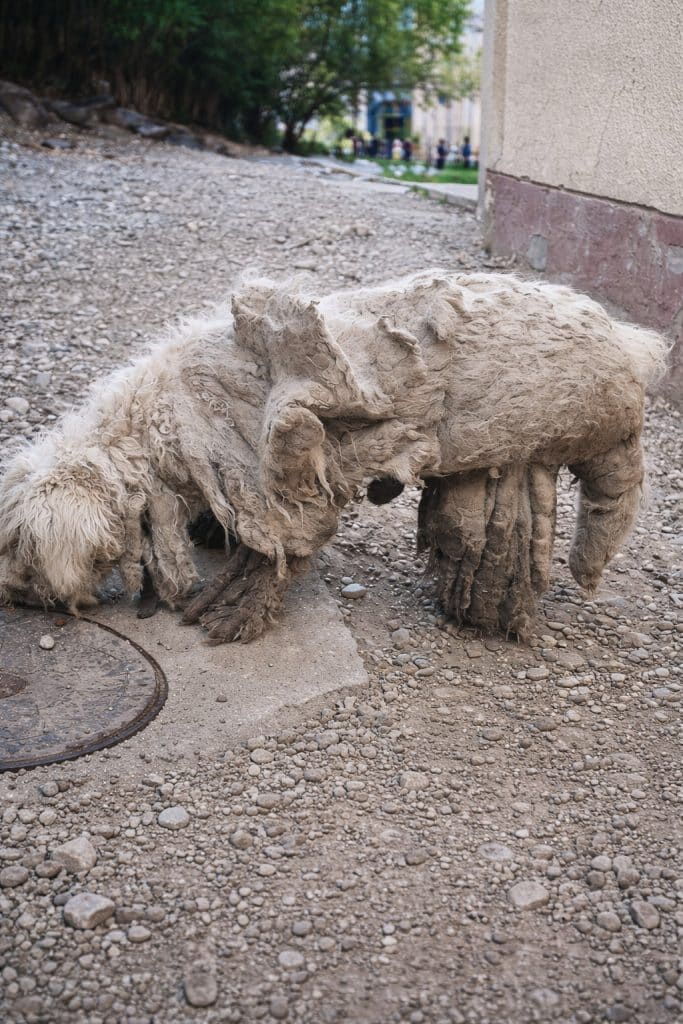
The dog standing before the rescuers barely looked like a dog at all.
His body was hidden beneath thick, hardened layers of tangled fur. His natural shape was almost impossible to recognize. Even his movements seemed restricted by the weight of the coat surrounding him.
His name was Beli.
And although he had a home and someone who loved him, he had spent years living with a physical burden he could not escape.
The two animal rescuers who had traveled more than an hour to reach him knew immediately that this was more complicated than an ordinary grooming appointment.
Beli was frightened of strangers. He growled when they approached and tried to keep his distance.
He did not understand that the people standing nearby wanted to relieve his suffering.
Nor did the rescuers yet know the full story of the elderly woman who had been caring for him.
What began as a call about a severely matted dog would eventually become something much larger.
It would become a lesson in patience, dignity, and the difference between judging a difficult situation and understanding how it happened.
A Dog Almost Lost Beneath His Own Coat
Beli's fur had grown far beyond the point of ordinary tangles.
Over time, loose hair, dirt, and debris had become packed together into thick, dense sections. The matting covered much of his body, creating a heavy outer layer that pulled against the skin beneath it.
This was no longer simply an untidy coat.
It was affecting the way he lived.
Each movement placed tension on areas where the fur had tightened. Walking comfortably had become difficult, and the pressure against his skin had created persistent discomfort.
For an animal who could not explain what was hurting, the situation was especially distressing.
Beli's first response to approaching humans was not excitement or curiosity.
It was fear.
He backed away and growled, making it clear that he was uncomfortable with anyone coming closer.
To someone unfamiliar with his condition, those reactions might have looked like aggression.
But the rescuers understood that a dog experiencing physical discomfort may become defensive when touched or approached.
Trying to force contact could make matters worse.
Beli needed help, but reaching him safely would require something that could not be rushed.
Trust.
Two Days of Patience Before the First Step Toward Freedom
The rescuers had already made a long journey to reach the small community where Beli lived.
Now they faced a different challenge.
They needed to convince a frightened dog, whose thick coat had made physical contact uncomfortable, that their presence did not mean further distress.
There was no quick solution.
The team spent two days gradually working to gain his confidence.
Instead of forcing an immediate confrontation, they allowed the process to unfold carefully, reducing the distance between themselves and Beli as he became more manageable.
Progress was measured in small changes.
A little less distance.
A little more tolerance.
Another opportunity to approach without making him retreat.
Those moments mattered because Beli's cooperation was essential to getting him the care he needed.
His appearance made the urgency obvious, but urgency alone could not justify frightening him further.
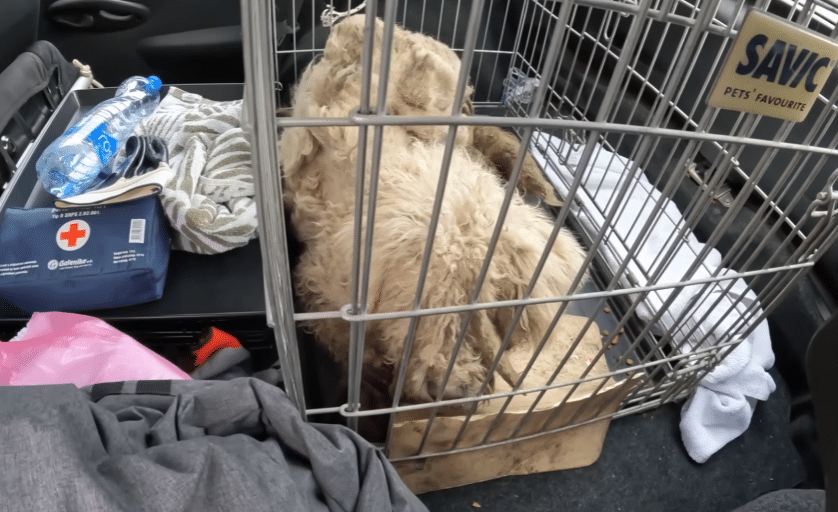
Eventually, the rescuers were able to guide him safely into a crate.
It was the first major turning point.
Beli had not yet been freed from the heavy coat surrounding his body. The difficult work of removing it was still ahead.
But he was finally on his way to professional care.
And for the first time in years, there was a real possibility that his daily discomfort could come to an end.
The rescuers had achieved something important without turning his fear into a struggle.
They had given him the time he needed.
The Transformation That Revealed the Dog Beneath
At the veterinary clinic, Beli's condition required careful assessment.
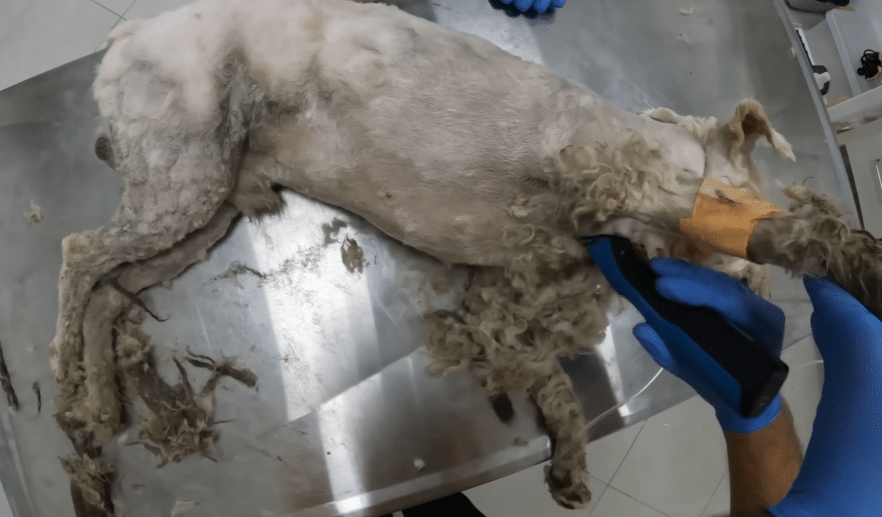
His coat had become so tightly matted that attempting to remove it while he was fully awake could have caused unnecessary stress or injury.
The veterinary team chose to use mild sedation to help keep him comfortable during the procedure.
It was an important precaution.
The goal was not simply to make Beli look different. It was to remove the dense material pressing against his body while protecting the sensitive skin underneath.
Before beginning the most demanding part of his care, the clinic also performed routine medical checks.
The staff examined him for parasites and possible underlying health problems.
Despite the remarkable condition of his fur, the findings were encouraging.
Beli appeared to be in relatively good overall health.
That was welcome news for everyone involved.
His neglected coat had created a serious welfare problem, but the medical assessment suggested that he had a promising path forward once the matting was removed.
Then the painstaking transformation began.
VIDEO: Beli Was Hidden Beneath Years of Matted Fur — Watch Rescuers Finally Set Him Free
Using clippers and scissors, the veterinary staff began separating the thick layers that had formed around his body.
This was not a matter of giving him a normal haircut.
The tangled sections were dense and extensive. Some had pulled tightly against his skin, requiring careful handling to avoid causing further harm.
Each section had to be approached with patience.
Around his legs and tail, where the skin could be especially vulnerable, the team worked with additional caution.
Slowly, the shape of the dog underneath began to emerge.
The thick covering that had concealed his body was gradually removed.
What had once seemed like an almost solid outer shell was reduced to a pile of discarded fur.
The amount was extraordinary.
Gathered together, it looked more like a heavy blanket than the coat of a single dog.
For years, Beli had been carrying that weight with him.
Now, piece by piece, it was finally coming off.
The Elderly Woman Behind a Story Few People Understood
As the rescuers learned more about Beli's circumstances, they discovered an important part of his life that was not visible beneath all that fur.
Beli was not a homeless dog.
He had not been abandoned.
He lived with an elderly woman who cared deeply about him.
After losing her husband, she had become increasingly isolated. In that difficult period of her life, Beli had remained one of her most important companions.
Their relationship mattered to both of them.
But caring about an animal and being able to meet every practical need are not always the same thing.
The woman was struggling financially.
Regular professional grooming had become something she could not afford.
As time passed, Beli's coat continued to grow. The tangles became more extensive, and the problem gradually developed into something far beyond ordinary home maintenance.
Months became years.
The thick matting spread.
Eventually, the condition had grown so severe that outside help was necessary.
From a distance, it would have been easy to see Beli's appearance and reach an immediate conclusion about his owner.
The rescuers chose to look more carefully.
They recognized that the situation involved an elderly woman facing loss, isolation, limited finances, and a growing problem she had been unable to resolve.
None of those circumstances changed the fact that Beli needed proper care.
His discomfort was real.
His condition could not simply be ignored.
But understanding why he had reached that point made it possible to consider a solution that helped both dog and owner.
That distinction would shape everything that followed.
Choosing Support Instead of Separation
Once Beli was receiving the veterinary attention he needed, the rescue team had to consider what should happen afterward.
One possibility was to remove him from his owner's care permanently.
Given the severity of his matting, that might have seemed like the obvious response.
But the rescuers also knew that Beli shared a meaningful bond with the elderly woman.
They listened to her circumstances rather than treating the condition of his coat as the only information that mattered.
The question became more than whether Beli had suffered from inadequate grooming.
He clearly had.
The question was whether the underlying circumstances could be changed so that he would not face the same problem again.
The rescuers believed there was another path.
Instead of permanently separating Beli from his owner, they worked with people in the community to establish a support network.
A local volunteer agreed to help coordinate future grooming appointments, veterinary visits, and preventive treatments.
These arrangements addressed the practical difficulties that had contributed to Beli's condition.
Professional grooming would no longer depend entirely on the elderly woman's ability to arrange and afford help by herself.
Other people would be involved in making sure his needs were met.
It was a compassionate solution, but also a practical one.
Beli needed consistent maintenance to prevent his coat from becoming severely matted again.
His owner needed assistance that matched her circumstances.
And both needed a plan that could work beyond the immediate rescue.
By involving the community, the team created an opportunity for Beli to remain in the familiar home he shared with someone who loved him.
It was not a decision to overlook what had happened.
It was a decision to prevent it from happening again.
A Lighter Body and the First Signs of Comfort
With the dense matting gone, the difference in Beli's appearance was striking.
He seemed smaller without the enormous bulk of tangled hair surrounding him.
His natural shape was visible again.
And without the heavy coat pulling against his body, he appeared considerably more comfortable.
The grooming process also revealed something that had remained hidden beneath the thick layers.
Veterinary staff found minor wounds caused by the pressure his skin had endured.
Fortunately, the injuries were treatable.
Beli received medication and appropriate care, and the healing process began.
Removing the matting had done more than change his appearance.
It had allowed the team to see the condition of the skin underneath, identify problems that had been concealed, and begin addressing them.
But another change was taking place as well.
The dog who had initially growled and retreated from rescuers began behaving differently.
He became more relaxed around people.
He started accepting gentle contact.
The defensive reactions that had made his rescue difficult began to fade.
It was a meaningful shift.
Beli had spent a long time living with discomfort that made ordinary handling difficult. With that pressure removed and his skin receiving care, he no longer appeared to need the same defensive response to human contact.
His eyes seemed calmer.
His manner softened.
These changes did not require a dramatic gesture to be important.
A dog who had once tried to keep everyone away was gradually becoming more comfortable in their presence.
For the people helping him, that was a transformation just as significant as the enormous pile of fur left behind.
The Small Collar That Marked a New Beginning
Before Beli left the veterinary clinic, he received a fresh collar.
It was a simple item.
Clean, comfortable, and ordinary.
Yet after everything he had experienced, it carried a quiet significance.
Beli no longer had to wear the thick mass of fur that had restricted his movements and caused so much discomfort.
His minor injuries were receiving treatment.
The rescue team had also helped establish a plan for his continued care.
And perhaps most importantly, his future did not involve losing the person who had been his companion for so long.
Beli was going home.
Back to the elderly woman who loved him.
But the circumstances around that homecoming had changed.
Instead of leaving her to face his grooming and medical needs without adequate resources, members of the community were now ready to help.
A volunteer would assist with organizing the care necessary to keep Beli healthy and comfortable.
The burden that had grown beyond one person's ability to manage was no longer hers to carry alone.
For an elderly woman who had become increasingly isolated after losing her husband, that support had particular importance.
The rescuers had recognized that protecting the dog and helping his owner did not have to be opposing goals.
In this case, the two could work together.
And that understanding made Beli's return home possible.
Sometimes Rescue Means Helping a Family Stay Together
Beli's story is memorable because of the remarkable difference between the dog rescuers first encountered and the one who emerged after his grooming.
The physical transformation was impossible to miss.
Years of tangled fur had concealed his body, restricted his movements, and caused ongoing discomfort.
Removing that burden gave him the opportunity to move more comfortably and begin healing.
But the most lasting lesson may come from what the rescuers discovered beyond his appearance.
Beli's condition was serious, and he unquestionably needed help.
Yet the circumstances behind it were more complicated than a simple story of abandonment or indifference.
An elderly woman had lost her husband, become isolated, and struggled with the cost of caring for the animal who remained so important to her.
Her affection for Beli had not been enough to prevent his suffering.
What changed the situation was the arrival of people willing to provide the practical assistance she could not manage alone.
The rescuers did not have to choose between Beli's welfare and compassion for his owner.
They found a way to protect one while supporting the other.
That approach offers a broader reminder about animal welfare.
Sometimes an animal needs to be removed from an unsafe situation.
Other times, the best long-term solution may involve helping the people responsible for that animal obtain the resources, guidance, and support they lack.
Understanding the difference requires careful attention to the facts.
It requires patience.
And it requires looking beyond first impressions.
For Beli, those choices made an extraordinary difference.
The heavy coat was gone.
His injuries were being treated.
His fear around people had begun to ease.
And a community support plan offered a way to keep him from returning to the condition in which rescuers had found him.
He could return to a familiar home without leaving behind the companionship that had shaped his life.
For years, Beli had carried a burden he could not remove on his own.
The elderly woman who loved him had also been struggling with difficulties she could not fully resolve by herself.
Their circumstances were different, but both needed help.
And when that help finally arrived, it did more than transform the appearance of one frightened dog.
It gave Beli a chance at lasting comfort and allowed a deeply connected pair to remain together.
Sometimes the most meaningful rescue is not the moment an animal leaves a home.
It is the moment people come together to make that home a better place for the animal to live.


