
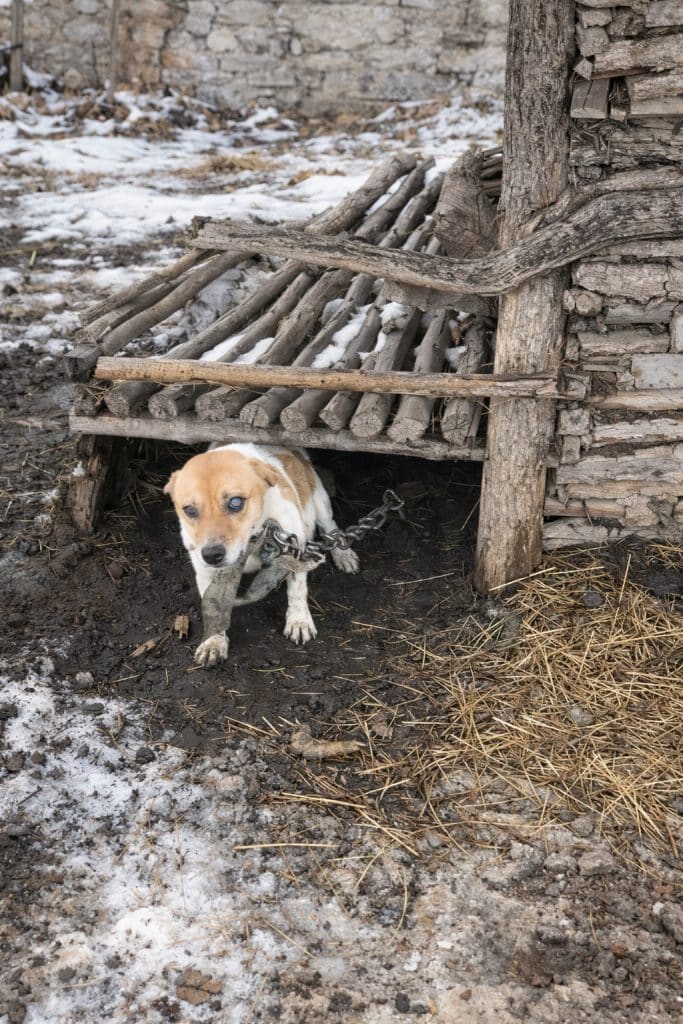
Some dogs cry loudly when they are frightened.
Others learn to become almost invisible.
In a yard in Krasnodar Krai, Russia, one small dog had discovered that staying unnoticed could sometimes feel safer than attracting attention. While the other dogs around him might react more openly to stress, he kept his eyes lowered, moved away from people, and tried to take up as little space as possible.
He did not demand attention.
He did not push forward.
He simply stayed back.
Over time, that quiet behavior became part of how he survived.
The Smallest Dog Learned to Stay Out of Sight
Life on the property offered little sense of security.
There was no dependable routine or consistent care. The atmosphere was uncertain, and the small dog responded by becoming increasingly withdrawn.
When movement happened around him, he stepped aside.
When someone approached, he avoided eye contact.
Instead of confronting what frightened him, he tried to disappear from it.
Among several dogs living there, he was also the smallest and easiest to overlook. That made his silence especially dangerous. A dog that does not bark, struggle, or demand attention can sometimes suffer without anyone immediately realizing how much help is needed.
Then the situation became even more serious.
The woman who had been living at the property was taken away, leaving the dogs behind.
They remained chained in the yard without reliable access to proper food or clean water. According to the story, neighbors occasionally threw pieces of bread over the fence.
It kept the dogs going.
But it was far from the care they needed.
For the smallest dog, whose condition was already fragile, every passing day mattered.
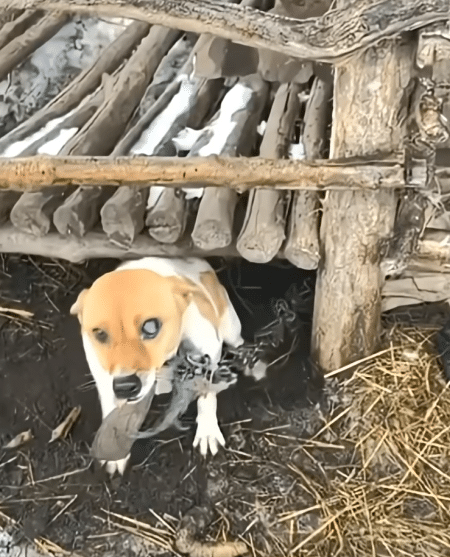
He was only three years old, yet weighed approximately five kilograms. Some of his teeth were missing, and one of his eyes had been badly damaged and left untreated.
His body showed how long he had been living without the care he required.
Still, he remained quiet.
Volunteers Noticed the Dog Who Asked for Nothing
When volunteers learned about the abandoned dogs, they came to help.
The smallest dog did not rush toward them.
He did not bark for attention or compete with the others.
Instead, the very behavior that had once helped him avoid notice became the reason the volunteers looked more closely.
He flinched when movements came too quickly.
He kept his gaze away from people.
His damaged eye appeared swollen and uncomfortable, and his thin body made it clear that he needed help.
Among all the dogs in the yard, he was the one who seemed most accustomed to being overlooked.
This time, someone refused to overlook him.
The volunteers carried him away from the property and began the next part of his journey.
For perhaps the first time in a long while, being noticed did not bring another reason to hide.
It brought rescue.
VIDEO: The Smallest Dog Stayed Silent in the Yard—Until Volunteers Finally Carried Him to Safety
In Moscow, His Injured Eye Could No Longer Be Saved
The rescued dog was taken to Moscow, where his condition could be properly evaluated.
There, the seriousness of his damaged eye became clear.
It was already blind.
It was chronically inflamed.
And instead of helping him see, it had become a continuing source of discomfort.
There was no realistic way to restore the eye. The medical decision was therefore focused on giving him relief rather than preserving something that could no longer function.
The damaged eye had to be removed.
For a dog that had already endured so much uncertainty, surgery marked a major turning point.
The goal was simple: remove the source of ongoing pain and give his body a chance to move forward without it.
Losing an eye might sound like another hardship.
For him, however, it also meant leaving one long chapter of discomfort behind.
Gentle Care Began Replacing Fear
Physical treatment was only part of what he needed.
The habits he had developed in the yard could not disappear overnight.
He had spent too long responding to people by lowering himself, retreating, and staying alert. Safety was new, and he needed time to understand it.
After surgery, his surroundings changed completely.
Instead of resting on hard ground outside, he had a soft place to sleep.
Instead of being exposed to uncertainty, he was indoors.
Food arrived reliably.
People spoke to him gently.
Hands approached him with care.
Most importantly, no one expected immediate trust.
That patience mattered.
Despite everything he had experienced, he did not respond with aggression. He remained a gentle dog, though clearly cautious about the people around him.
At first, progress could be measured in very small changes.
He began lifting his head more often.
He allowed people to remain closer.
His body slowly appeared less tense while he rested.
These were not dramatic transformations.
They were quiet signs that he was beginning to understand the difference between his old life and the new one unfolding around him.
Trust Returned One Small Step at a Time
For a dog accustomed to making himself invisible, learning to occupy space again was its own form of recovery.
There was no single moment when fear disappeared.
Trust returned gradually.
A few steps closer.
A calmer rest.
A willingness to remain nearby rather than immediately moving away.
The changes might have seemed ordinary to someone who had never known his past, but they carried meaning.
Every relaxed moment showed that he no longer felt the same need to protect himself by disappearing.
The people caring for him could not erase what had happened before his rescue.
They could give him something different in the present.
Consistency.
Warmth.
Food.
A safe place indoors.
And enough patience for him to decide, at his own pace, that human contact did not always have to mean fear.
That realization seemed to change more than his surroundings.
It changed how he moved through them.
He No Longer Needs to Make Himself Small
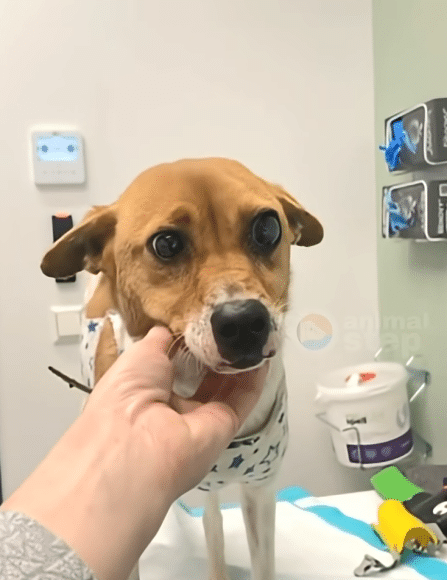
Today, the little dog lives indoors.
He is fed regularly, cared for, and treated with kindness.
His injured eye is gone, but so is the constant discomfort associated with it.
He now sees the world through one eye.
More importantly, he experiences that world from a place of safety.
The dog who once lowered his head and stayed at the edge of everything no longer has to spend each day trying not to be noticed.
He can rest.
He can approach.
He can simply exist without wondering whether visibility will bring something frightening.
That may be one of the most meaningful changes of all.
Sometimes the Quietest Dog Needs Us to Look Closest
His rescue offers a simple reminder about animals living in difficult circumstances.
The one needing help most urgently is not always the one making the most noise.
Sometimes it is the animal standing behind the others.
The one avoiding eye contact.
The one who has learned not to ask.
For this small dog, silence had become a survival strategy. By staying out of the way, he had tried to protect himself in an environment where he could not depend on kindness.
Eventually, volunteers noticed what his silence was hiding.
They saw his fragile body.
They saw the damaged eye.
And they saw a dog who had spent far too long trying to disappear.
That moment of attention changed the direction of his life.
He was removed from the yard, taken for medical care, relieved of the painful damaged eye, and given the chance to experience something entirely different.
Safety without conditions.
Care without fear.
A place where he no longer has to hide.
For years, his instinct told him that being unseen was the safest option.
Now he has learned another possibility.
Sometimes being seen is exactly what saves you.


