
Some dogs show their strength in ways that are easy to miss.
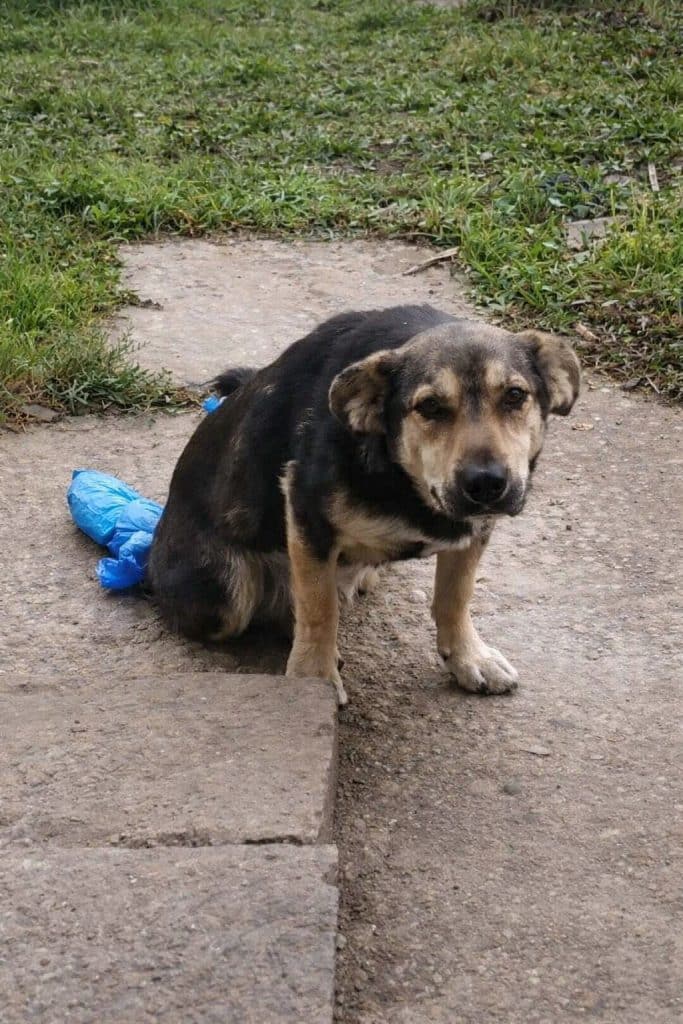
When a woman first noticed Lambroshka near her home, the first thing she saw was not fear or aggression.
It was a wagging tail.
He approached her willingly and accepted the food she offered without hesitation. His expression was gentle, and there was something remarkably open about the way he responded to a stranger.
For a brief moment, he looked like any friendly dog grateful for a meal.
Then she saw how he moved.
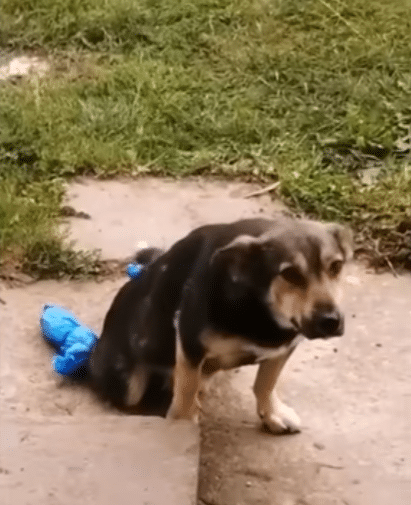
Lambroshka was not walking.
His back legs lay motionless behind him, loosely covered with fabric. To get anywhere, he had to pull the rest of his body forward with his front legs, dragging himself across the ground little by little.
And somehow, through all of it, his tail continued to wag.
He Chose to Follow Her
No one there knew exactly what had happened to Lambroshka.
The damage to his hind legs appeared to have been present for a long time, but the circumstances that caused it were unclear.
What was obvious was how much effort every movement required.
He could not simply rise and walk after the woman who had fed him. He had to pull himself forward using the strength he still had.
Yet after finishing the food, that was exactly what he tried to do.
He followed her home.
There was something deeply moving about that decision.
A dog who had apparently been surviving with severe mobility problems still approached a person without hostility. He still accepted kindness when it was offered. He still seemed willing to trust.
His body had been struggling.
His ability to connect with people had not disappeared.
Help Could Not Wait
The woman contacted rescuers, and once they arrived, Lambroshka's condition became even clearer.
His hind legs were not functioning normally, and the problem was not something that could be addressed with a little rest.
He needed professional care.
Until that moment, he had apparently been compensating in the only way available to him—using his front legs to move while his back half dragged behind.
That meant every ordinary task demanded far more effort.
Moving toward food.
Following someone.
Changing position.
Reaching a safer place.
Even so, the dog meeting his rescuers was not defined only by his injuries.
He remained gentle.
He remained responsive.
And he allowed them to help.
They carefully lifted him and took him to a veterinary clinic, beginning a new chapter that would focus not simply on what he had lost, but on what might still be possible.
A Frightening New Place
The clinic was unfamiliar.
There were new sounds, new movement, unfamiliar people and a completely different environment from the one Lambroshka had known outside.
At first, he became tense and still.
That reaction did not last long.
As the people around him handled him with care, the softer side of his personality returned. He began to relax and once again showed the trusting nature the woman had noticed when they first met.
It was an important reminder.
Lambroshka needed medical attention, but he was more than a diagnosis.
He was a social, affectionate dog learning that the people around him were there to help.
VIDEO: He Could Only Drag Himself Forward — But Lambroshka Refused to Stop Trying
The Examination Revealed Serious Damage
A full veterinary examination confirmed that Lambroshka's condition was severe.
The damage involved his hind legs, including both the skeletal structures and the nervous system. Because the problem had been left untreated for so long, the possibility of him returning to completely normal walking was considered extremely limited.
It was difficult news.
There was no simple promise that treatment would restore everything.
No guarantee that enough rehabilitation would make the past disappear.
But the people caring for Lambroshka did not treat that uncertainty as a reason to stop.
Instead, they changed the goal.
Recovery would not be measured only by whether he could someday walk like an uninjured dog.
It would be measured in movement.
Comfort.
Strength.
Control.
And every small improvement his body could achieve.
Learning to Move in Water
Hydrotherapy became one of the first important parts of Lambroshka's rehabilitation.
Supported by a flotation vest, he was carefully placed into warm water.
On land, gravity worked against him. His weakened hind legs could not properly support his weight, and moving them was extremely difficult.
In water, the situation was different.
His body was supported.
The pressure on his legs was reduced.
And for the first time during rehabilitation, he could practice movements without needing to carry his full weight.
At the beginning, nothing looked smooth.
His motions were uncertain and limited.
But the purpose was not perfection.
It was activation.
Little by little, the water allowed his hind legs to participate again. Muscles that had spent so long doing very little were given a chance to work.
The changes were small.
But small changes mattered now.
They showed there was still something to build upon.
Soon, Lambroshka was transferred to a rehabilitation clinic where his therapy could continue more intensively.
His Favorite Things Began to Appear
As the days passed, Lambroshka's personality became easier to see.
He developed a strong attachment to simple comforts.
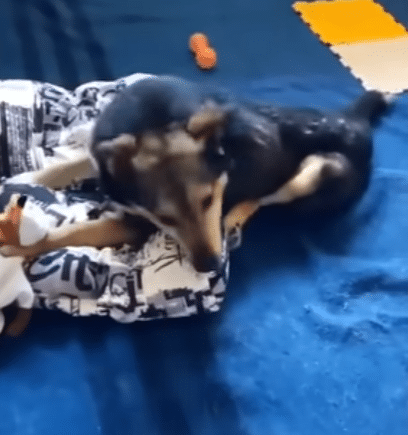
A tennis ball became one of his favorite things to carry.
He also grew fond of a small stuffed teddy bear, keeping it close and holding onto it whenever he could.
Those details mattered because recovery was not only happening in his legs.
Lambroshka was adjusting emotionally to an entirely new life.
The rehabilitation clinic offered treatment, but the environment could also be stressful.
When familiar rescuers came to visit, he became visibly excited.
When they left again, the change affected him.
His response made something increasingly clear.
Physical therapy alone was not enough.
Lambroshka needed stability.
He needed a calmer place where rehabilitation could continue without so much emotional strain.
A Foster Home Changed the Rhythm of Recovery
The team eventually moved Lambroshka into a foster home.
The difference was noticeable.
Away from the clinical surroundings, he could settle into a quieter routine.
Instead of spending all of his time on hard indoor surfaces, he was able to exercise outside.
Grass became part of his daily rehabilitation.
Fresh surroundings offered a gentler setting for work that remained physically demanding.
His caregivers used a support harness to help him practice standing.
In the beginning, those attempts lasted only a short time.
His body simply was not ready to remain upright for long.
So they repeated the process.
Support him.
Let him try.
Give him time.
Then try again later.
After exercise sessions, his muscles were gently massaged to help with stiffness and circulation.
There was no dramatic overnight transformation.
Recovery came through repetition.
The same movements.
The same support.
The same patient encouragement.
Day after day.
Tiny Signs Began to Add Up
For a dog with injuries as serious as Lambroshka's, progress could easily have been overlooked by someone waiting only for a dramatic result.
But his caregivers were watching closely.
And eventually, they began seeing signs of greater control.
One paw responded.
Then another.
His hips began lifting farther from the ground.
He could hold parts of his body in position for slightly longer periods.
Each improvement was modest on its own.
Together, they showed that the rehabilitation was helping him use his body differently.
That was enough reason to continue.
His story had never been about reaching some perfect finish line.
It was about discovering what remained possible.
Then He Pushed Himself Up
One day, during another quiet exercise session on the grass, Lambroshka tried something that carried enormous meaning for everyone who had watched his rehabilitation.
He pushed upward.
His body was unsteady.
His balance was fragile.
But instead of remaining completely on the ground, he lifted himself and stood.
For only a dog who had once been dragging both hind legs behind him, standing was not a small achievement.
It represented all the work that had come before it.
The warm water.
The supported exercises.
The harness.
The massage.
The repeated attempts.
The days when improvement was barely visible.
Then came an even more uncertain movement.
Lambroshka tried to step.
It was not a normal stride.
It was not evidence that every injury had disappeared.
But it was movement produced by a body that had once seemed to have so little control over its hind legs.
And for the people helping him, that attempt meant everything.
Progress Does Not Have to Look Perfect
Stories of recovery are often told as though healing must end with complete restoration.
Lambroshka's journey offers a different picture.
His injuries were severe.
Veterinary examinations had made it clear that normal mobility might never fully return.
Nothing about rehabilitation erased that reality.
What changed was what Lambroshka could do within it.
He learned to use the water.
He developed more control.
He practiced standing.
He lifted his body.
He tried to step.
The value of those achievements did not depend on whether he would ever run normally.
Progress was already happening.
One movement at a time.
The Same Gentle Dog Was Still There
Perhaps one of the most remarkable parts of Lambroshka's story was not physical at all.
From the moment a woman offered him food, he responded with trust.
When rescuers approached, he allowed them to carry him.
At the clinic, after his initial uncertainty faded, his gentle personality returned.
During rehabilitation, he formed attachments to the people and objects that comforted him.
His body had endured a long period of severe limitation.
Yet his willingness to connect remained.
That quality stayed with him through every stage of his recovery.
A Step Can Mean More Than Distance
For most dogs, taking a step is ordinary.
For Lambroshka, trying to take one was the result of an entire chain of people refusing to give up simply because his prognosis was difficult.
Someone stopped and fed him.
Someone noticed how badly he needed help.
Rescuers came.
Veterinary professionals examined him.
Therapists gave his muscles a chance to move.
Caregivers supported him day after day.
A foster home gave him a calmer place to continue.
None of those actions guaranteed a perfect outcome.
Together, they gave him an opportunity.
And sometimes, that is what rescue really means.
Not promising that everything will become exactly as it was supposed to be.
Not measuring a life only by what the body can or cannot do.
But making sure an animal no longer has to struggle alone.
Lambroshka once moved by dragging himself forward, inch by inch.
Even then, his tail still wagged.
Later, supported by patient hands and months of rehabilitation, he managed to lift himself from the ground and try again.
His story is not powerful because every limitation vanished.
It is powerful because the effort never did.


