
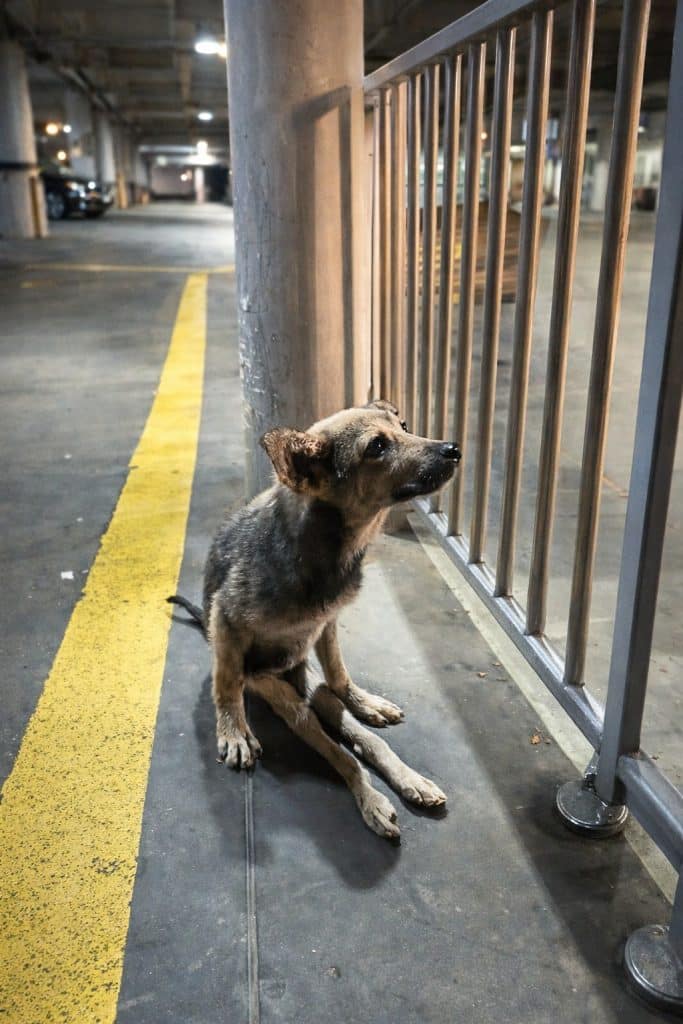
The little dog could barely pull himself across the wet pavement, yet he kept moving toward the young man who had stopped to look at him.
His front legs carried nearly all his weight. Behind him, his hind legs dragged helplessly along the ground.
Dark clouds hung overhead. Rain had already soaked his thin coat, and the people passing nearby were hurrying to find shelter.
For everyone else, the approaching storm was a reason to keep moving.
For this fragile dog, it meant something very different.
He had nowhere obvious to go.
But when someone finally noticed him, he did not turn away.
He struggled forward.
That small movement would become the beginning of a remarkable change in his life.
The Little Dog Everyone Was Walking Past
The young man had not set out to rescue an animal that day.
Like the other pedestrians, he was outside as the weather worsened. People were moving quickly, eager to get home before the rain became heavier.
Then he saw something near the roadside.
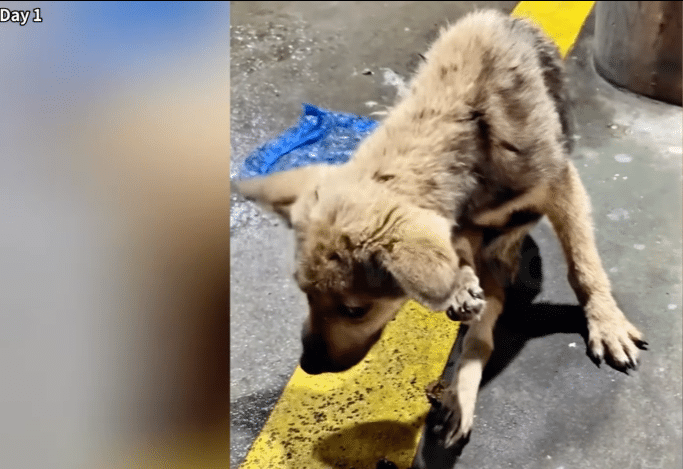
A small dog was lying on the ground, his fur drenched and his body alarmingly thin.
The most troubling detail was the way he moved.
His back legs offered no visible support. Whenever he tried to get somewhere, he had to pull the rest of his body forward using only his front legs.
Even a short distance seemed difficult.
There was no information about how long he had been living this way, what had caused his mobility problems, or whether anyone had cared for him before.
What the young man could see was enough to cause concern.
The dog was weak.
He appeared desperately hungry.
And he was exposed to the worsening weather without a safe place to rest.
Yet his response to the stranger was unexpected.
Instead of trying to hide, the dog began moving toward him.
Slowly, he pushed against the pavement with his front paws. His thin body followed, while his hind legs remained stretched behind him.
There was no sudden burst of strength.
No easy movement.
Just a determined effort to close the distance between himself and the person standing nearby.
It was impossible to know what the dog expected.
Perhaps he had approached people before. Perhaps he had learned that a human hand sometimes meant food or comfort.
His past remained unknown.
But his behavior showed something important: despite his difficult circumstances, he was still willing to approach someone.
And this time, that person paid attention.
An Egg Became His First Small Piece of Hope
The young man decided to offer the dog something to eat.
He bought an egg and gave it to him.
The response was immediate.
The little dog ate eagerly, consuming the food with an urgency that suggested he had not been receiving enough to eat.
His thin frame had already raised concerns about his condition.
Watching him eat made those concerns even harder to ignore.
A single egg could not solve everything.
It could not restore strength to his body overnight or explain why his hind legs were unable to support him.
But it offered something the dog clearly needed at that moment.
Food.
And, perhaps just as importantly, the attention of someone who was willing to help.
The young man watched the small animal closely.
Here was a dog who could not move normally, who was wet and visibly underweight, and who seemed to have very little ability to protect himself from the weather.
Leaving him beside the road would mean returning him to the same uncertainty.
The young man could have continued on his way after feeding him.
Instead, he made a different decision.
He would take the dog home.
It was a simple choice in one sense.
There was no elaborate rescue operation, no large organization, and no specially prepared facility waiting for the little animal.
There was only a person who had noticed a vulnerable dog and decided that helping him should not end with one meal.
For the dog, however, that decision changed everything about where he would spend the coming night.
He would no longer have to remain on the rain-soaked roadside.
He would have somewhere protected to sleep.
And someone would be there to provide food and care.
VIDEO: He Could Barely Crawl Through the Rain — Watch the Moment His Rescue Journey Began
A Small Corner of the House Became His Safe Place
Bringing the dog home was only the first step.
The young man did not have a dedicated rescue space or specialized equipment ready for an animal with such limited mobility.
He had to make room using what was already available.
He cleared an area inside his home, even rearranging space that had previously belonged to his cat.
Then he prepared bedding so the dog could lie down comfortably.
The arrangement was modest.
There were no expensive furnishings or elaborate accommodations.
But the difference between that small indoor corner and the roadside was enormous.
Outside, the dog had been exposed to rain, cold pavement, and the difficulty of moving without the use of his hind legs.
Inside, he had a resting place that did not require him to keep struggling forward.
He could lie down without searching for another patch of shelter.
He could receive food without having to drag himself along the street.
And he could begin adjusting to a place where his immediate needs were being considered.
For animals with physical limitations, an accessible and comfortable resting area can be especially meaningful.
Even ordinary movements may require considerable effort.
A softer surface, a clean environment, and reliable access to food can make everyday life less demanding.
Those were the basic comforts the young man began providing.
The dog had not suddenly become healthy.
His mobility difficulties remained.
But his circumstances had changed in a fundamental way.
He was no longer trying to manage everything by himself.
The Needs That Became Clearer After the Rescue
Once the dog was indoors, the young man had a better opportunity to observe him.
The first concerns had been obvious on the roadside: severe thinness, weakness, and difficulty moving.
But there were other problems requiring attention.
The dog's skin needed care, and fleas were present in his fur.
His appetite was also striking.
Even after being offered food, he continued to behave like an animal who was intensely hungry.
The source does not establish precisely how long he had gone without adequate nutrition.
Still, his appearance and eagerness to eat made consistent feeding an important part of his care.
There was no instant solution to the challenges he faced.
His body needed attention.
His living space needed to remain clean.
His skin condition required care.
And his inability to walk normally meant that ordinary routines would have to be adapted around his limitations.
The young man began making those adjustments.
He provided regular meals and a more comfortable place to sleep.
He maintained a cleaner environment and attended gently to the dog's needs.
None of these steps was dramatic.
There was no single moment in which every problem disappeared.
Instead, the care took the form of small, practical actions repeated over time.
A meal when the dog was hungry.
A comfortable place when he needed to rest.
A cleaner space where he could remain protected.
And the continued presence of the person who had brought him home.
For a dog who had recently been lying helplessly beside a wet road, these ordinary things represented an extraordinary improvement.
The Quiet Signs That He Was Beginning to Feel Safe
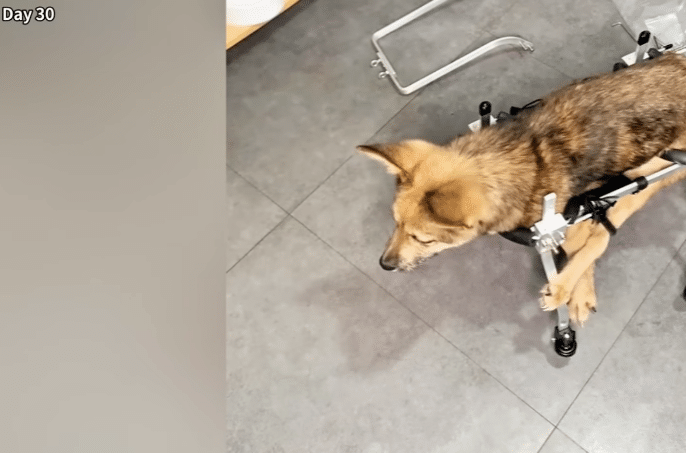
Something encouraging became apparent as the days passed.
Despite his physical struggles, the dog responded warmly to the attention he received.
He ate well.
He slept peacefully.
And whenever he could, he tried to follow the young man around.
That last behavior was particularly touching because moving was still difficult for him.
He did not have the freedom of movement that a healthy dog might enjoy.
Following someone required effort from a body already dealing with serious limitations.
Yet he continued seeking the young man's company.
His willingness to remain close suggested that he was becoming comfortable with the person caring for him.
The dog also accepted affection.
There was no indication that he needed to be forced into every interaction or that he consistently withdrew from human contact.
Instead, he seemed receptive to the gentle attention being offered.
These were small observations, but they mattered.
Physical recovery and emotional adjustment are not the same thing.
An animal may continue to face mobility challenges while still becoming more relaxed and secure in a new environment.
For this little dog, there were visible signs of that growing comfort.
He could rest without the immediate pressures of the street.
He could eat regularly.
And he could look for companionship from someone who was becoming a familiar part of his daily life.
The young man's care was changing the dog's routine.
At the same time, the dog's needs were changing the way the young man organized his home.
Space had been rearranged.
Daily feeding had become a responsibility.
Comfort and cleanliness required continuing attention.
What began as a brief encounter beside a road was becoming an ongoing commitment.
A Different Kind of Progress
It would be easy to measure the dog's story entirely by whether he could walk normally again.
After all, the sight of his hind legs dragging behind him was one of the most distressing parts of his discovery.
But the account of his early rescue does not provide a confirmed medical diagnosis, a documented rehabilitation plan, or detailed evidence of how his mobility changed during this period.
His inability to walk normally remained a serious challenge.
That uncertainty is important.
Kindness can provide safety and support, but it does not automatically resolve every physical condition.
At this stage, the clearest improvements were in his living circumstances and daily comfort.
He had been taken away from the roadside.
He was receiving regular food.
He had bedding and a protected place to sleep.
His skin and cleanliness were receiving attention.
And he was showing a willingness to trust the person caring for him.
Those changes deserve recognition in their own right.
For a vulnerable animal, progress does not always begin with a dramatic physical milestone.
Sometimes it begins when the immediate struggle to survive becomes less overwhelming.
Sometimes it is the ability to sleep comfortably.
Sometimes it is no longer having to search desperately for food.
And sometimes it is simply being able to remain close to someone without needing to fear being left alone in difficult conditions.
The little dog still had challenges ahead.
But he was beginning to experience a more stable life.
That was a meaningful first chapter in his rescue journey.
The Moment That Made the Difference
Looking back at the beginning, one image stands out.
A tiny, soaked dog pulling himself across the pavement while people hurried past him.
He did not have the strength to move easily.
He could not follow the crowd to safety.
He could only work with the movement his body still allowed.
Then a young man stopped.
He saw the dog's condition, offered him food, and chose to bring him into his home.
There was nothing complicated about the kindness itself.
The young man did not need to know the dog's entire history before helping.
He did not have to understand the exact cause of his physical limitations to recognize that the animal needed shelter and care.
He began with what he could provide.
A meal.
A place to rest.
A safer environment.
And the commitment to keep caring for a dog whose needs would not disappear after one night.
The little dog's future physical progress was not fully established in this part of the account.
What was clear was the difference between the life he had been facing on the roadside and the one beginning inside the young man's home.
He was still fragile.
His hind legs still presented serious difficulties.
But he had food, shelter, and companionship.
Most importantly, he was no longer alone in facing those difficulties.
His story is a reminder that rescue is not always defined by one extraordinary event.
Often, it begins with an ordinary person choosing not to walk past an animal in need.
And for this small dog, that decision meant the chance to rest, receive care, and face the days ahead somewhere safe.


