
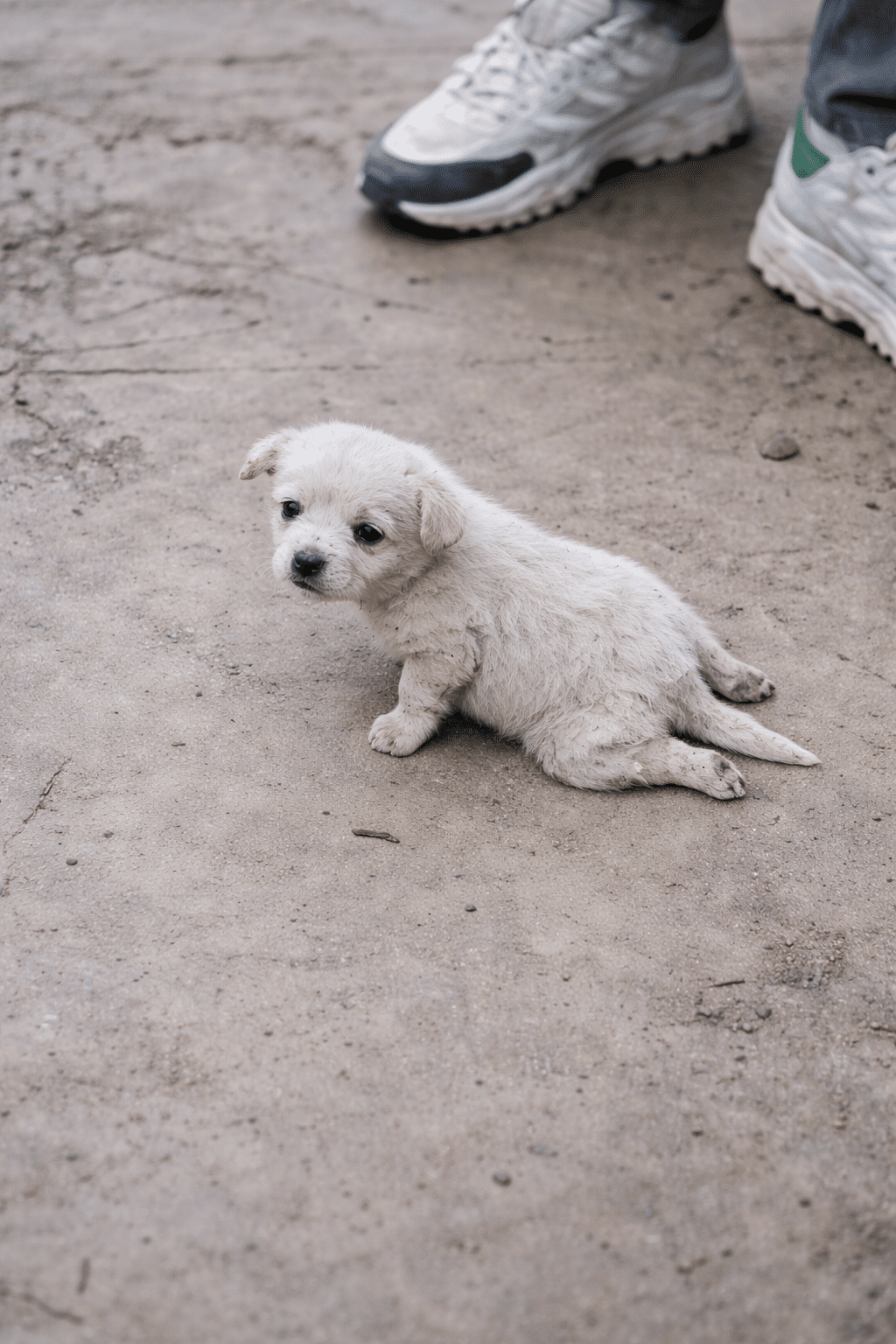
The small dog could move only by pulling himself forward with his front legs.
Outside a busy neighborhood supermarket, while shopping carts rolled past and the entrance doors opened and closed, he lay close to the pavement and watched people come and go.
His hind legs did not move.
Every time he needed to change position, his front paws did all the work, dragging the rest of his thin body behind him. The repeated contact with the hard ground had already left his knees badly irritated.
Yet one detail stood out more than anything else.
Whenever someone passed, he raised his head.
He watched.
He waited.
There was no attempt to chase anyone away. He simply followed the movement of strangers with his eyes, as though each approaching person might finally be the one who noticed him.
For most of the afternoon, people continued on their way.
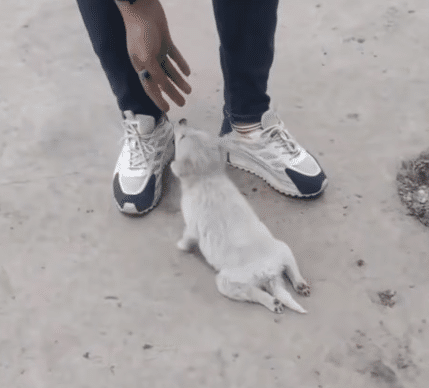
Then someone stopped.
The Moment the Crowd No Longer Passed Him By
That decision changed his surroundings almost immediately.
Instead of remaining beside the supermarket entrance, he was taken to a safe home that same day.
The first priorities were simple: food, cleanliness, comfort, and protection.
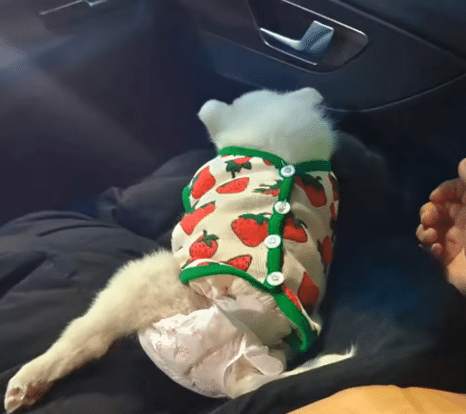
He was given a warm, soft meal that was easy to eat. Afterward, he received a gentle bath. Dirt from the time he had spent pulling himself along the ground slowly washed away.
Because it was the weekend and a full veterinary appointment was not immediately available, his rescuers contacted a veterinarian for guidance.
Following those instructions, they gave him medication intended to reduce his fever and carefully treated the damaged areas around his knees.
A diaper was also used to help keep him clean and protect his skin.
Nothing was rushed.
His rescuers handled him gently, moving slowly around a dog whose entire world had changed in only a matter of hours.
He did not fight their care.
He did not try to escape.
Instead, he quietly watched everything happening around him.
The pavement was gone.
Food was within reach.
Someone was staying beside him.
For the first time since he had been noticed outside the store, he no longer had to pull himself forward simply to find a safer place to rest.
VIDEO: He Could Only Drag Himself Across the Pavement — Then One Person Finally Stopped
An X-Ray Finally Explained Why He Could Not Walk
The following morning brought the next important step.
He was taken for X-rays so veterinarians could understand why his back legs were completely paralyzed.
The images revealed a spinal fracture.
According to the assessment, the injury was most likely connected to a recent accident. It explained why his hind legs were unable to support him and why he had been forced to depend entirely on his front legs.
It also explained the condition of his knees.
They had endured constant friction as he pulled himself across hard surfaces, turning every attempt to move into another strain on an already exhausted body.
Surgery was considered.
However, after evaluating the position of the fracture, the veterinarians determined that an operation would carry significant risk. The possibility of serious complications meant surgery could potentially leave him in an even more difficult condition.
So his care team chose a more cautious path.
Medication would continue.
His condition would be monitored closely.
And rehabilitation would become part of his daily routine.
Every morning at 10 a.m., he returned to the clinic for therapy.
There was no promise that his hind legs would regain full function.
There was only a commitment to give him the best support possible with the condition he had.
Progress Began in Smaller Ways
Recovery did not arrive as one dramatic breakthrough.
It appeared through quieter changes.
After about a week, his body began to look stronger.
He started gaining weight.
The irritated areas on his knees gradually began to improve.
His coat became cleaner and healthier-looking after receiving regular care.
But the change that seemed most noticeable was not something that could be measured on an X-ray.
It was the way he carried himself.
The tired expression that had followed people outside the supermarket began to soften.
He was still unable to use his hind legs, but he started learning how to move within that reality rather than being completely limited by it.
Using his front legs, he became more confident navigating the home.
What had once been a desperate way of moving across pavement gradually became a skill he could use in a safe environment.
Rooms that were unfamiliar at first became places he learned to cross.
His front paws carried him toward food, toward familiar voices, and toward the people who now cared for him.
His physical limitations remained.
But his daily life was beginning to contain more than those limitations.
A Home Began to Feel Like His Own
There was another resident in the household waiting for him: a black cat.
Before long, the two began interacting and playing gently together.
For a dog whose earlier world had been reduced to pavement, passing feet, and the effort required for every movement, companionship brought something entirely different into his routine.
There was activity around him now.
There were familiar sounds.
There were people speaking to him and stroking his head.
There was another animal sharing the same space.
His rescuers celebrated small improvements rather than measuring his value by whether he would someday walk normally on four legs.
That distinction mattered.
A complete physical recovery remained uncertain, and the veterinarians were honest that the chance of regaining full function was low.
But his new life did not depend on a perfect medical outcome.
He could still eat comfortably.
He could explore.
He could play.
He could respond to affection.
And most importantly, he no longer had to face each day alone.
His Future Was More Than a Medical Percentage
There are conditions that care cannot instantly reverse.
His spinal injury remained serious, and treatment continued without any guarantee that his back legs would recover completely.
The family caring for him understood that.
But they also understood that progress could be measured in more than steps.
Security mattered.
Comfort mattered.
Connection mattered.
The dog once lying outside the supermarket now had a routine and a warm place to sleep.
He had people who expected to see him every day.
He greeted his family with bright eyes and an eager wag of his tail, responding to a life that had become familiar and safe.
The contrast was impossible to miss.
Not long before, he had been pulling his thin body across concrete, lifting his head whenever strangers approached and waiting to see whether anyone would stop.
Now he no longer had to search the crowd for attention.
Someone already knew where he was.
Someone was already watching over him.
Healing Did Not Have to Mean Walking Again
His rehabilitation continues, along with the medication and care recommended for his condition.
No one can promise exactly what his physical future will look like.
That uncertainty remains part of his story.
But it is no longer the whole story.
The spinal fracture may have changed the way he moves, yet it did not prevent him from building a life filled with warmth, companionship, and daily care.
His journey is a reminder that rescue is not always about returning an animal to the body it once had.
Sometimes it is about helping that animal live fully within what is possible now.
A safe room instead of hard pavement.
Regular meals instead of waiting outside a store.
Gentle hands instead of a crowd that keeps moving.
A family instead of strangers passing by.
The dog who once looked at every person with hope no longer has to wonder whether someone will finally notice him.
He has already been seen.
And whatever happens with his legs, he now has something he did not have outside that supermarket:
a place where he belongs.


