
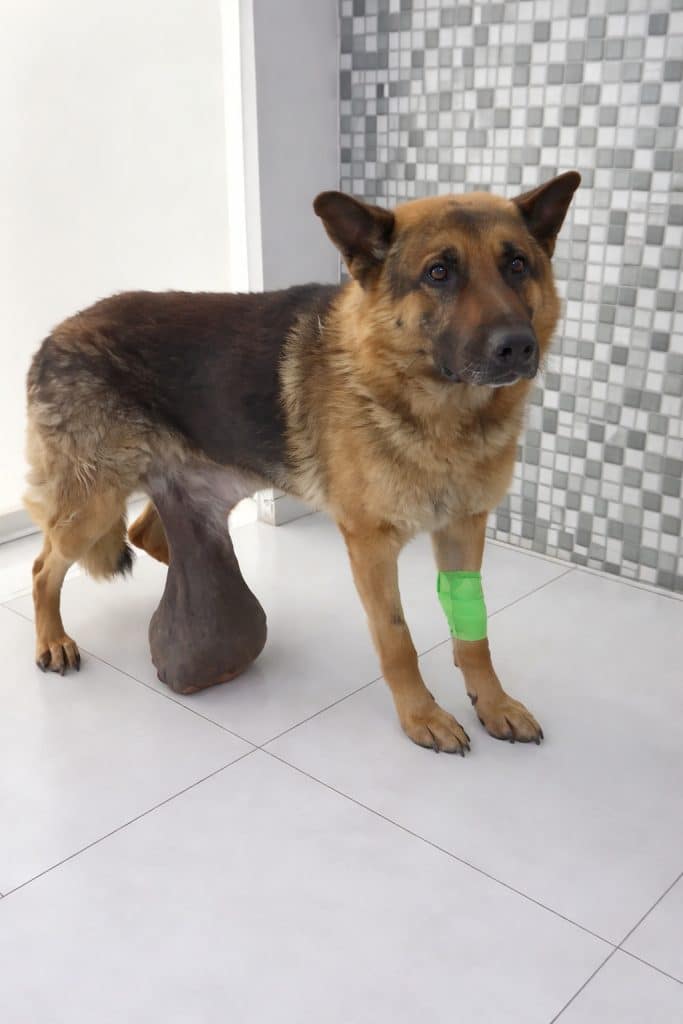
The enormous growth hanging beneath Fabrício's body moved every time he took a step.
For this German Shepherd, walking had become something far more difficult than an ordinary daily activity. A tumor weighing nearly seven pounds had changed the way he moved, the way he carried himself, and the effort required simply to get from one place to another.
Yet he continued walking.
Not because the burden had become easier, but because he had been living with it for so long.
By the time rescuers learned about his condition, Fabrício needed much more than temporary relief. He needed medical intervention that could give him back the freedom his body had gradually lost.
And although the road ahead would involve a complicated operation and careful recovery, someone had finally recognized that his suffering could not continue.
The Weight He Had Learned to Carry
Fabrício was not an ordinary case of a dog arriving with a small swelling that needed examination.
When the rescue team first received information about him, they were told he had an unusually large lump. The description was concerning, but seeing the German Shepherd in person revealed the true extent of his condition.
Beneath his body hung a massive tumor measuring nearly eight inches in length.
It weighed approximately 3.5 kilograms.
More than seven pounds.
That number alone was troubling, but the effect on Fabrício's everyday life made the situation even harder to witness.
The growth shifted whenever he moved. Its size and position caused it to come into contact with the ground, irritating the surrounding skin and making movement uncomfortable.
Walking required him to manage not only his own body weight but also the additional mass hanging beneath him.
A movement that should have been effortless had become a challenge.
For a German Shepherd, a breed known for its strength and mobility, the limitation was especially striking.
Fabrício could still move, but his condition dictated how he moved.
Each step had to accommodate something his body was never meant to carry.
And there was another detail that made his situation difficult to understand.
Fabrício had an owner.
He had not been living entirely on his own, unnoticed on the streets. Nevertheless, the growth had been allowed to reach a size that seriously affected his comfort and mobility.
The available information does not explain why he had not received treatment sooner.
What mattered to the rescuers now was that he finally had an opportunity to receive the care he urgently needed.
The Moment His Suffering Was Finally Taken Seriously
The rescue team understood that Fabrício's condition could not be resolved through ordinary care.
The mass was too large.
Its effect on his movement was too significant.
And without knowing how deeply it extended into his body, no one could safely assume that removing it would be straightforward.
He needed a veterinary team capable of evaluating the growth and deciding whether surgery was possible.
That decision marked an important turning point.
Until then, the tumor had been a constant part of Fabrício's physical existence. It followed him everywhere, swinging beneath his body whenever he attempted to walk.
Now, for the first time in this part of his story, there was a plan to address the cause of that suffering.
Rescuers arranged for him to receive emergency veterinary attention.
There were still many unanswered questions.
How deeply had the tumor spread?
Could it be removed safely?
Would Fabrício be able to regain normal bodily function afterward?
The answers would come from the medical examinations.
But the most important change had already begun.
Instead of being left to endure the burden, Fabrício was finally receiving help.
VIDEO: Fabrício Carried a 7-Pound Tumor Beneath His Body—Watch His Journey Toward Walking Free Again
A Difficult Diagnosis and an Even Harder Decision
At the emergency veterinary hospital, Fabrício underwent detailed examinations.
The results confirmed that the growth was more complicated than its outward appearance suggested.
This was not simply a large mass resting on the surface of his body.
The tumor had extended into deeper tissue and involved structures associated with his reproductive system.
That finding changed the nature of the treatment.
Removing the visible growth alone would not be enough. The surgeons would need to address the affected tissue while protecting and rebuilding essential anatomical structures.
It was a delicate medical challenge.
The veterinary team planned an extensive operation that would combine tumor removal with reconstruction of the affected area.
The goal was not merely to make Fabrício look different.
It was to relieve his suffering while preserving, as much as possible, the bodily functions he needed for a comfortable life.
That distinction mattered.
A successful operation would mean little if he survived but could no longer function normally.
The surgeons had to consider both immediate safety and the quality of life he might have afterward.
There were significant risks involved.
The procedure would be lengthy, and the extent of the tumor meant there was no simple solution.
Without surgical intervention, however, Fabrício's prospects were poor.
The team decided to proceed.
For the dog who had spent so long adapting to an unbearable weight, the operation offered something he had not been able to experience for a long time.
A realistic chance at relief.
The Hours That Could Change Everything
When Fabrício entered surgery, the veterinary team faced the difficult task they had carefully prepared for.
The tumor needed to be separated from the surrounding structures.
Diseased tissue had to be removed.
The affected area then required reconstruction so that his body could continue performing its essential functions.
It was the kind of procedure in which careful surgical decisions mattered at every stage.
Removing such a large growth was only one part of the challenge.
The surgeons also needed to consider what would remain once the tumor was gone.
The reconstruction was especially important because the disease had affected tissue connected to Fabrício's reproductive and urinary anatomy.
For the people waiting outside the operating room, there was little to do except hope that the medical team's work would succeed.
Fabrício had already lived through a prolonged period of discomfort.
Now his future depended on the outcome of a single, complicated procedure.
Hours passed before the operation was complete.
Then came the news everyone had been hoping to hear.
Fabrício had survived the surgery.
The massive tumor had been removed.
The reconstruction had been performed.
It was an enormous step forward, but no one could yet consider his recovery complete.
There was still the question of how his body would respond after anesthesia, how the surgical area would heal, and whether normal function could be restored.
Those answers would emerge gradually.
For the moment, however, the most immediate obstacle had been overcome.
The weight that had dominated Fabrício's movements was finally gone.
A Small Moment That Meant More Than It Seemed
After surgery, Fabrício entered a period of careful medical supervision.
His body needed time to recover from the extensive procedure.
Pain management helped keep him comfortable, while protective measures reduced the risk of disturbing the healing surgical area.
Veterinary staff continued observing his condition.
The recovery process required patience.
Even though the tumor had been removed, the surgery had involved sensitive structures, and the medical team needed to confirm that those structures could function properly.
One particular milestone carried tremendous significance.
Fabrício was able to urinate normally on his own.
It might sound like an ordinary bodily function.
For him, it represented something much greater.
Because the tumor had involved structures associated with his reproductive system, the operation had required careful reconstruction. The ability to urinate independently was therefore an important sign that the surgical work had achieved a crucial goal.
It was a practical measure of progress.
A sign that his body was beginning to work without the obstruction and complications created by the enormous growth.
Not every recovery milestone looks dramatic.
Sometimes the most meaningful improvement is something healthy animals do without anyone giving it a second thought.
For Fabrício, this simple act carried the reassurance that his life after surgery could be more comfortable than the one he had known before.
His journey was no longer focused only on surviving an operation.
It was becoming a journey toward regaining ordinary daily life.
Learning to Walk Without the Burden
For so long, Fabrício's movements had been shaped by the tumor.
Every time he changed position, the hanging mass moved with him.
Whenever he walked, its weight and size added to the effort.
That physical limitation had become part of his routine.
After surgery, the source of that burden was no longer there.
But recovery did not mean that Fabrício immediately returned to unrestricted activity.
His body had undergone a major procedure, and healing required a gradual return to movement.
At first, his steps were cautious.
He needed time to adjust to the unfamiliar sensation of moving without the large mass beneath him.
The difference was considerable.
His body no longer had to accommodate the tumor swinging below his abdomen.
He could begin walking without the same painful contact with the ground.
And as his recovery progressed, his movements became steadier.
The small changes mattered.
Standing with greater ease.
Taking a few more steps.
Walking with increasing confidence.
These were not spectacular achievements by ordinary standards, but they showed that Fabrício was beginning to reclaim abilities the tumor had restricted.
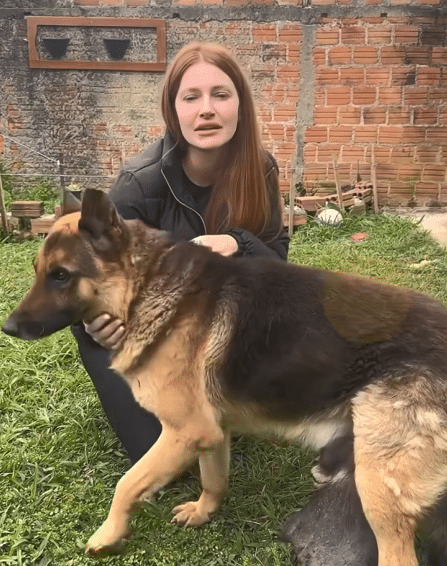
The improvement became especially clear when he was able to move across the grass.
What had once been a slow and uncomfortable struggle gradually became a more natural walk.
Then something even more encouraging happened.
Fabrício began to trot.
For the people who had seen him burdened by the enormous growth, watching him move this way was a powerful sign of progress.
There was no heavy mass dragging beneath him.
No need to adjust every movement around the tumor.
Just a German Shepherd moving forward with a freedom he had been denied for far too long.
It was a quiet but meaningful transformation.
And it revealed how much the surgery had changed his everyday experience.
The Changes That Could Be Seen in Every Step
Fabrício's recovery did not end when he first began walking more comfortably.
Veterinary follow-up remained important.
The team continued monitoring his healing, strength, and mobility to make sure his improvement was progressing as expected.
Recovery from an operation of this complexity takes more than the removal of a tumor.
The body must heal.
Affected tissues need time to recover.
Movement has to become comfortable again.
For Fabrício, each new improvement offered another reason for hope.
His posture began to reflect the changes.
His walk became more confident.
The physical restriction that had been so obvious before surgery was no longer determining every step.
These visible differences told a story that did not require elaborate explanations.
Before his rescue, Fabrício carried a growth weighing approximately 3.5 kilograms.
After surgery, he was able to move without that burden.
Before treatment, walking had been associated with repeated discomfort.
During recovery, he gradually rediscovered the ability to move more freely.
The transformation was not only about the disappearance of a large tumor.
It was about what that disappearance made possible.
A dog who had once struggled beneath the weight of his own medical condition could now experience moments of ordinary activity again.
And those moments were worth celebrating.
The Future He Finally Has a Chance to Enjoy
Fabrício's story has reached an encouraging stage, although his recovery remains an ongoing process.
He has survived major surgery.
The enormous tumor has been removed.
His ability to urinate normally has returned.
And his mobility has improved enough for him to begin trotting across the grass.
These are significant achievements for a dog whose condition had once made even simple movement difficult.
Continued veterinary monitoring will remain important as he heals.
The available account does not establish every detail of his long-term prognosis or future living arrangements, so there is still more to learn about the life ahead of him.
But the progress already confirmed is meaningful.
For a long time, Fabrício lived with a physical burden that no animal should have to endure without treatment.
His condition was visible, yet the help he needed did not arrive until the growth had become enormous.
His rescue is a reminder of the importance of recognizing medical problems early and seeking appropriate veterinary attention before they become overwhelming.
It also demonstrates what dedicated care can accomplish, even when the challenges are complicated.
The rescuers gave Fabrício access to help.
The veterinary team gave him a chance through difficult surgery.
And the careful recovery that followed helped him begin moving with comfort and confidence again.
There is something deeply moving about the simplicity of his progress.
A dog walking across grass should be an ordinary sight.
For Fabrício, it represents the return of something he had been missing.
Freedom from the enormous weight beneath his body.
Freedom to move without the same constant discomfort.
And the chance to continue healing, one steady step at a time.
His story does not need an exaggerated ending to be meaningful.
Sometimes the clearest evidence of compassion is simply a dog who once struggled to walk, now able to move forward without the burden he carried for so long.


