
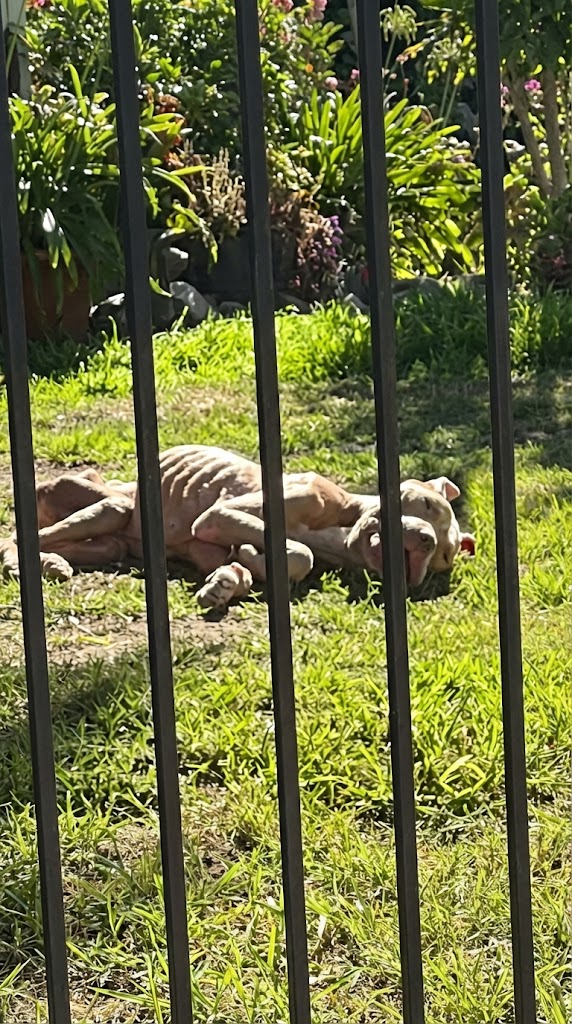
By the time help reached Gator, his body had become a quiet record of how long he had been struggling.
The Pit Bull was living in a backyard in Highland, California, where he remained chained and severely underweight. His ribs and bones were clearly visible beneath his skin, and his condition was impossible to ignore once someone truly looked.
Yet there was another description attached to him.
He was said to be “aggressive.”
His owner also maintained that Gator was eating normally and suggested that an unexplained illness was responsible for his appearance.
But when rescuers finally saw Gator for themselves, the dog in front of them did not resemble the frightening animal they had been warned about.
He barely had the strength to raise his head.
The Dog Behind the Label
Labels can shape the way people see an animal before they ever meet it.
In Gator’s case, the word “aggressive” had created an image of a dog who was difficult or dangerous. What rescuers encountered instead was a deeply exhausted animal whose most immediate problem was simply surviving.
He was weak.
He was severely underweight.
And his body suggested that he needed help without delay.
At first, surrendering Gator was not straightforward. His owner reportedly resisted giving him up and continued to point toward a possible illness as an explanation for his condition.
But the rescuers could see that waiting was no longer a reasonable option.
With authorities involved, Gator was eventually removed from the property.
For him, that moment meant more than leaving a backyard.
It meant leaving the chain behind.
It meant moving toward a place where his condition would finally be examined carefully and where his needs would no longer be dismissed.
The First Hours of Safety
Gator was taken directly to a veterinary clinic.
Only then did the full extent of his condition begin to come into focus.
His Body Condition Score was recorded at 1 out of 9, placing him at the extreme low end of the scale. His paws were swollen and irritated, and his ears showed signs of infection.
Everything about his body required careful attention.
The veterinary team began caring for him gently, giving him warmth, cleaning him, and handling him with the patience required for a dog in such a fragile state.
For Gator, even ordinary kindness seemed unfamiliar.
During his early care, he trembled.
No one could know exactly what he understood in those moments, but his reaction showed how uncertain he still was around people.
He had reached safety physically.
Trust would take longer.
VIDEO: Gator Was Finally Taken From the Backyard — See the First Moments of His New Life
When Kindness Was Still Something New
The clinic staff continued working around Gator’s physical limitations without rushing him.
A bath, warm surroundings, medical attention, and gentle hands were simple things, but for a dog who had arrived in such poor condition, they marked a dramatic change in daily life.
His body no longer had to remain on the dirt outside.
He no longer had to stay attached to a chain.
Food and care were now part of a routine rather than something uncertain.
Still, recovery was never going to happen overnight.
Gator had been weakened considerably, and the problems affecting his body did not disappear simply because he had been rescued.
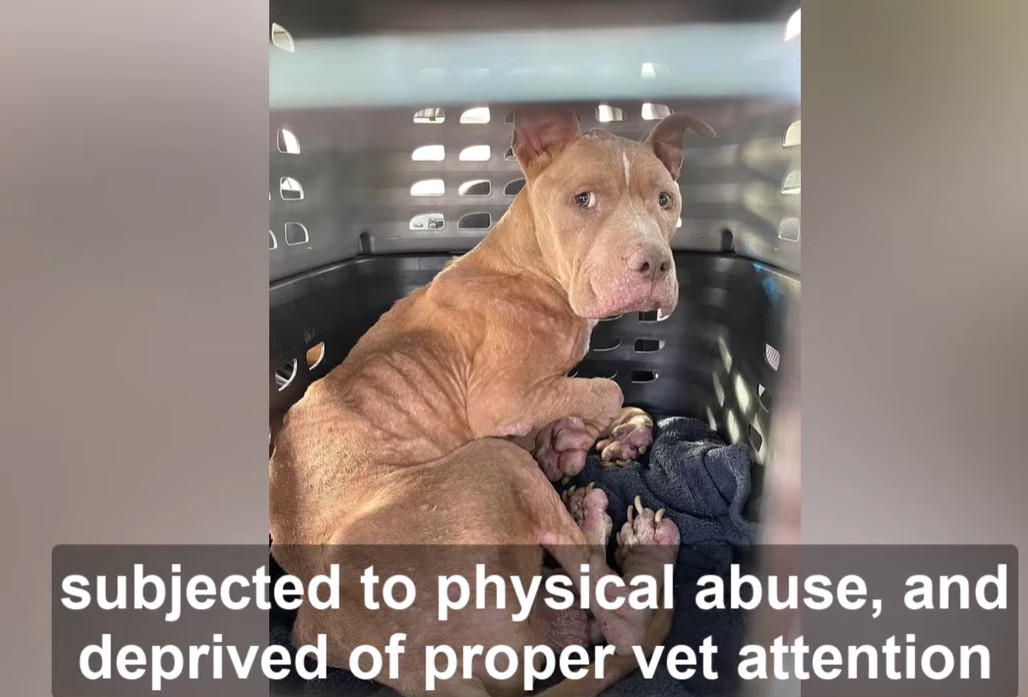
As the days passed, however, the people around him began noticing something important.
The dog they had been told was aggressive was showing another side of himself entirely.
Gator accepted gentle contact.
He leaned toward the people caring for him.
Instead of confirming the reputation that had followed him into the clinic, he gradually revealed himself to be remarkably gentle.
It was one of the clearest reminders in his story that behavior cannot always be separated from circumstances.
A frightened, hurting, or neglected animal may be described in simple terms.
The reality can be far more complicated.
His Body Still Had a Difficult Fight Ahead
About two weeks into his hospitalization, Gator appeared more alert and engaged with the people around him.
That progress mattered.
But medically, there were still serious challenges.
His paws remained inflamed despite treatment, prompting further testing. Cultures eventually identified a chronic and resistant form of dermatitis that required specialized veterinary attention.
This meant his recovery would take more than rest and regular meals.
His skin problems needed continued treatment, and rebuilding his strength had to happen carefully.
There was no single dramatic moment when everything suddenly became better.
Instead, Gator’s recovery was built from repeated acts of care.
Another examination.
Another treatment.
Another meal.
Another day spent in a place where people were paying attention to what his body was telling them.
That kind of healing can look slow from the outside.
For a dog who had arrived barely able to lift his head, every small improvement carried weight.
The Dog Everyone Was Beginning to Know
As Gator’s condition improved, his personality became easier to see.
Fear and physical exhaustion had dominated the earliest days.
Now there was room for something else.
He began responding more openly to affection.
He sought contact instead of shrinking away from it.
The people treating him saw a dog who wanted connection.
This was especially meaningful because of the description that had followed him from the backyard.
The supposedly dangerous dog was becoming known at the clinic for his gentleness.
His recovery was not only changing his body.
It was giving others the chance to meet the dog hidden beneath his condition.
Over time, the expression in his eyes softened.
His strength slowly returned.
And although his medical needs remained real, he was no longer the motionless dog rescuers had first encountered.
Sixty Days Between Two Very Different Lives
Gator remained under veterinary care for roughly two months.
Sixty days can sound like a short period on a calendar.
For him, it represented an entire transition.
During that time, he received ongoing medical treatment, including specialized dermatology care. His body was given the opportunity to stabilize, regain strength, and recover from the condition in which he had arrived.
The process required patience.
There was no reason to rush a dog whose body had already been pushed so far.
Eventually, the veterinary team reached the milestone everyone had hoped for.
Gator was ready to leave the clinic.
But he would not be going back to the backyard in Highland.
A foster home was waiting.
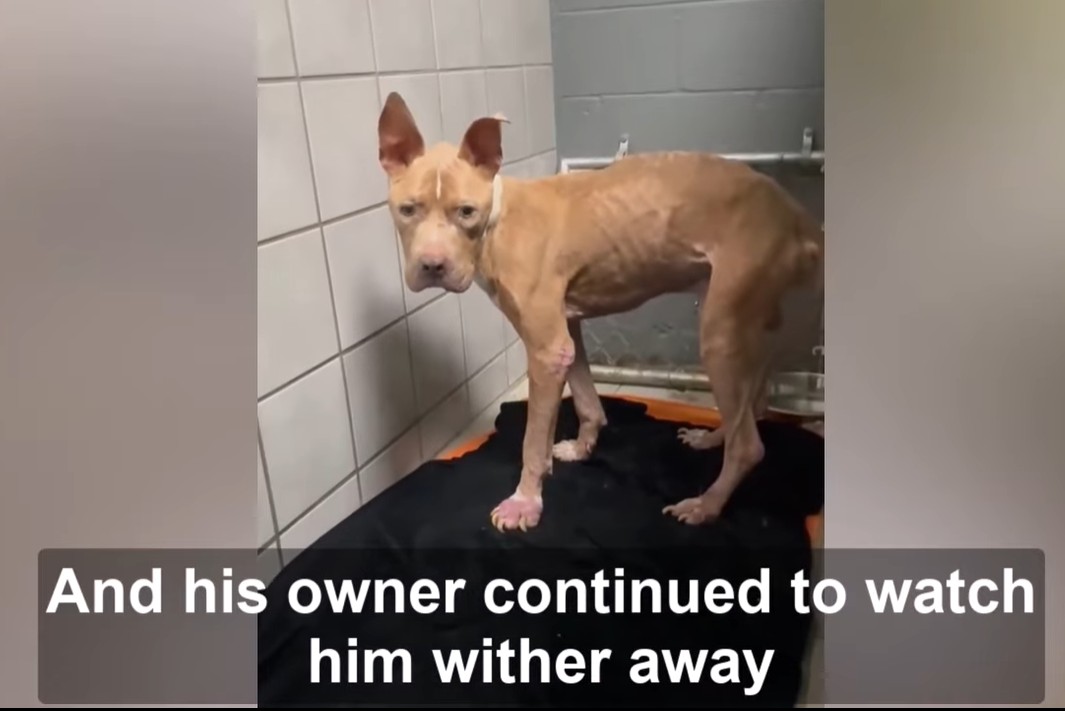
Walking Into a Life Without Chains
Moving into foster care marked a new chapter for Gator.
For the first time in his documented journey, his future was no longer defined by the place where rescuers had found him.
He had a safe home environment.
He had people responsible for his continued care.
And he had the chance to experience ordinary life away from the chain and dirt that had surrounded him before.
His medical journey was not erased by that move.
Recovery can continue long after the most dramatic part of a rescue is over.
But there is an enormous difference between healing while still exposed to neglect and healing somewhere safe.
Gator had crossed that line.
He was no longer waiting for someone to notice.
Someone already had.
What Gator’s Story Leaves Behind
Gator’s story is powerful partly because the dog rescuers found was so different from the description they had been given.
He had been called aggressive.
Yet in care, he showed a gentle nature and responded warmly to people who treated him with patience.
That does not mean every frightened dog will react the same way.
It does mean labels should never replace careful observation.
Sometimes an animal’s condition tells a story that words do not.
Gator’s body showed that he needed help.
The rescuers listened.
The veterinary team continued that work for sixty days.
And when he finally left the clinic, he was not returning to the life that had brought him there.
He was moving forward.
Safe.
Stable.
Eating.
Receiving care.
And living in a foster home where his future could be built around something very different from survival.
Gator still had a road ahead of him, but it was finally a road he could walk surrounded by people who were paying attention.
For a dog once too weak to lift his head, that change meant everything.


