
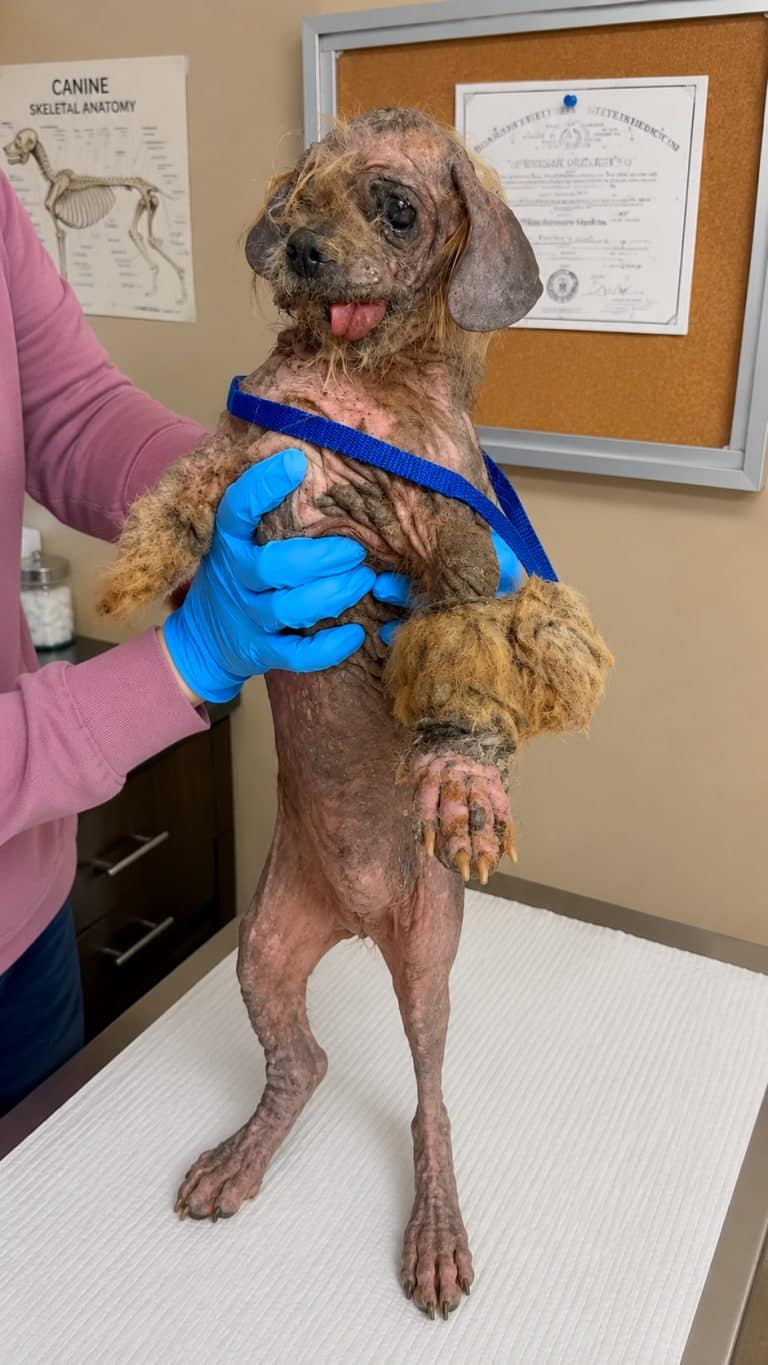
Freddy pushed himself onto his feet, managed a few uncertain steps, and fell again.
For a little dog already struggling with serious physical problems, even standing upright was difficult. His legs could not reliably support him, and his body seemed to demand more strength than he had available.
Yet he kept trying.
There was no dramatic breakthrough in those early attempts. No sudden moment when walking became easy.
Just a small dog repeatedly gathering the strength to rise, even when the effort ended with another fall.
When Freddy arrived at a rescue organization, his condition raised serious concerns. Most of his fur was missing, his teeth were in poor shape, one eye had been badly damaged, and a spinal disorder affected his ability to stand and walk.
He needed considerably more than a comfortable place to rest.
He needed sustained care, treatment, and someone willing to recognize that his limitations did not define everything he could become.
That person would be a foster volunteer named Caitie.
And the relationship that followed would help change Freddy's future.
A Small Body Carrying an Enormous Burden
Freddy's difficulties were apparent in nearly every movement.
His skin was largely uncovered because of extensive fur loss. Only a few patches of tangled hair remained around his front legs.
His damaged eye and deteriorated teeth added to the concerns surrounding his health.
But his spinal condition was especially challenging because it interfered with something most dogs do without a second thought.
Walking.
For Freddy, moving across even a short distance required unusual effort.
He could push himself upright, but maintaining his balance was another matter. Sometimes he remained standing only briefly before losing his footing.
The pattern repeated.
He would rise.
Attempt to move forward.
Then fall.
Each attempt revealed how much his condition restricted him. At the same time, his repeated efforts showed that he had not stopped attempting to move independently.
It would have been easy to see only his physical limitations.
His nearly bare body, uncertain steps, and visible health problems were impossible to overlook.
But those details did not tell the entire story.
Beneath them was a dog still willing to engage with the world, even when doing so required considerable effort.
The people caring for Freddy faced an important question.
Could consistent treatment and rehabilitation help him gain enough strength and mobility to enjoy a better quality of life?
There was no reason to assume the answer would come quickly.
His needs were substantial, and recovery would require patience.
The Foster Volunteer Who Saw More Than His Struggles
When Caitie became involved in Freddy's care, she was taking responsibility for a dog with several significant health challenges.
She volunteered to bring him into her home as a foster dog while he received treatment.
It was an important turning point.
Freddy now had someone who could support him through the ordinary, repeated work of recovery.
Caring for him would involve much more than offering affection.
His physical condition required medical attention. His difficulty walking meant rehabilitation would be part of his routine. His lack of fur also made keeping him comfortable and warm especially important.
None of these needs could be resolved through encouragement alone.
They required practical care and consistency.
Caitie understood that the process was likely to be lengthy. There would be no guarantee that each day would bring visible progress.
For a dog who struggled to remain upright, success might initially mean managing only a few additional steps.
For someone watching casually, that might seem insignificant.
For Freddy, it could represent a meaningful improvement.
The important change was not that his problems had disappeared.
They had not.
It was that he now had a supportive environment in which to work through them, with someone prepared to help him keep going.
VIDEO: Freddy Could Barely Walk When He Was Rescued — Watch His Remarkable Journey Toward Recovery
Warm Pajamas, Daily Care, and the Long Work of Healing
Life in Caitie's home brought a different kind of routine for Freddy.
One of the most noticeable details was his clothing.
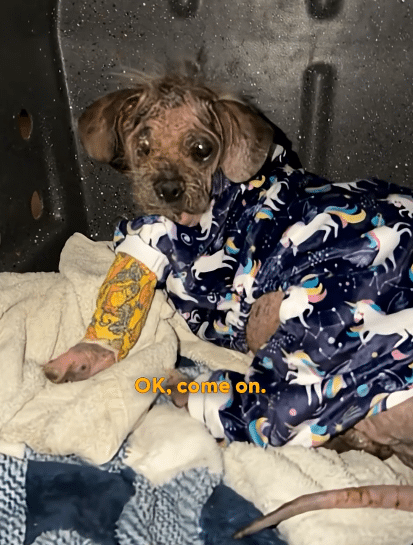
Because so much of his fur was missing, Freddy often wore small pajamas to help him remain warm and comfortable.
The outfits were charming, but they also served a practical purpose.
His limited coat offered little protection, so maintaining his comfort was an important part of his daily care.
Alongside that simple measure came a much more demanding treatment process.
Freddy received medication, including antibiotics, and participated in rehabilitation activities intended to support his recovery.
Each aspect of his care addressed a different part of a complicated situation.
His health required attention.
His muscles needed strengthening.
His ability to move needed patient, repeated practice.
And his progress had to be measured against what his body was actually capable of doing.
There was no shortcut through that process.
For Freddy, walking practice was not simply exercise. It meant repeatedly attempting a movement that had previously ended in a fall.
Caitie continued encouraging him as he worked to build strength.
Some attempts went better than others.
On difficult days, his physical limitations remained obvious. Improvement was not always steady, and setbacks were part of the experience.
But the work continued.
A little more time spent standing.
A few steps taken with greater control.
A movement that appeared slightly less difficult than before.
These were the kinds of changes that began to matter.
Not because they were spectacular, but because they suggested Freddy was moving in the right direction.
There is something particularly moving about watching an animal regain an ability that once seemed beyond reach.
The achievement may look ordinary to anyone unfamiliar with the struggle.
A dog standing.
A dog crossing a room.
A dog reaching the place he wants to go.
Yet for Freddy, those actions had required sustained care and effort.
His progress was developing slowly, through the combined work of treatment, rehabilitation, and his own repeated attempts to move.
The changes were not yet the complete transformation everyone hoped to see.
But they were becoming more encouraging.
The Little Victories That Began to Change Everything
As Freddy continued treatment, his mobility gradually improved.
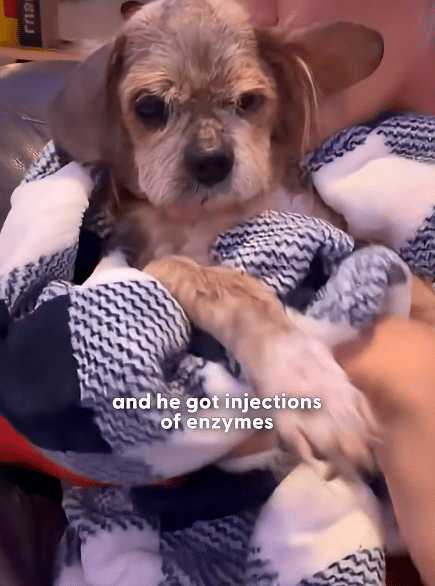
According to his recovery story, specialized injections intended to help with his spinal condition contributed to better movement.
Physical therapy also helped him develop greater strength.
The result was increasingly noticeable.
Freddy could remain standing for longer periods, and his steps began to show more confidence.
This was not the kind of recovery defined by one dramatic event.
It was a series of improvements that gradually added up.
Where he had once struggled to keep his balance, he began finding more control over his movements.
Where short distances had been difficult, he became increasingly willing and able to explore.
The difference was especially meaningful because mobility affects so much of a dog's everyday experience.
Walking is how a dog investigates his surroundings.
It is how he approaches something interesting, moves toward familiar people, and participates in ordinary activities.
For Freddy, greater mobility meant more opportunities to do those things without the same overwhelming physical effort.
And walking was not the only area where his condition changed.
His coat began to return.
At first, Freddy had arrived with almost no fur across much of his body.
During recovery, new hair gradually appeared, covering areas that had previously been bare.
As more of his coat grew in, his appearance became noticeably different from the fragile little dog who had first entered rescue care.
It was an outward sign of how much his situation had changed.
But the most meaningful developments were not limited to his appearance.
Freddy was also becoming more active.
He began exploring his surroundings with growing confidence.
His movements became more purposeful.
And play, which had once been difficult because of his physical limitations, increasingly became part of his life.
The dog who had previously spent so much effort simply trying to stay on his feet was beginning to experience movement as something enjoyable.
That difference mattered.
Recovery was no longer only about helping Freddy manage his condition.
It was also about giving him the freedom to participate in the ordinary pleasures of being a dog.
From Careful Steps to a More Confident Life
There was no need to compare Freddy's progress with that of a healthy dog.
His starting point had been entirely different.
The improvements that mattered most were the ones measured against his own earlier difficulties.
At the beginning, remaining upright for more than a few seconds could be challenging.
Later, he could move for longer periods.
At first, each attempt to walk demanded enormous effort.
Over time, movement became steadier and more confident.
This gradual change also allowed his personality to become more apparent.
As his physical abilities developed, Freddy showed greater curiosity about the environment around him.
He was no longer defined solely by the difficulty of getting from one place to another.
He could explore.
He could play.
He could take part in moments that had once seemed far beyond his abilities.
For Caitie, watching these changes meant seeing the results of consistent support over time.
The care had not been effortless.
Medical treatment, medication, rehabilitation, and the daily commitment to helping Freddy practice walking all formed part of the journey.
Some improvements were small enough that they might have been overlooked without close attention.
Others became impossible to miss.
Together, they showed what sustained care could make possible.
Freddy had arrived as a dog with serious physical challenges and an uncertain outlook.
Now he was developing the strength and confidence to enjoy a much more active life.
And eventually, another important possibility opened.
He was ready to find a permanent home.
The Family Freddy Needed Had Been Nearby All Along
For many foster animals, recovery and adoption are separate journeys.
First comes the work of helping an animal become healthier and more comfortable.
Then comes the search for a family prepared to offer a lasting home.
Freddy's story followed that general path, but with a particularly heartwarming detail.
The person who would eventually adopt him was already nearby.
One of Caitie's neighbors had been following Freddy's recovery.
As the little dog's condition improved, the neighbor became increasingly attached to him.
By the time Freddy was ready for adoption, the connection had grown into something lasting.
The neighbor welcomed Freddy into the family.
It was a wonderful outcome for a dog whose future had once been uncertain.
He had received the treatment and patient support needed to improve his health.
Now he also had a permanent family.
And because his new home was close to Caitie's, the person who had helped him through foster care could remain part of his life.
Caitie was still able to visit and follow his progress.
That detail made Freddy's adoption especially meaningful.
The transition into a forever home did not require leaving every familiar connection behind.
The care and affection that had supported him during recovery could continue in a different form.
Freddy gained a family of his own, while remaining close to someone who had played an important role in helping him reach that point.
A Dog Who Once Kept Falling Can Now Run Through the Grass
The contrast between Freddy's early condition and his later life is remarkable.
When he first reached the rescue organization, he struggled to walk.
Much of his fur was missing.
His damaged eye, poor dental health, and spinal disorder made his situation especially concerning.
Simply getting onto his feet could be a major challenge.
Today, his life looks very different.
His coat has returned.
His body has become stronger.
His movement is far more confident.
And instead of repeatedly struggling to remain standing, Freddy can run through the grass with excitement.
That image captures something important about his recovery.
The goal was never merely to change how Freddy looked.
A fuller coat and improved appearance were encouraging, but his increasing freedom of movement made an even greater difference to his daily experience.
He could engage with his surroundings.
He could enjoy play.
He could move with an ease that had once seemed unlikely.
And he could do all of that while living with a family who wanted him.
His physical challenges had been serious, and the effort required to support his improvement should not be overlooked.
Nor should his determination.
Each time Freddy attempted to stand during those difficult early days, he was working against limitations that made a simple movement unusually demanding.
His willingness to keep trying gave his caregivers something to build upon.
With the appropriate support, those repeated efforts gradually became progress.
The Second Chance Built One Step at a Time
Freddy's journey is not a story about an instant transformation.
His difficulties did not vanish as soon as someone offered him a home.
He needed medical treatment.
He needed rehabilitation.
He needed practical help staying comfortable while his body recovered.
Most of all, he needed people willing to keep supporting him when improvements came slowly.
Caitie's role as a foster caregiver was central to that process.
By opening her home to Freddy and helping him through treatment, she provided the consistency his recovery required.
The medical care and rehabilitation he received were equally important.
And when he had gained enough strength to move forward into a permanent home, a neighbor who had followed his journey offered him that opportunity.
Each part of the story contributed to the outcome.
Rescue created the possibility of safety.
Foster care provided ongoing support.
Treatment and rehabilitation helped improve his physical condition.
Adoption gave him a lasting place to belong.
None of those steps needed to be dramatic to matter.
In fact, Freddy's recovery is a reminder that many of the most meaningful changes in animal rescue happen gradually.
They happen through repeated acts of care, attention to small improvements, and the willingness to continue even when progress is difficult to measure.
For Freddy, a few uncertain steps eventually became confident movement.
A body that had lost nearly all its fur developed a healthy coat.
A dog who had struggled with ordinary activity began running and playing.
And a temporary foster arrangement eventually led to a permanent family nearby.
His story does not suggest that every animal facing similar medical challenges will experience the same recovery.
Each dog's needs and possibilities are different.
But Freddy's experience shows what can happen when an animal receives dedicated care suited to his condition, together with the time and support needed to improve.
The little dog who once fell after only a few steps now has a very different daily life.
He can move through the grass.
He can play.
He can enjoy the affection of his family.
And Caitie, who welcomed him when he needed help, can still see how far he has come.
Freddy's second chance was not created in a single extraordinary moment.
It was built patiently, one small step after another.
And for a dog who once struggled simply to stand, that makes every confident step today especially meaningful.


